
Can a Pomeranian be a service dog? Yes, a Pomeranian can become a service or assistance dog when individually trained to perform specific tasks for a person with a disability. Although this tiny breed cannot provide mobility support or complete tasks requiring physical strength, an intelligent, attentive Pomeranian may be suitable for hearing alerts, medical alerts and certain psychiatric assistance tasks.
I’m Denise Leo, a Pomeranian breeder, exhibitor, judge and author with more than 50 years of experience with this remarkable breed. Pomeranians are intelligent, highly responsive to their owners and surprisingly capable learners. However, not every Pom has the calm temperament, confidence and concentration required for assistance work.
Quick Answer: Can Pomeranians Be Service Dogs?
Yes. A Pomeranian service dog can assist a person with a disability by performing trained tasks suited to the breed’s small size. These may include alerting a handler to sounds, retrieving lightweight objects, interrupting certain repetitive behaviours or seeking help during a medical event.
A Pomeranian therapy dog and a Pomeranian emotional support dog serve different purposes. Therapy dogs comfort other people during organised visits, while emotional support dogs provide companionship and reassurance to their owners. Neither automatically has the same public-access rights as a properly trained service or assistance dog.
Important: Terminology and access laws vary between countries and regions. Always check the laws that apply where you live or plan to travel.

What Can a Pomeranian Service Dog Do?
A Pomeranian service dog must be individually trained to perform one or more specific tasks that assist a person with a disability. Simply providing love, comfort or companionship does not make a Pom a service dog.
The tasks must also be suitable for the Pomeranian’s small size. A Pom cannot safely support a person’s weight, assist with balance, pull a wheelchair or perform other physically demanding mobility work. However, the breed’s intelligence, alertness and close bond with its owner may make some Pomeranians suitable for lighter assistance tasks.
Tasks a Pomeranian May Be Trained to Perform
- Alerting a deaf or hearing-impaired handler to a doorbell, alarm, telephone or someone calling their name.
- Retrieving small items such as medication, a mobile phone, keys or a television remote.
- Seeking another person or activating an alert device when help is required.
- Interrupting repetitive or harmful behaviours with a trained touch or other response.
- Responding to signs of anxiety or distress by performing a specific trained action.
- Providing a trained interruption or grounding response during certain psychiatric episodes.
- Alerting to particular medical changes when the individual dog has demonstrated the ability and received appropriate specialist training.
Medical-alert work should never be assumed simply because a Pomeranian appears sensitive to its owner. The dog must respond reliably to the relevant change, and any alerting ability should be evaluated and developed with experienced professional guidance. A service dog complements appropriate medical care; it does not replace medical advice, monitoring equipment or prescribed treatment.
Definition of Service Dogs
“A service animal is defined as a dog that has been individually trained to do work or perform tasks for an individual with a disability. The task(s) performed by the dog must be directly related to the person’s disability.” – Americans with Disability Act (ADA)
These laws don’t specify the particular dog breeds that can be considered service dogs. Instead, these laws specify the roles and responsibilities that service animals perform for their humans.

What Is the Difference Between a Service Dog and an Emotional Support Dog?
A service dog and an emotional support dog are not the same. The most important difference is that a service dog is individually trained to perform specific tasks that assist a person with a disability. An emotional support dog provides comfort and companionship but does not require specialised task training.
| Feature | Pomeranian Service Dog | Pomeranian Emotional Support Dog |
|---|---|---|
| Main role | Performs trained tasks that assist a person with a disability. | Provides comfort, companionship and emotional reassurance. |
| Specialised training | Yes. The dog must be trained to perform disability-related work or tasks. | No task-specific assistance training is required, although good behaviour remains essential. |
| Public access | May have legally protected access when the dog meets the requirements applying in that location. | Does not automatically have the same access rights as a service or assistance dog. |
| Who receives support? | The dog’s handler. | The dog’s owner. |
A psychiatric service dog is also different from an emotional support dog. A psychiatric service dog is trained to take a specific action related to its handler’s disability. If a Pom’s presence simply makes its owner feel calmer, it is providing emotional support rather than performing a trained service-dog task.
Public-access, housing and travel rules vary between countries and sometimes between states or territories. Owners should check the current requirements of the relevant government authority, accommodation provider or transport operator before assuming that a dog has access rights.

Can a Pomeranian Be an Emotional Support Dog?
Yes, a Pomeranian can be a wonderful emotional support dog. Poms are affectionate, devoted and usually happiest when close to their owners. Their small size also makes them easy to hold and convenient companions in the home.
A Pomeranian emotional support dog may help its owner feel calmer, less lonely or more secure through companionship and affection. Caring for a dog can also provide a comforting daily routine and encourage gentle activity and social interaction.
However, an emotional support dog is not the same as a service dog. Emotional support comes from the dog’s presence and companionship, while a service dog is individually trained to perform tasks directly related to a person’s disability.
Qualities Needed in an Emotional Support Pomeranian
A suitable Pom should be:
- Affectionate and comfortable being close to its owner.
- Calm enough to settle quietly when required.
- Friendly, confident and not excessively fearful.
- Responsive to basic training and household rules.
- Healthy and comfortable with the expected lifestyle.
- Properly socialised without being forced into stressful situations.
Even though specialised service-dog training is not required, every emotional support Pomeranian should be house-trained, manageable and under its owner’s control. Excessive barking, aggression and uncontrolled behaviour can make outings stressful for both the dog and owner.
Important: Purchasing an identification card, certificate, vest or online registration does not automatically give a Pomeranian emotional support dog the legal status or public-access rights of a service dog. Requirements differ between countries, so always consult the appropriate local authority.
What to Look for in a Pomeranian Service Dog
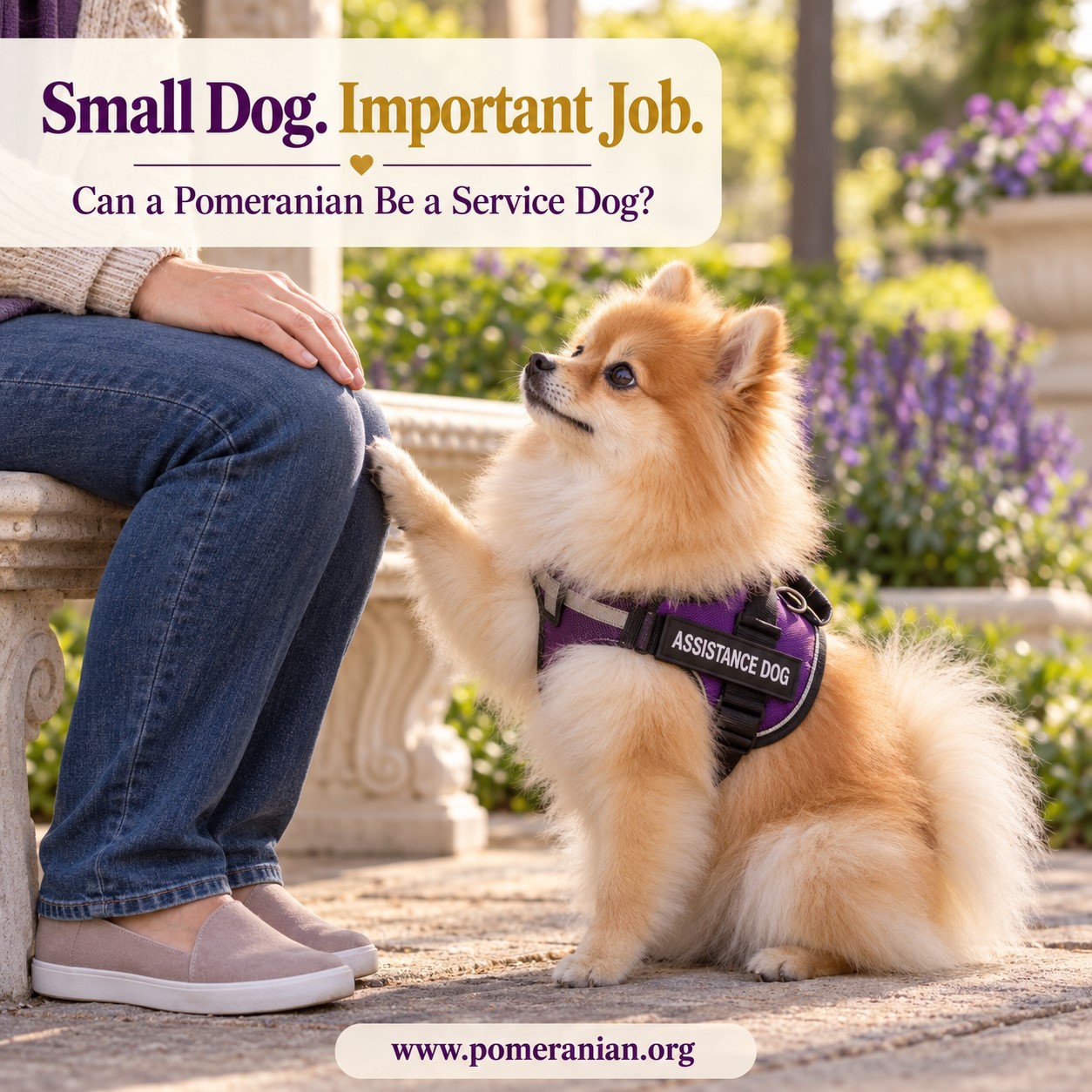
Not every Pomeranian is suited to service work. Intelligence is important, but temperament, health and reliability matter just as much. A service dog must remain calm and focused in busy public places while responding consistently to its handler.
A potential Pomeranian service dog should have the following qualities:
- A calm temperament: The Pom should remain composed around strangers, children, other dogs, traffic, loud noises and unfamiliar surroundings.
- Confidence: A suitable dog should recover quickly if startled and must not be excessively timid, anxious or suspicious.
- Excellent focus: The dog must be able to concentrate on its handler despite food, people, animals and other distractions.
- Trainability: A good candidate should enjoy learning, respond reliably to cues and be motivated by praise, play or suitable rewards.
- Appropriate sociability: The dog should accept people calmly without constantly seeking attention from everyone nearby.
- Reliable public behaviour: Barking, lunging, snapping, marking and uncontrolled excitement are unsuitable behaviours for a working service dog.
- Sound health: The Pom must be physically capable of performing its trained tasks without discomfort or unnecessary strain.
- A strong bond with the handler: The dog should naturally pay attention to its handler and be comfortable working closely with that person.
Pomeranians can be alert and vocal, so reliable control of barking is particularly important. A Pom that reacts strongly to unfamiliar people or dogs may find public-access work stressful, even if it is affectionate and obedient at home.
Expert tip: Select the dog for the required task and lifestyle rather than choosing the breed first. A professional service-dog trainer can help assess whether an individual Pomeranian has the temperament and ability needed for the proposed work.
Can a Pomeranian Be a Therapy Dog?
Yes, a well-trained and sociable Pomeranian can make an excellent therapy dog. Poms are affectionate, engaging and small enough to sit comfortably beside someone or on an invited person’s lap. Their cheerful personalities can bring comfort and companionship to people experiencing illness, loneliness, anxiety or grief.
A Pomeranian therapy dog may visit places such as:
- Hospitals and rehabilitation centres.
- Nursing homes and aged-care facilities.
- Hospices.
- Schools and libraries.
- Community support programs.
- Facilities assisting people through stressful or difficult experiences.
Unlike a service dog, a therapy dog usually works with its handler to comfort other people. Therapy dogs are not trained to perform disability-related tasks for one handler and do not automatically receive public-access privileges.
What Makes a Good Pomeranian Therapy Dog?
A suitable therapy Pom should:
- Enjoy gentle attention from unfamiliar people.
- Remain calm around mobility aids, medical equipment and unusual noises.
- Walk politely on a lead and follow basic cues.
- Be comfortable being handled without becoming frightened or defensive.
- Remain quiet and settled during visits.
- Be clean, well groomed and in good health.
- Show no signs of aggression or excessive anxiety.
Pomeranians are naturally alert and may be inclined to bark, so calm behaviour and reliable training are essential. Therapy work must also be enjoyable for the dog. If a Pom appears tired, overwhelmed or uncomfortable, the visit should be shortened or ended.
Remember: A therapy-dog vest or certificate does not give a Pomeranian unrestricted access to shops, restaurants or other places where pets are normally prohibited. Visits are generally arranged through an approved therapy-dog organisation or with the facility’s permission.
Why Pomeranians Can Make Good Service or Therapy Dogs
Pomeranians possess several qualities that may make them suitable for service, emotional support or therapy roles. However, every dog is an individual, and these breed traits do not guarantee that a particular Pom will be suited to this work.
Intelligent and Trainable
Pomeranians are intelligent dogs that can learn cues, routines and task sequences. They usually respond best to short, enjoyable training sessions using praise, play and suitable food rewards. Repetition is important, but training should remain varied enough to hold the Pom’s attention.
Alert and Observant
Poms are naturally attentive to movement, sounds and changes in their surroundings. This alertness may be valuable for hearing-related tasks and certain trained alerts. Their tendency to bark, however, must be carefully managed so they respond only when appropriate.
Closely Bonded to Their Owners
Many Pomeranians form a strong attachment to their owners and quickly notice changes in behaviour and daily routines. This attentiveness can support assistance work, provided the dog remains confident enough to function without becoming overly dependent or anxious.
Small and Portable
A Pomeranian’s compact size can be helpful for handlers living in smaller homes or travelling in suitable circumstances. A Pom can also perform some trained tasks from its owner’s lap. However, the dog should walk appropriately whenever possible rather than routinely being carried in a handbag.
Affectionate and Engaging
The breed’s cheerful, affectionate personality can make a well-socialised Pom an appealing therapy or emotional support companion. A suitable dog should enjoy gentle interaction without becoming overexcited, demanding or protective of its owner.
Important Pomeranian Limitations
Pomeranians are not suitable for heavy physical work. They cannot safely provide balance support, brace a handler, pull a wheelchair or retrieve heavy objects. Their small size also means they must be protected from being stepped on, handled roughly or approached unsafely by larger dogs.
Some Poms are vocal, cautious around strangers or reactive toward other dogs. These behaviours may make public work unsuitable unless they can be reliably and humanely addressed through training. The welfare of the Pomeranian must always be considered alongside the needs of the handler.
Training a Pomeranian to Become a Service Dog
Training a Pomeranian service dog requires much more than teaching basic obedience. The dog must learn to perform specific disability-related tasks while remaining calm, safe and under control in many different environments.
Begin With Basic Training and Socialisation
A young Pomeranian should first learn essential skills such as responding to its name, coming when called, walking politely on a lead, settling quietly and following basic cues. House training must also be completely reliable.
Careful socialisation should introduce the puppy to different people, surfaces, noises, vehicles and environments in a positive and controlled way. Socialisation does not mean allowing everyone to handle the puppy. The goal is to help the Pom feel calm and confident without becoming distracted by every person or dog it sees.
Assess Temperament and Health
Before advanced training begins, the Pomeranian should be assessed for confidence, concentration, recovery from unexpected events and suitability for the required work. A veterinary examination is also important because service work should never place strain on a dog with physical or health limitations.
Teach the Required Assistance Tasks
The dog can then be trained for tasks that directly assist its handler. These might include alerting to particular sounds, retrieving medication or a mobile phone, interrupting a specific behaviour or seeking help when instructed.
Each task must be clearly defined and practised until the Pom performs it consistently in different situations—not only at home when there are no distractions.
Develop Reliable Public Behaviour
A working Pomeranian must learn to ignore food, strangers and other animals while remaining attentive to its handler. The dog should settle quietly, walk without pulling, avoid unnecessary barking and remain under control in crowded or unfamiliar environments.
Consider Professional Guidance
An experienced assistance-dog trainer can evaluate the Pom, design an appropriate training program and identify potential problems early. The trainer should use humane, reward-based methods and understand the limitations of toy breeds.
Important: Training requirements and legal recognition differ between countries and regions. Completing an online course, buying a vest or registering a dog on a commercial website does not automatically make a Pomeranian a legally recognised service or assistance dog.
Frequently Asked Questions
Can Pomeranians Be Service Dogs?
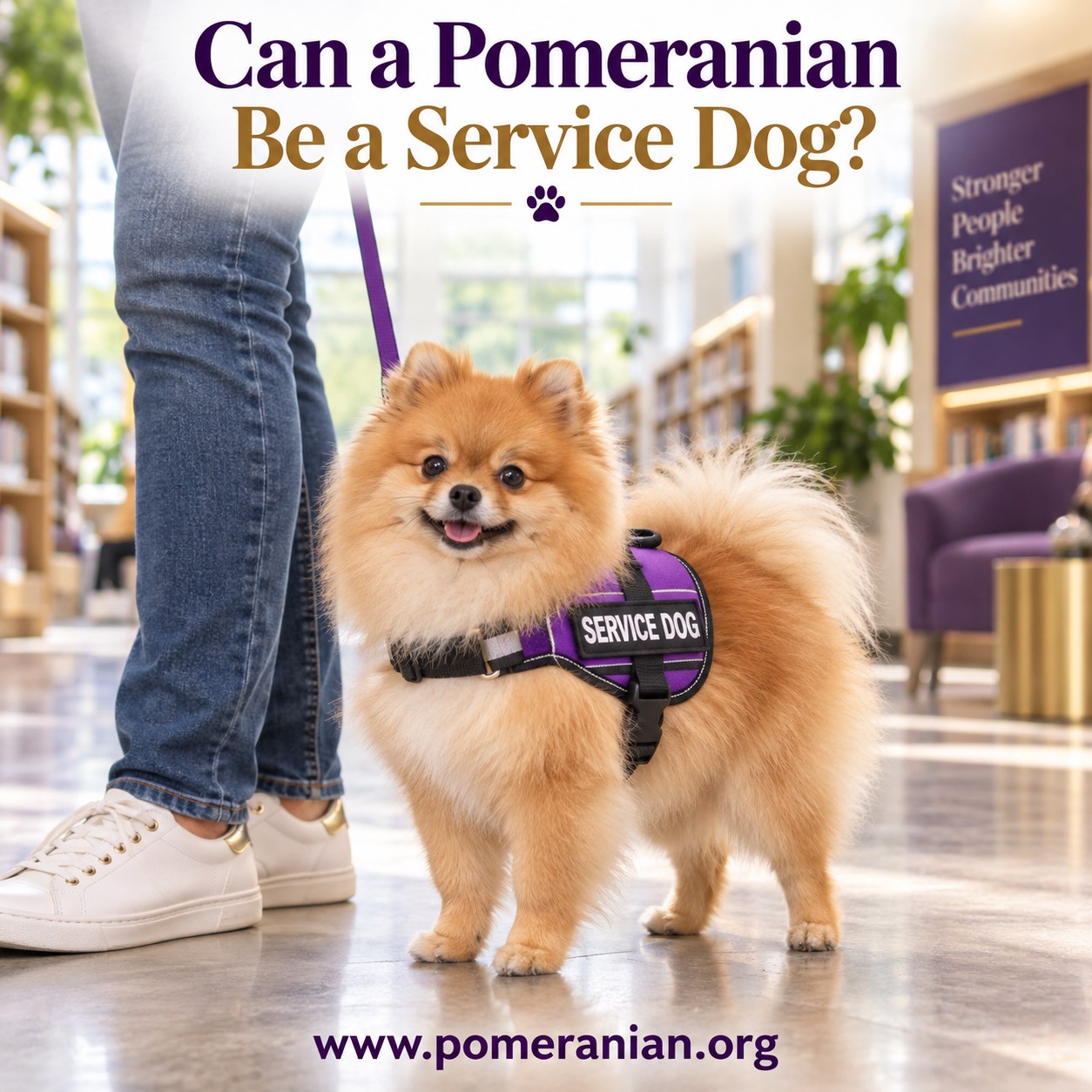
Yes. Pomeranians can be service dogs when individually trained to perform specific tasks for a person with a disability. Their small size limits the physical work they can safely perform, but some Poms may be suitable for hearing alerts, retrieving light objects and certain medical or psychiatric assistance tasks.
Can a Pomeranian Be a Service Dog for Anxiety?
A Pomeranian may become a psychiatric service dog if it is trained to perform a specific task related to its handler’s disability. Examples may include interrupting a harmful behaviour or responding in a trained way when an anxiety episode begins. Simply providing comfort does not make the Pom a service dog.
Can a Pomeranian Be a Medical Alert Dog?
Some individual Pomeranians may be capable of medical-alert work, but this ability should never be assumed. The dog requires specialised training and must demonstrate that it can respond reliably to the relevant medical change. A dog should not replace professional medical care or prescribed monitoring equipment.
Does a Pomeranian Service Dog Have Public-Access Rights?
A properly trained service or assistance dog may have protected access rights when it meets the legal requirements applying in that location. Laws and terminology vary between countries, states and territories, so handlers should check with the appropriate government authority.
Can a Pomeranian Be a Therapy Dog?
Yes. A calm, friendly and well-trained Pomeranian can make an excellent therapy dog. A Pomeranian therapy dog may visit hospitals, schools, hospices or aged-care facilities to provide comfort to other people. Therapy dogs do not automatically have the public-access rights of service dogs.
Can a Pomeranian Be an Emotional Support Dog?
Yes. A Pomeranian emotional support dog can provide affection, companionship and reassurance to its owner. However, emotional support alone is not a trained service-dog task, and emotional support dogs do not automatically receive the same public-access rights as service dogs.
Does an Emotional Support Pomeranian Need to Be Registered?
Commercial online registration does not turn a pet into a legally recognised service or assistance dog. Requirements for emotional support animals vary according to location and situation. Owners should consult the relevant housing, transport or government authority rather than relying on a purchased certificate, identification card or vest.
Can Any Pomeranian Become a Service Dog?
No. A suitable Pomeranian must be healthy, confident, calm, trainable and able to work reliably around distractions. Some Poms are too anxious, vocal or reactive for public service work, even though they may be loving and obedient family companions.
Can a Pomeranian Be a Service Dog? Final Thoughts
A Pomeranian can be a service dog when the individual dog has the right temperament, health and training for tasks suited to its small size. Poms cannot provide heavy mobility assistance, but some may succeed in hearing, medical-alert or psychiatric assistance roles.
A Pomeranian therapy dog or Pomeranian emotional support dog has a different purpose and does not automatically receive the same public-access rights. Whatever role is chosen, the Pom’s wellbeing, abilities and limitations must always come first.
Copyright Pomeranian.org. All Rights Reserved.
📚 References & Further Reading
- [1] AKC Pomeranian Breed Standard (2011)
- [2] English Kennel Club Breed Standard
- [3] The Pomeranian Handbook – Denise Leo
- [4] Denlinger, The Complete Pomeranian
- [5] Kimbering, 1891–1991
- [6] Taplin, The Sportsman’s Cabinet
- [7] Parker, The Popular Pomeranian
- [8] Ives, Show Pomeranians