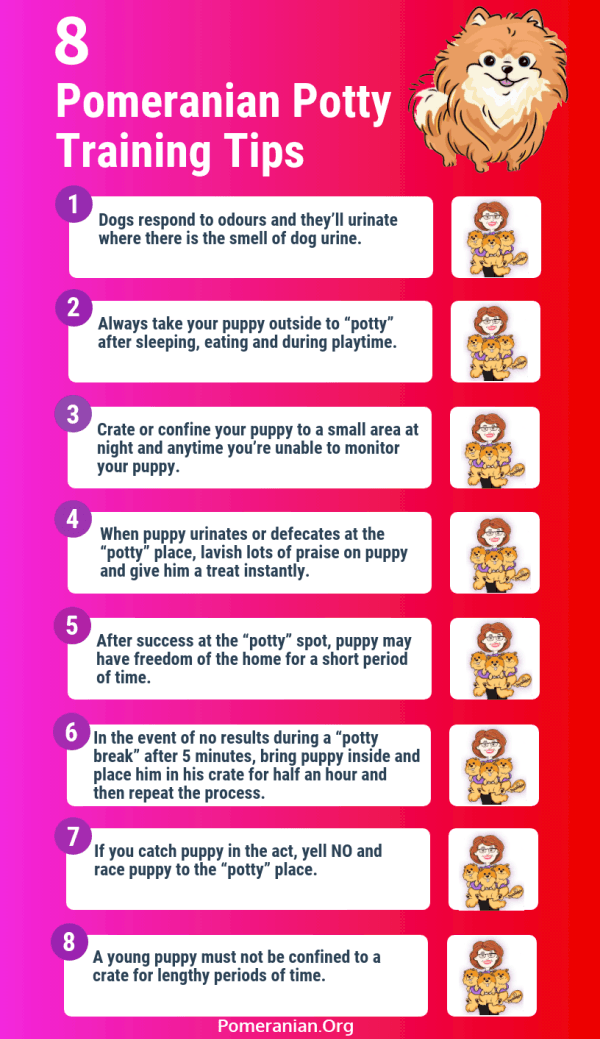

Pomeranian potty training succeeds through supervision, a predictable routine and immediate rewards. Take your puppy to the chosen toilet area after waking, eating, drinking and playing, as well as frequently throughout the day. Praise and reward your puppy immediately after toileting in the correct place. Accidents are a normal part of learning and should never be punished.
Are Pomeranians Difficult to Potty Train?
Pomeranians are intelligent and capable of learning good toilet habits. However, their small size, limited bladder capacity and need for frequent toilet opportunities can make the early stages of training more demanding.
A young puppy does not automatically understand where you want it to toilet. It must learn through repetition, supervision and immediate rewards. Accidents usually happen because the puppy has been given too much freedom, has not been taken to the toilet area frequently enough or has not yet developed sufficient bladder control.
Pomeranian puppies learn most successfully when owners:
- Follow a predictable daily routine.
- Provide frequent opportunities to toilet.
- Use one clearly defined toilet area.
- Supervise the puppy closely inside the home.
- Reward successful toileting immediately.
- Prevent unsupervised access to large areas.
- Respond calmly when accidents occur.
Some puppies understand the routine within a short time, while others require several weeks or months of consistent training. Progress is rarely perfect. A puppy may appear fully trained and then have another accident during excitement, illness, bad weather or a change in routine.
The goal is not to punish mistakes but to create as many opportunities for success as possible. With patience and consistency, most Pomeranians can develop reliable toilet habits.
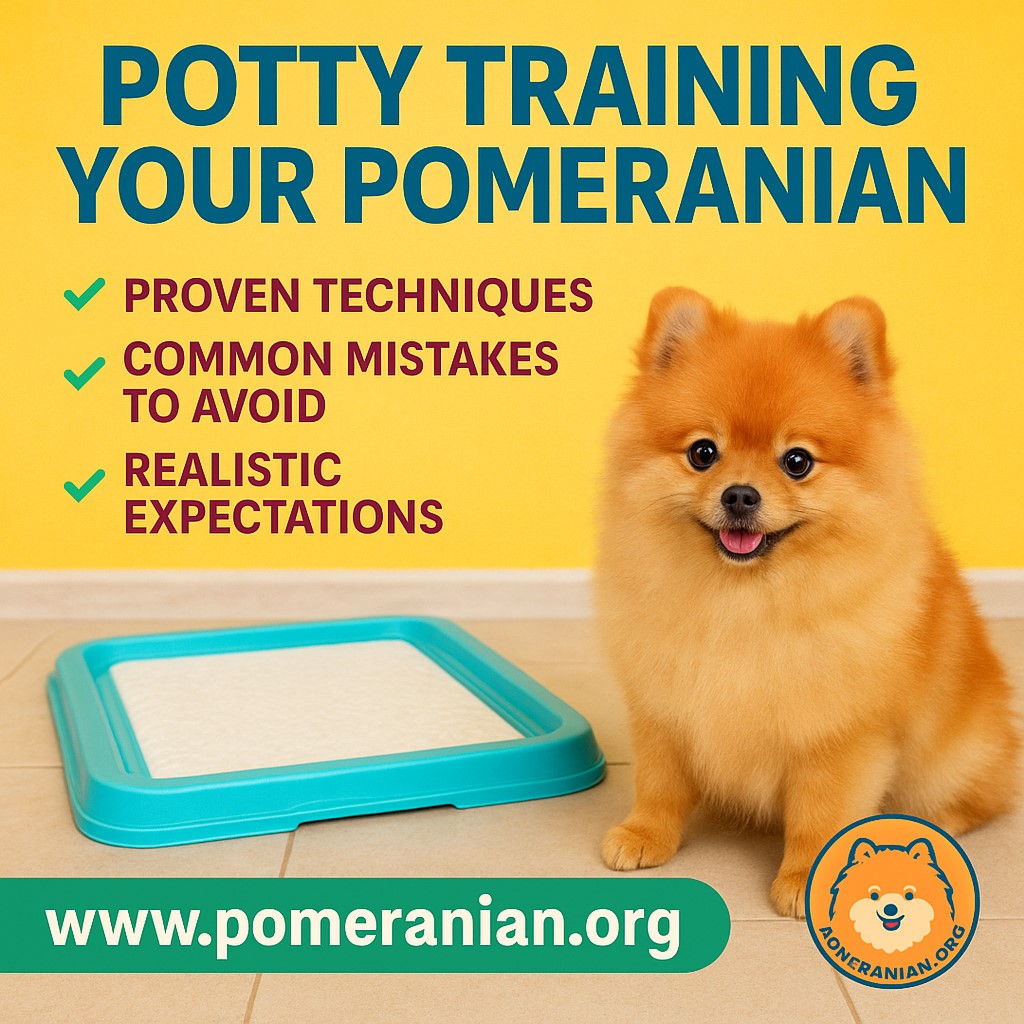
What You Need for Pomeranian Potty Training
You do not need a large collection of products to potty train a Pomeranian. A few suitable supplies, used consistently, will make training easier and help prevent accidents.
A Clearly Defined Toilet Area
Decide where you want your Pomeranian to toilet before training begins. This may be:
- A designated area outside
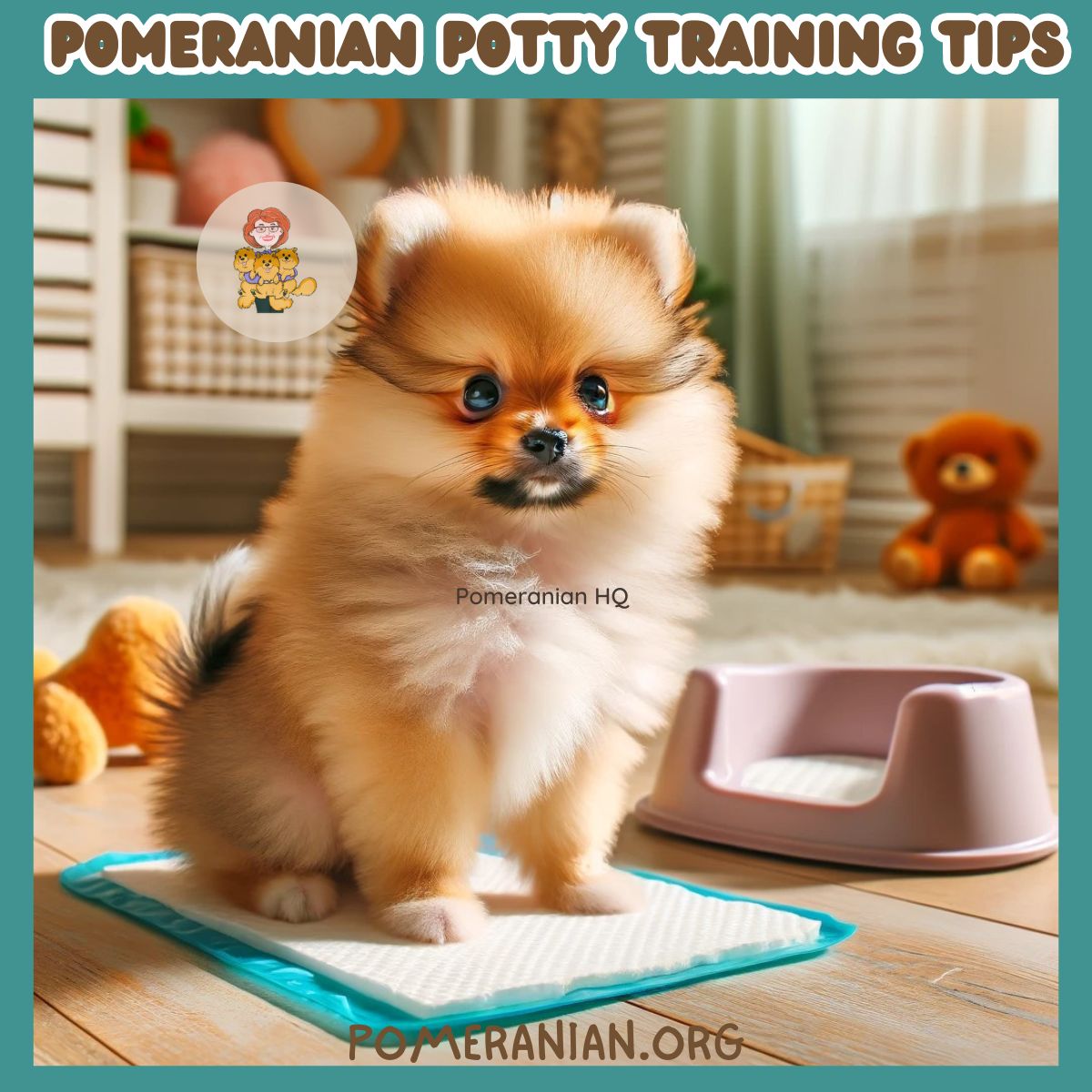
- A puppy pad in a fixed indoor location
- A dog-safe toilet tray
- An artificial-grass toilet
- A combination of indoor and outdoor areas
Avoid moving the toilet area unnecessarily. Using the same location helps the puppy understand what is expected.
A Secure Playpen or Puppy Area
A playpen provides a safe space when you cannot supervise your puppy directly. It should be large enough to contain:
- A comfortable sleeping area
- Fresh water
- A small selection of safe toys
- A separate toilet area at the opposite end
The toilet pad or tray should never be placed immediately beside the puppy’s bed, food or water.
A Lead and Harness
Use a lightweight lead and correctly fitted harness when taking your puppy outside. This prevents wandering and helps the puppy concentrate on toileting instead of playing or exploring.
Take the puppy to the same location, remain calm, and allow enough time to finish.
Small Training Rewards
Keep small, suitable treats close to the toilet area. Give the reward immediately after your puppy finishes toileting in the correct place.
The timing matters. If the reward is delayed until you return indoors, the puppy may not understand which behavior earned it. Quiet praise can be used with the treat to reinforce the lesson.
An Enzymatic Cleaner
Accidents must be cleaned thoroughly with a pet-safe enzymatic cleaner. These products break down the organic material that causes lingering urine and fecal odors.
Ordinary household cleaning may remove the smell for people while leaving traces detectable by a puppy’s sensitive nose. Any remaining scent can encourage the puppy to use the same location again.
Optional Indoor-Toilet Supplies
If you plan to teach an indoor option, choose one consistent surface, such as a washable pad, disposable pad, artificial grass or a dog-safe toilet tray.
Avoid frequently changing between pads, newspaper, rugs and other surfaces. Too many similar options can make it difficult for a young puppy to understand which surface is the approved toilet area.
Choose an Outdoor, Indoor or Combined Toilet Method
Before training begins, decide where you ultimately want your adult Pomeranian to toilet. A clear and consistent plan will help prevent confusion.
Outdoor Toilet Training
Outdoor training is usually the best choice when you have safe, convenient access to a garden or designated toilet area.
Take your puppy to the same location each time. Use a lead to limit distractions and introduce a simple cue such as “go potty” while the puppy is toileting.
Reward the puppy immediately after it finishes. Do not wait until you return inside, because the puppy needs to associate the reward with toileting in the correct place.
Young puppies should not be taken to public areas used by unfamiliar dogs until your veterinarian confirms that it is safe, based on the puppy’s vaccination status. A secure private garden or protected toilet area may be more appropriate during this period.
Indoor Toilet Training
An indoor toilet can be useful for:
- Apartment living
- Extreme weather
- Owners with limited outdoor access
- Very young puppies requiring frequent opportunities
- Adult or senior dogs with health or mobility limitations
Choose one toilet system and keep it in a permanent, easily accessible location. Suitable options include a puppy pad secured in a holder, a washable pad, a dog toilet tray or an artificial-grass toilet.
The indoor toilet must be clearly separated from the puppy’s sleeping, feeding and play areas.
Combined Indoor and Outdoor Training
Some owners need their Pomeranian to use both an outdoor area and an indoor toilet. This is possible, but the rules must remain consistent.
Use clearly different toilet surfaces and take the puppy directly to the appropriate location. For example, you might use grass outdoors and a secured toilet tray indoors.
Reward success in both approved places. Do not place loose pads throughout the home, as this can teach the puppy that toileting on soft surfaces in multiple rooms is acceptable.
Can You Change Methods Later?
A Pomeranian can learn a new toilet routine, but changing methods may temporarily cause confusion. Make the transition gradually.
If moving from puppy pads to outdoor toileting, shift the pad progressively closer to the door and then to the chosen outdoor location. Continue rewarding the puppy until the new routine is reliable.
Whichever method you choose, consistency is more important than the particular toilet surface. Everyone in the household should follow the same routine, use the same cue, and reward the puppy in the same way.
How to Potty Train a Pomeranian Step by Step
Successful potty training depends on preventing avoidable accidents and rewarding the correct behavior every time it occurs.
1. Begin as Soon as Your Puppy Arrives
Take your Pomeranian directly to the chosen toilet area before allowing it to explore the house. Remain calm and give the puppy several minutes to investigate the area and toilet.
If the puppy is successful, provide immediate praise and a small reward.
2. Follow a Predictable Routine
Take your puppy to the toilet area:
- Immediately after waking
- Shortly after eating or drinking
- After active play or excitement
- Before entering the playpen or crate
- Immediately after leaving confinement
- Before traveling in the car
- As soon as you return home
- Before bedtime
- Frequently throughout the day
Very young Pomeranians may initially need a toilet opportunity approximately every hour while they are awake.
3. Learn Your Puppy’s Warning Signs
Watch for behavior indicating that your puppy may need to toilet, including:
- Sniffing the floor intently
- Circling
- Wandering away from play
- Moving towards a previously used location
- Becoming suddenly restless
- Squatting
- Approaching or scratching at the door
Take the puppy to its toilet area immediately when you notice these signs.
4. Use a Consistent Toilet Cue
Choose a short phrase such as “go potty” or “toilet time.” Say it quietly as the puppy begins toileting.
Avoid repeatedly saying the cue while the puppy is still searching for a location. With consistent timing, the puppy can gradually learn to associate the words with the action.
5. Reward the Puppy Immediately
As soon as your puppy finishes toileting in the correct place, offer calm praise and a small treat.
The reward should be given at the toilet location within a few seconds. Waiting until you return inside makes it more difficult for the puppy to connect the reward with the correct behavior.
6. Allow Supervised Freedom After Success
After successful toileting, the puppy may have a short period of supervised freedom in the home.
Keep the puppy in the same room as you and watch closely. A lightweight indoor lead can help prevent the puppy from wandering into another room unnoticed.
7. Respond Calmly When Nothing Happens
If the puppy does not toilet after several quiet minutes, return indoors and place it in the playpen or another supervised area for approximately 10 to 15 minutes.
Then take the puppy back to the toilet area and try again. Do not allow unrestricted play immediately after an unsuccessful toilet visit, because the puppy may have an accident inside.
8. Record Your Puppy’s Routine
For the first few weeks, write down when your puppy eats, drinks, sleeps, urinates and passes a bowel movement.
A simple record will reveal patterns and help you predict when the next toilet visit is likely to be needed. As the puppy matures and becomes reliable, the interval between visits can gradually increase.
Pomeranian Puppy Potty Training Schedule
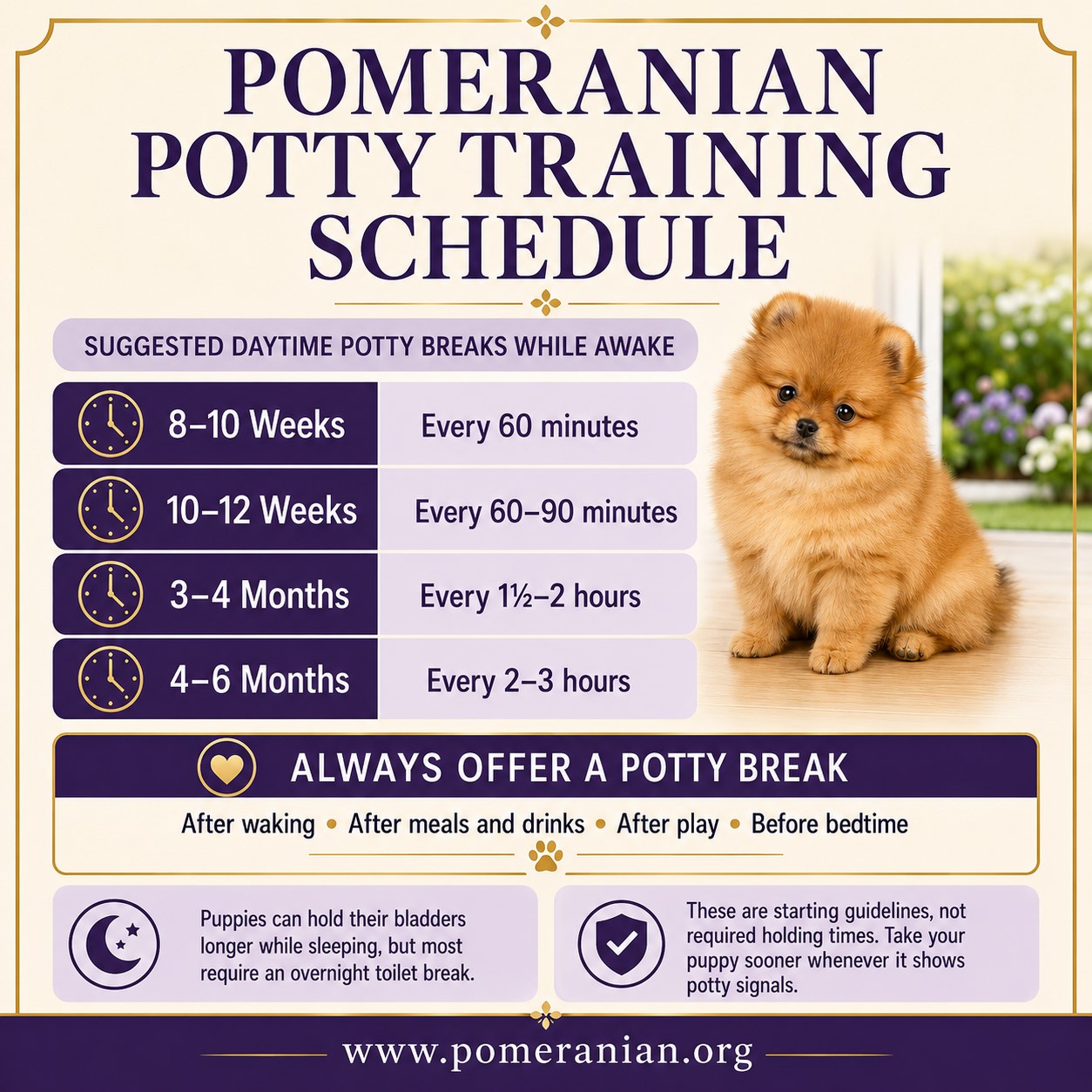
A predictable schedule helps prevent accidents and teaches your puppy where to potty. The intervals below are starting points rather than strict rules. Very small, active, excited, or recently fed puppies may need to go more frequently.
| Puppy’s Age | Suggested Daytime Interval | What to Expect |
|---|---|---|
| 8–10 weeks | About every 45–60 minutes while awake | Bladder control is very limited. Overnight potty breaks are usually still necessary. |
| 10–12 weeks | Approximately every 60–90 minutes | The puppy may begin showing recognizable signals but still requires close supervision. |
| 3–4 months | Approximately every 1½–2 hours | Successful intervals may gradually increase, but accidents can still occur after meals, naps, and play. |
| 4–6 months | Approximately every 2–3 hours | Many puppies become more reliable, although excitement and changes in routine may cause setbacks. |
| 6 months and older | Increase gradually according to the individual dog | Continue scheduled trips until the Pomeranian reliably asks to go out and remains accident-free. |
Important: These intervals are not targets for making a puppy “hold it.” Take your Pomeranian out sooner whenever you notice potty signals. Bladder control develops with physical maturity, not by forcing a young puppy to wait.
Always Offer a Potty Break
- Immediately after waking
- Shortly after eating or drinking
- After active play or excitement
- Before entering a playpen or crate
- Immediately after confinement
- Before and after a car trip
- Before bedtime
- Whenever your puppy shows potty signals
How to Recognize Your Pomeranian’s Potty Signals
Learning your puppy’s behavior can help you prevent accidents before they happen. Some Pomeranians provide an obvious warning, while others display only a brief change in behavior before they begin to potty.
Sniffing the Floor
Persistent, concentrated sniffing—especially around a previously used location—often means the puppy is searching for a potty spot.
Circling or Pacing
A puppy may circle, pace, or repeatedly return to the same small area immediately before urinating or passing a bowel movement.
Suddenly Leaving Play
If your puppy abruptly stops playing and wanders away, it may be looking for a quiet place to potty.
Restlessness
Whining, fidgeting, moving between rooms, or appearing unable to settle can indicate an urgent need for a potty break.
Approaching the Exit
Waiting near, staring at, scratching, or returning repeatedly to the door may be your puppy’s developing signal to go outside.
Moving Toward the Potty Area
A puppy trained to use pads or a toilet tray may begin moving toward that area but fail to arrive in time.
Posture Changes
A hunched back, lowered tail, spreading of the rear legs, or the beginning of a squat requires an immediate response.
Disappearing From View
Puppies may quietly slip behind furniture or into another room when they have previously been scolded for accidents.
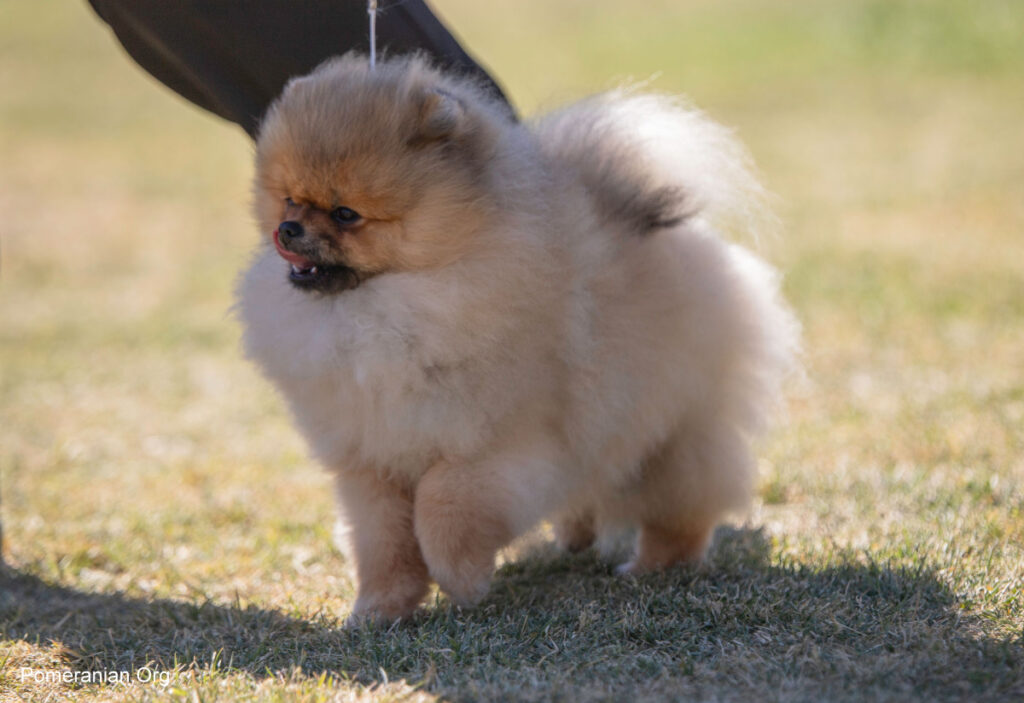
Using a Playpen or Crate During Potty Training
A playpen or properly introduced crate can help prevent accidents when you cannot supervise your Pomeranian directly. These areas should provide safety and structure; they must never be used as punishment.
Using a Puppy Playpen
For young Pomeranian puppies, I prefer a playpen because it provides enough room for a bed, water, toys, and a separate potty area.
Arrange the playpen so the sleeping area and potty area are at opposite ends. Most puppies naturally prefer to keep their bed clean, and this layout helps them begin distinguishing between places for sleeping and toileting.
The playpen should include:
- A comfortable bed or sleeping area
- Fresh water
- A few safe, age-appropriate toys
- A secured puppy pad, toilet tray, or litter box at the opposite end
- Enough room for the puppy to move comfortably
Do not cover the entire playpen floor with puppy pads. Doing so can teach the puppy that every part of the enclosure is an acceptable toilet. Instead, create one clearly defined potty area.
Using a Crate
A crate can be useful for short periods, overnight sleeping, travel, and times when close supervision is impossible. It should be large enough for the puppy to stand, turn around, and lie comfortably, but not so large that one end becomes a toilet.
Introduce the crate gradually with treats, meals, comfortable bedding, and short positive sessions. Your puppy should learn that the crate is a safe resting place.
Very young puppies must not be expected to remain in a crate for long periods. They have limited bladder control and may require nighttime potty breaks.
What to Do After Confinement
Take your puppy directly to the designated potty area:
- Immediately after waking
- As soon as the crate door opens
- When removing the puppy from the playpen
- After returning home
- Before allowing play or household freedom
Carry a very young puppy if necessary to prevent an accident on the way. Once the puppy finishes, provide immediate praise and a small reward.
If Your Puppy Does Not Potty
If nothing happens after several quiet minutes, return your puppy to the crate, playpen, or another closely supervised area for approximately 10 to 15 minutes. Then try again.
Do not allow unrestricted play after an unsuccessful potty trip. Movement and excitement may trigger the need to urinate or defecate as soon as the puppy returns indoors.
Gradually Increasing Freedom
Household freedom should be earned in small stages. Begin with one puppy-safe room under direct supervision. After a successful potty trip, allow a short period of freedom before returning the puppy to its playpen or supervised area.
As reliability improves, gradually increase the time and space available. If accidents return, reduce the puppy’s freedom temporarily and resume more frequent potty trips.
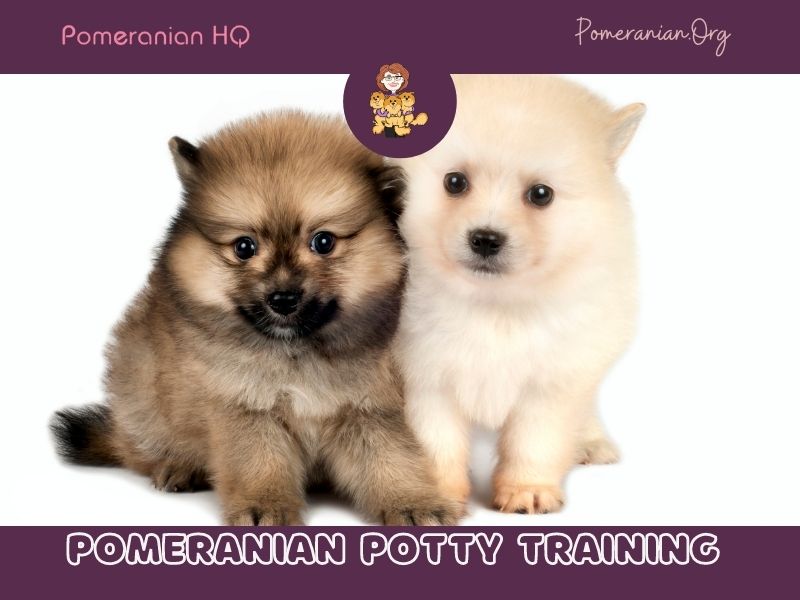
How to Handle Potty-Training Accidents
Accidents are a normal part of raising a puppy. They do not mean your Pomeranian is stubborn, spiteful, or incapable of being trained. Usually, an accident means the puppy was not taken out soon enough, was given too much freedom, or has not yet developed sufficient bladder control.
If You Catch Your Puppy in the Act
Remain calm. Use a gentle sound or short phrase to interrupt the puppy without frightening it, then immediately take or carry it to the designated potty area.
If the puppy finishes in the correct place, provide praise and a small reward. This teaches the puppy what you want without creating fear or confusion.
Do not yell, clap loudly, chase the puppy, or react angrily.
If You Discover an Accident Later
Do not take your puppy back to the accident, scold it, or rub its nose in the mess. A puppy cannot connect punishment with something that happened earlier.
Quietly clean the area and review the circumstances:
- Was the puppy left unsupervised?
- Had it recently eaten, drunk, played, or awakened?
- Was the interval between potty breaks too long?
- Did you miss a warning signal?
- Was the puppy given access to too much of the home?
Use the accident to adjust your routine rather than blaming the puppy.
Clean the Area Thoroughly
Remove as much urine or solid waste as possible, then use a pet-safe enzymatic cleaner according to the product instructions.
Ordinary household cleaners may make the area smell clean to you while leaving traces detectable by your puppy. Lingering odor can encourage repeated toileting in the same location.
Avoid cleaning products containing ammonia, as their odor may resemble urine to a dog.
Prevent Repeat Accidents
After cleaning, temporarily restrict access to the location or supervise your puppy closely whenever it enters that area.
You can also place a bed, toy station, or food puzzle there once the surface is completely clean and dry. Puppies are generally less inclined to toilet in an area they regularly use for resting or activities.
Never Punish a Puppy for an Accident
Punishment does not teach a puppy where it should potty. Instead, it may teach the puppy to:
- Hide before urinating or defecating
- Avoid toileting while you are nearby
- Become frightened when you approach
- Wait until it is alone to potty
- Feel anxious during training
Calm supervision, frequent potty opportunities, and immediate rewards are far more effective.
When Accidents May Indicate a Health Problem
Contact your veterinarian if a previously reliable Pomeranian suddenly begins having accidents or if you notice:
- Frequent attempts to urinate
- Straining or signs of pain
- Blood in the urine
- Excessive thirst
- Urine leaking during rest
- Diarrhea or persistent loose stools
- A sudden inability to control the bladder or bowels
- Changes in appetite, energy, or behavior
Medical problems should be ruled out before treating a sudden change as a training failure.
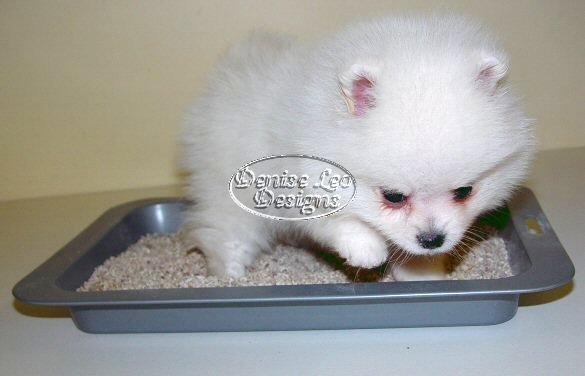
How to Train a Pomeranian to Use Puppy Pads
Puppy pads can provide a practical indoor toilet for young Pomeranians, apartment dogs, and households without immediate outdoor access. They are most effective when placed in one clearly defined location and used consistently.
Choose a Permanent Location
Place the puppy pad in a quiet, easily accessible area with a washable floor. Keep it away from the puppy’s bed, food, water, and main play area.
If the pad is inside a playpen, position it at the opposite end from the sleeping area.
Avoid placing pads throughout the house. Multiple locations can make it difficult for a puppy to understand that only one area is intended for toileting.
Secure the Puppy Pad
Young puppies may drag, chew, fold, or play with loose pads. A pad holder or low-sided toilet tray keeps the pad flat and helps define the toilet area.
The tray should be large enough for your Pomeranian to stand on comfortably and turn around without stepping off the pad.
Take Your Puppy to the Pad Frequently
Place or guide your puppy onto the pad:
- Immediately after waking
- Shortly after eating or drinking
- After active play
- Before and after confinement
- Before bedtime
- Whenever you notice potty signals
Remain nearby, but keep the visit calm and free from distractions.
Introduce a Potty Cue
As your puppy begins to urinate or defecate, quietly say a consistent phrase such as “go potty.”
Avoid repeating the cue continuously before anything happens. The puppy will learn more effectively when the words are associated with the action itself.
Reward Success Immediately
Praise your puppy and provide a small treat as soon as it finishes on the pad.
Keep rewards close to the toilet area so there is no delay. Immediate reinforcement helps the puppy understand exactly which behavior earned the reward.
What to Do if Your Puppy Misses the Pad
If the puppy repeatedly urinates beside the pad, the toilet area may be too small. Use a larger pad, place two pads side by side, or choose a tray with more standing room.
Clean any missed areas thoroughly with a pet-safe enzymatic cleaner. Do not punish the puppy or move it back to the accident after the event.
Gradually Reduce the Pad Area
If you begin with several pads, gradually reduce the covered area as your puppy becomes more accurate. Remove one pad at a time rather than making a sudden change.
Continue rewarding success until your Pomeranian uses the remaining pad reliably.
Moving From Puppy Pads to Outdoor Toileting
If outdoor toileting is your eventual goal, move the pad gradually toward the exit over several days. Then place it immediately outside the door and finally move it to the chosen outdoor potty area.
Take your puppy to the new location on a regular schedule and continue rewarding success. Do not remove the indoor pad abruptly until the puppy understands the outdoor routine.
Puppy pads can be a permanent indoor option or a temporary stage in outdoor training. Whichever approach you choose, consistency is essential.
Pomeranian Potty Training FAQs
Quick answers to common questions about house-training Pomeranian puppies and adult dogs.
How long does it take to potty train a Pomeranian?
Some Pomeranians understand the routine within a few weeks, while others require several months to become completely reliable. Age, previous training, supervision, household routine, and individual development all affect progress.
Are Pomeranians difficult to potty train?
Pomeranians are intelligent and can learn reliable potty habits. Their small bladders mean young puppies need more frequent opportunities and closer supervision than many larger dogs.
How often should I take my Pomeranian puppy to potty?
A very young puppy may need an opportunity every 45 to 60 minutes while awake, as well as after sleeping, eating, drinking, playing, and leaving confinement. Adjust the schedule to your individual puppy rather than waiting for an accident.
Does a Pomeranian puppy need nighttime potty breaks?
Many young puppies cannot remain dry throughout the night. Provide a quiet scheduled break or an accessible indoor toilet until the puppy develops greater bladder control. Nighttime trips should be calm, brief, and free from play.
Can a Pomeranian be litter box trained?
Yes. Pomeranians can learn to use a low-sided toilet tray or litter box. Use a non-toxic, non-clumping, puppy-safe substrate or secure a puppy pad inside the tray. Avoid dusty, scented, or clumping cat litter that could be harmful if swallowed.
Can my Pomeranian use both puppy pads and go outside?
Yes, provided both approved locations remain consistent and clearly defined. Avoid scattering loose pads throughout the house, as this can make the rules unclear.
Should I punish my puppy for an accident?
No. Punishment can create fear and teach a puppy to hide before toileting. Clean the accident thoroughly, increase supervision, offer more frequent breaks, and reward successful potty trips.
Why does my puppy potty immediately after coming inside?
The puppy may have been distracted outside or may not have had enough time to finish. Keep the puppy on a lightweight lead, visit the same quiet location, and delay play until after toileting.
Why does my Pomeranian keep using the same indoor spot?
Residual odor may identify the location as a toilet. Clean it with a pet-safe enzymatic cleaner, temporarily block access, and closely supervise the puppy when it returns to that room.
Why has my potty-trained Pomeranian started having accidents?
A change in routine, stress, marking, illness, or reduced access to the toilet area may cause a setback. Return temporarily to a structured schedule and arrange a veterinary examination if the change is sudden or persistent.
Is excitement urination the same as failed potty training?
Not necessarily. Some puppies release a small amount of urine during exciting or intimidating greetings. Keep arrivals calm, avoid looming over the puppy, and allow greetings to happen outdoors when practical.
When should potty accidents be discussed with a veterinarian?
Seek veterinary advice for sudden loss of bladder control, unusually frequent urination, straining, pain, blood in the urine, excessive thirst, urine leakage during rest, diarrhea, or any accompanying change in health or behavior.
Final Thoughts on Pomeranian Potty Training
Potty training a Pomeranian requires patience, supervision, and a consistent daily routine. Young puppies have limited bladder control, so accidents should be expected while they learn where and when to potty.
Success comes from offering frequent potty opportunities, recognizing your puppy’s signals, and rewarding the correct behavior immediately. A playpen, puppy pads, an outdoor potty area, or a dog-safe litter box can all be effective when used consistently.
Never punish your Pomeranian for an accident. Instead, clean the area thoroughly, review the circumstances, and adjust the schedule to create a better opportunity for success next time.
Every puppy develops at a different rate. Some Pomeranians learn quickly, while others need additional time and repetition. Temporary setbacks may occur during changes in routine, bad weather, excitement, illness, or periods when supervision is reduced.
With calm guidance and realistic expectations, your Pomeranian can develop reliable potty habits that last throughout its life.
Enjoy your Pomeranian. Download the FREE eBook on Pomeranian Potty Training in our member’s section.
Copyright Pomeranian.Org. All Rights Reserved.
References and Further Reading:
[1] Denise Leo “The Pomeranian Handbook.”
[2] Denise Leo “Training Your Pomeranian.”

- INCLUDES: 50 Regular-size standard-absorbency puppy pee pads; ideal for puppy training, senior dogs, car trips, and more
- 5-LAYER PROTECTION: Multi-layer construction with quick-dry surface and absorbent core that turns liquid into gel on contact
- LEAKPROOF: Plastic lining keeps floors safe from damage; plastic border on all 4 sides to prevent overflow
- BUILT-IN ATTRACTANT: Helps aid in potty training
- PRODUCT DIMENSIONS: 22 x 22 inches (LxW, overall); 19 x 19 inches (LxW, center pad); 1.65 inch border


- FSC-certified PADS (FSC N004130). Made with materials from well-managed forests, recycled materials, and/or other controlled sources
- INCLUDES: 100 Regular-size standard-absorbency puppy pee pads; ideal for puppy training, senior dogs, car trips, and more
- 5-LAYER PROTECTION: Multi-layer construction with quick-dry surface and absorbent core that turns liquid into gel on contact
- LEAKPROOF: Plastic lining keeps floors safe from damage; plastic border on all 4 sides to prevent overflow
- BUILT-IN ATTRACTANT: Helps aid in potty training

- MAXIMUM ABSORBENCY – IMPROVIA Reusable Underpad is a revolutionary Incontinence Pad that provides faster and more effective fluid absorption. It is the only absorbent pad that wicks the fluid to the edges – serving as a barrier for 100% leakproof protection.
- USES AND APPLICATIONS – Incontinence is no more a problem with IMPROVIA Underpad! It works perfectly for kids, adults, the elderly, and pets. Use it as a bed pad, pet pad, puppy pad, potty training pad, or pee pad and maximize your bed’s or furniture’s longevity.
- SAFE FOR SENSITIVE SKIN – Since this Underpad effectively absorbs fluids, such as urine, you can ensure that your skin is completely safe from wetness and rashes. Its super soft texture is highly recommended for skin care – protecting you against common skin infections.
- WASHABLE UP TO 500X – With our Reusable Bed Pads, you can get a more comfortable sleep as they stay in the correct position – keeping you and your bed dry all night long! They are 100% Washable and Stain-Resistant – saving you up to 500 Disposable Underpads!

- 【5 Layer Protection】: Wowflash disposable changing pads for baby features a 5 protectional layers design which quickly asborb and lock the liquid without leaking, providing a simple solution to protect the bedding while changing the diaper.
- 【Supper Absorbency】: With a super absorbent core of high polymer material, these disposable pads turn liquid into gel in seconds for easy clean up.
- 【Comfortable & Skin Friendly】: Quilted no-woven top provides a comfortable touch for your baby without irritation.
- 【Easy to Take Out】: These disposable diaper changing pads are great and convenient to take out, making it easy for the diaper changing outside.
- 【Value Package】: Package contains 50 count 17” x 13” disposable underpads. Wowflash provides you a cost-effective product for your baby.

- Maximum Absorbency – Utopia bedding reusable underpads are designed for optimal fluid absorption, quickly drawing moisture away from the surface. Unlike other bed pads, it channels liquids towards the edges, providing reliable protection and helping prevent leaks, keeping beds and furniture dry.
- Versatile Use – These bed pads are a practical solution for managing incontinence for all ages, from kids to adults, seniors, and even pets. They’re ideal as a bed pads, pet pads, or training pads, offering dependable protection for mattresses and furniture.
- Enhanced Fluid Control – These washable incontinence pads quickly absorbs liquids, providing a dry surface for longer periods. Its durable design can absorbs up to 6 cups of water (1600 cc).
- Durable & Washable – Our waterproof bed pads can be machine washed up to 500 times without losing effectiveness. They stay in place throughout the night, keeping you dry and comfortable. (Packaging might slightly vary)
- Superior Protection for Limited Mobility – Our incontinence pads offer a leak-proof barrier, keeping beds, wheelchairs, and seating dry, ensuring comfort and dignity for Individuals with special needs.

- 【5 Layer Protection】: Wowflash disposable underpads features a 5 protectional layers design which quickly asborb and lock the liquid without leaking, providing a simple solution to protect the your floor, bedding, chair and furniture.
- 【Supper Absorbency】: With a super absorbent core of high polymer material, these disposable pads turn liquid into gel in seconds for easy clean up.
- 【Comfortable & Skin Friendly】: Quilted no-woven top provides a comfortable touch for baby, adults and pets, perfect for all-night protection without irritation.
- 【Multiple Use】: These multi-functional disposable pads are great for childre, adults and pets. A must have baby changing pads, bed pads for adults and puppy cat pee pads for dogs.
- 【Value Package】: Package contains 100 count 22” x 22” disposable underpads. Wowflash provides you a cost-effective product for your baby, elderly and pets.

- FSC-certified puppy pee pads (FSC N004130). Made with materials from well-managed forests, recycled materials, and/or other controlled wood sources.
- INCLUDES: 50 Regular-size heavy-duty-absorbency puppy pee pads; ideal for puppy training, senior dogs, car trips, and more
- 5-LAYER PROTECTION: Multi-layer construction with quick-dry surface and absorbent core that turns liquid into gel on contact
- LEAKPROOF: Plastic lining keeps floors safe from damage; plastic border on all 4 sides to prevent overflow
- BUILT-IN ATTRACTANT: Helps aid in potty training

- FSC-certified puppy pee pads (FSC N004130). Made with materials from well-managed forests, recycled materials, and/or other controlled wood sources.
- INCLUDES: 150 Regular-size standard-absorbency puppy pee pads; ideal for puppy training, senior dogs, car trips, and more
- 5-LAYER PROTECTION: Multi-layer construction with quick-dry surface and absorbent core that turns liquid into gel on contact
- LEAKPROOF: Plastic lining keeps floors safe from damage; plastic border on all 4 sides to prevent overflow
- BUILT-IN ATTRACTANT: Helps aid in potty training

- Leak-Proof Protection Guarantee: Each pee pad features Polyethylene backing with a border to protect the floor by blocking leaks, The polymer layer absorbs liquid and turns into a gel for easy clean-up, Keep Your Home Clean and without Odor.
- Pee Pads Suitable for Dog All Stages: The training pads can be used for all kinds of dogs no matter new puppies or seniors. Perfect for Male & Female dog Potty Training, sick dogs Recovery, Longtime stay at home, and Travelling.
- Built-in Attractant Designed with 5 Premium Inner Layers: COCOYO dog training pads made of 5 Premium lining layers, protect dogs or puppies from stains in kennels.ttractant
- Super Absorbent Puppy Pee Pads: Designed to turn urine and liquid into a mess-free gel these puppy pads pet training pads help protect the carpet and hardwood floors from accidents, stains, or odors when training indoor puppies or dogs
- Best Value & Good Choice for Puppy Training Pads: You can use these dog pee pads on their own, in a puppy crate, or even as a liner. A necessary match for the kennel. Good choice for taking care of your dog’s daily life.
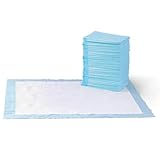
- INCLUDES: 40 X-Large standard-absorbency puppy pee pads; ideal for puppy training, senior dogs, car trips, and more
- 5-LAYER PROTECTION: Multi-layer construction with quick-dry surface and absorbent core that turns liquid into gel on contact
- LEAKPROOF: Plastic lining keeps floors safe from damage; plastic border on all 4 sides to prevent overflow
- BUILT-IN ATTRACTANT: Helps aid in potty training
- PRODUCT DIMENSIONS: 28 x 34 inches (LxW)


- 【Large Size for Comfort】At 39.3 x 31.5 inches, this astroturf gives your dog plenty of room to move around and do their business. Perfect for potty training, it helps teach your pet to “go potty” with ease. Save time and give your dog the convenience of staying indoors during bad weather—no more walks in rain, snow, or extreme heat.
- 【Fast-Drain】 Our Rapid-drain turf grass for pets features 63 drainage holes spaced every 10 cm. This design maximizes water flow and prevents messy buildup, so your dog’s paws won’t leave the crate or floor wet and dirty.
- 【Soft & Natural Look】Made from non-toxic polypropylene with 4-tone blades, our fake grass feels soft and lush under your pup’s paws. It looks far more realistic than standard all-green turf, so your dog will feel right at home.
- 【Easy to Clean】Designed with plenty of urine drainage holes for rapid flow-through. Simply hose it down with mild soap and warm water—mess rinses off in seconds. Requires far less maintenance than natural grass.
- 【Great Potty Option】Our large pet artificial grass is ideal for apartments, backyards, balconies, patios, and even bathrooms. Suitable for small, medium, and large dogs alike, it fits seamlessly into any space to meet your training or potty needs.
- INCLUDES: 50 Regular-size standard-absorbency puppy pee pads; ideal for puppy training, senior dogs, car trips, and more
- 5-LAYER PROTECTION: Multi-layer construction with quick-dry surface and absorbent core that turns liquid into gel on contact
- LEAKPROOF: Plastic lining keeps floors safe from damage; plastic border on all 4 sides to prevent overflow
- BUILT-IN ATTRACTANT: Helps aid in potty training
- PRODUCT DIMENSIONS: 22 x 22 inches (LxW, overall); 19 x 19 inches (LxW, center pad); 1.65 inch border

- NATURAL TRAINING SPOT: Designed with a 30″ x 20″ artificial grass surface, this grass patch for dogs’ potty recreates the familiar feel of outdoor grass. The realistic turf encourages pets to use the designated area naturally during training. This helps puppies build consistent potty routines and makes indoor training more convenient for pet owners.
- LAYERED DRAINAGE STRUCTURE: This dog pee grass pad features a 3-layer system with grass turf, a drainage grid, and a collection tray. The layered structure allows liquid to pass quickly through the top layer and into the tray below, rather than pooling on the surface. This helps keep the grass area cleaner and keeps your dog’s paws drier during daily use.
- SOFT YET LONG-LASTING: This dog grass pad features dense, soft artificial turf grass fibers designed to stay in place during use. The reinforced turf structure resists shedding and helps prevent the fibers from collapsing. This structure provides a comfortable stepping area for dogs while keeping the potty space neat and consistent with repeated use.
- SIMPLE MAINTENANCE: This puppy pee pad features a detachable multi-piece design, allowing the turf, grid, and tray to be separated for cleaning. Each component can be rinsed with water or cleaned with a mild detergent, while the built-in drainage openings help speed up drying. This reusable setup simplifies daily maintenance and reduces the need for disposable pads.
- INDOOR POTTY SOLUTION: This dog potty grass pad is sized for small to medium dogs and designed to fit in apartments, balconies, or indoor pet areas. The compact yet functional layout allows flexible placement in different living spaces. This design creates a reliable indoor potty spot during training, bad weather, or busy days when outdoor walks are not possible.

- [KEEP PAWS DRY & CLEAN] The perforated grate design allows urine to flow directly into the training pad below, preventing your puppy’s paws from getting wet. No more messy footprints on your floors or carpets!
- [DURABLE & SAFE MATERIAL] Made of high-quality, non-toxic, and sturdy PP plastic. This potty tray is built to last and provides a stable surface for your pet to use comfortably. Perfect for puppies, small breeds, and senior dogs.
- [MESS-FREE & PAD PROTECTION] The snap-on/off mesh grate prevents clever puppies from reaching and tearing up the pee pads. It saves you money on pad replacements and keeps your home tidy from shredded paper.
- [EASY CLEANING & MAINTENANCE] Cleaning is a breeze! Simply remove the mesh grate, rinse with warm soapy water, and replace the pad. The lightweight design makes it easy to move around your home or take on trips.
- [PERFECT SIZE FOR SMALL PETS] Dimensions: 20″ x 16″ x 1.2″. This compact yet spacious tray fits perfectly in laundry rooms, bathrooms, or balconies. Ideal for pet owners who live in apartments or work long hours.

- [PEE PAD WITH TRAY]: This turf pee pad offers a hygienic solution for your pet to relieve themselves indoors, on your balcony or patio. Ideal reusable alternative to disposable dog training pads.
- [EASY PUPPY TRAINING]: Make potty training your new best friend a breeze, even in an apartment or if you work long hours. This washable dog grass pad prevents accidents while reinforcing the habit of going potty on grass.
- [PREVENT MESSES]: The grass mat sits securely on top of the tray, allowing liquids to drain into the collection tray, reducing messes and spills.
- [EASY CLEAN UP]: Rinse the 2 layers with soapy water and you are done!
- [ITEM DETAILS]: Artificial Grass and Rubber Tray | Size: 15″ x 30″

- REPLACEMENT SET: Dog pee pads 14×18 inches compatible for 16×20 inches Puppy Potty Trainer tray. You will get 2 packs a set. It is convenient for you to wash one while the other is available for use
- RAPID FLOW DRAINAGE: This fake grass constructed with a highly-drainable backing material to maximize draining capacity, with drainage holes to help urine and clear water wee away quickly, and the porous grass avoids wet paws after the dog use- Avoid any mess for potty time
- LOW MAINTENANCE: Stop worrying about mowing and using special treatments to keep your dog is lawn alive and healthy. This artificial green lawn allows you to sit back and relax without having to work on it every week! It all about efficiency and taking the workload off your shoulders
- EASY TO CLEAN & NO SMELL: No assembly, settings are instant, fast and simple, and reusable. Easy to clean, wash with soap and warm water in under 10 minutes, and let it dry out. The washable pee pad for dogs is built into the backing and the yarn, which helps to minimize odors
- PERFECT FOR INDOOR OR OUTDOOR: Use indoor, porches, patios, balconies, backyard, apartment, pet carriage etc, portable and weatherproof, make you and your furry friend life more easier

- COME WITH TWO PADS: Loobani dog indoor potty comes with two fake grass mats, you can replace another one when cleaning. Loobani artificial grass mat offers that really feel that your dog needs to do his or her business. The dog potty is available in four different sizes, which works well for most dogs, even larger breeds
- EASY TO CLEAN: The top pad consists of grass pee pad which is easy to clean. Simply spray it off with a hose, wash it in warm soapy water, and you’re good to go! or, if you want to wash the whole thing – that’s easy, too – just hose it off in the yard, or in the laundry room sink
- RAPID FLOW DRAINAGE: Constructed with a highly-drainable backing material to maximize draining capacity, to help urine and clear water wee away quickly, and the porous grass avoids wet paws after dog use- Avoid any mess for potty time
- PORTABLE AND LIGHTWEIGHT: The loobani dog turf potty for outdoor or apartment use. An indoor dog potty could be the best solution for you if you sometimes have to work extra long hours, it’s portable design sets it up for both indoor and outdoor usage, so even if you are on the road with your dog, this loobani dog potty would come in very handy
- MULTIPLE USES: loobani grass pee pads for dogs with tray have multiple uses can help you in creating a green space in your apartment, balcony or terrace or even patios, providing a safe training tool for your pet’s pee on it
- FSC-certified PADS (FSC N004130). Made with materials from well-managed forests, recycled materials, and/or other controlled sources
- INCLUDES: 100 Regular-size standard-absorbency puppy pee pads; ideal for puppy training, senior dogs, car trips, and more
- 5-LAYER PROTECTION: Multi-layer construction with quick-dry surface and absorbent core that turns liquid into gel on contact
- LEAKPROOF: Plastic lining keeps floors safe from damage; plastic border on all 4 sides to prevent overflow
- BUILT-IN ATTRACTANT: Helps aid in potty training

- DOG PEE GRASS WITH TRAY – This artificial turf dog pee pads provide a sanitary place for your pet to relieve themselves inside dog house, puppy playpen, on your balcony or patio. A reusable alternative to disposable dog training pads for small-sized pets.
- EASY PUPPY TRAINING – Potty training your new best friend just got easier, even if you live in an apartment or work long hours. This dog grass pad helps avoid accidents while enforcing your pup’s training that they should go potty on grass.
- FOUR-LAYER SYSTEM – The artificial dog grass mat sits on top of an odor-resistant cloth mat and a secure plastic drainage insert that allows liquid to empty into the durable collection puppy pad holder to avoid messes and spills.
- EASY CLEAN-UP – Cleaning this reusable grass pad for dogs is quick and easy. Rinse the four layers of the dog potty tray with soapy water and clean-up is complete.
- PRODUCT DETAILS – Materials: PP, Artificial Turf, and Polyester Cotton. Dimensions: (L) 20.86” x (W) 16.73” x (H) 1.57”. Color: Green and Black.