
What Is a Parti-Colour Pomeranian?
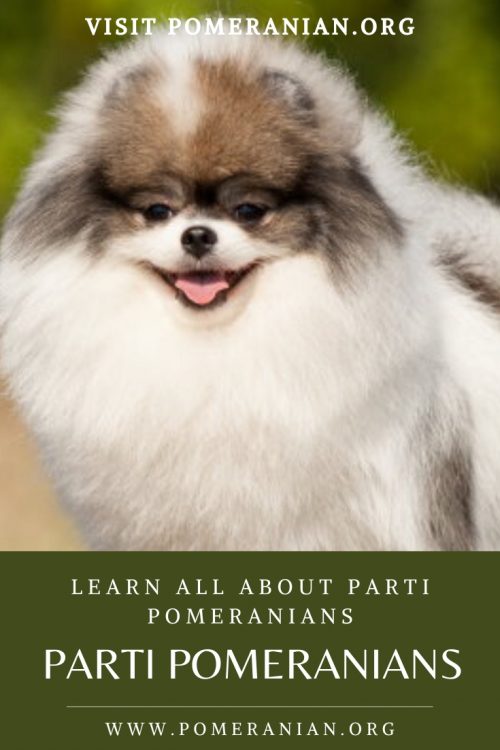
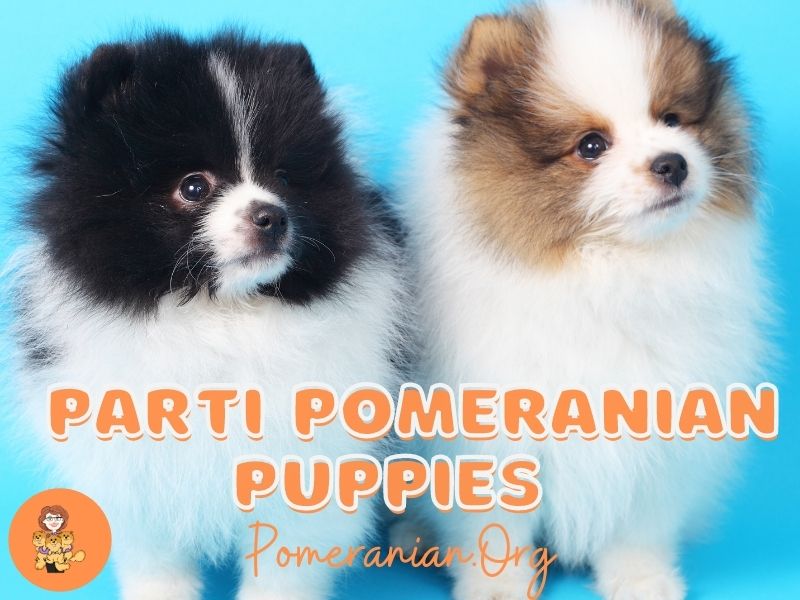
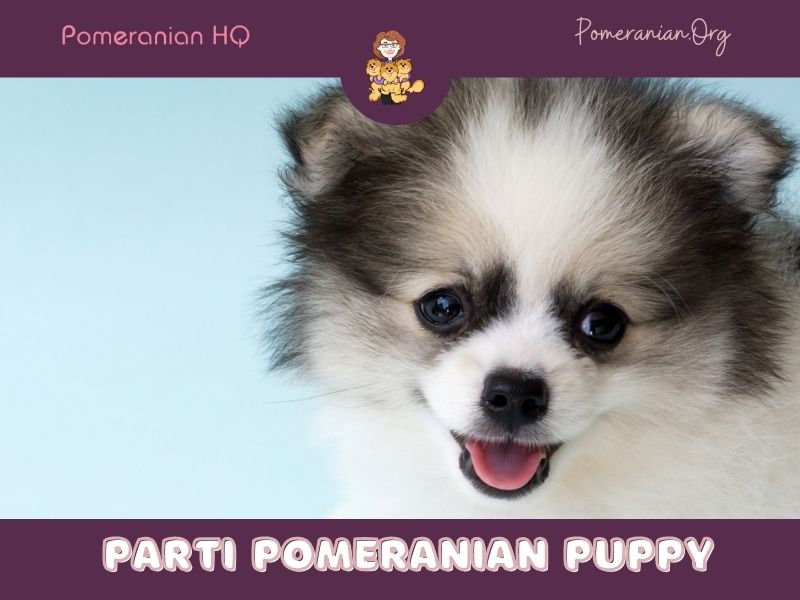
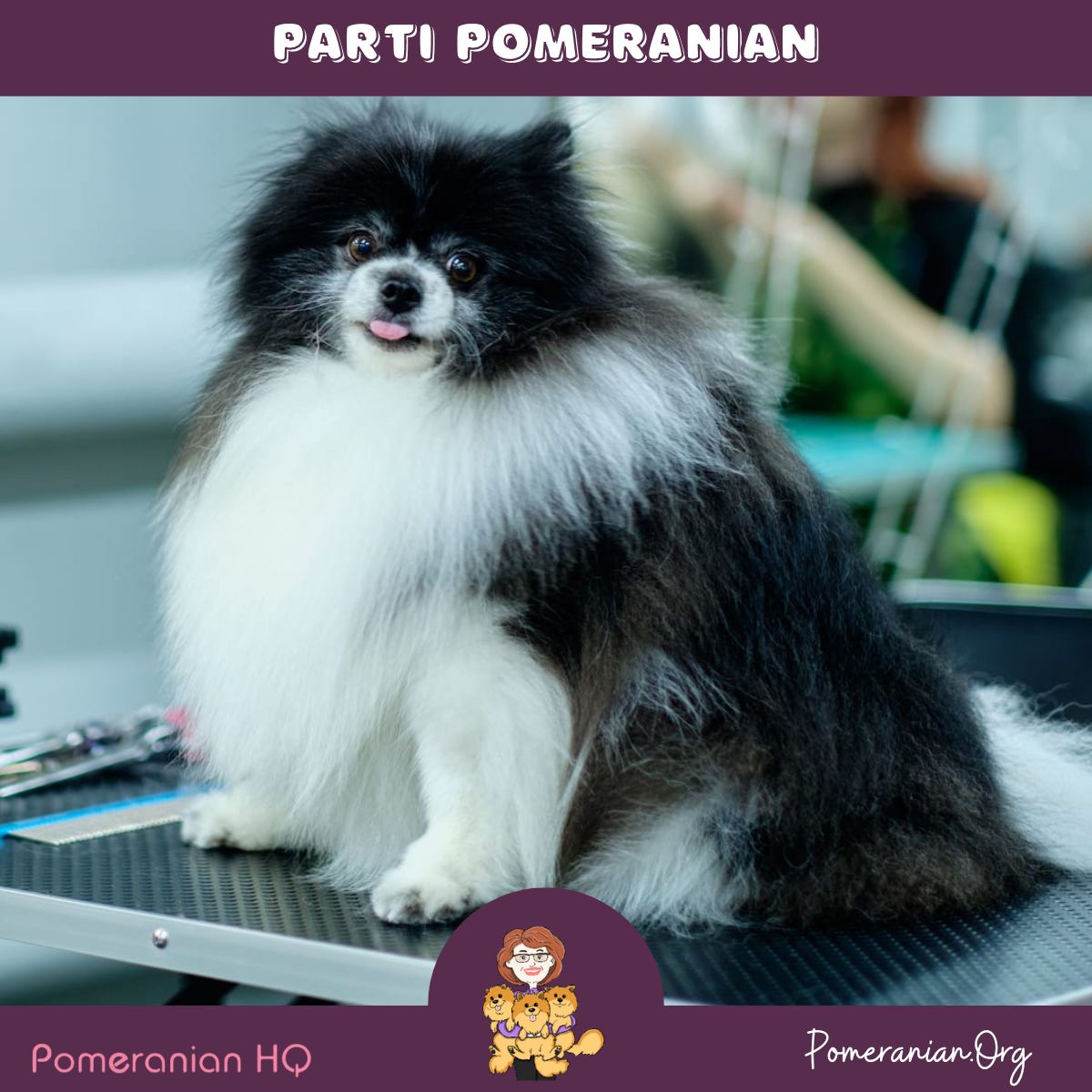
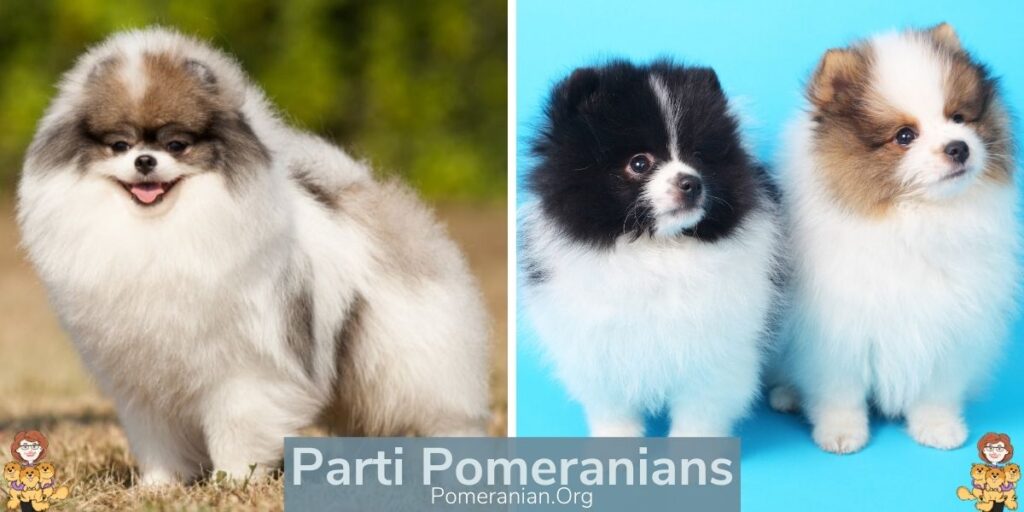
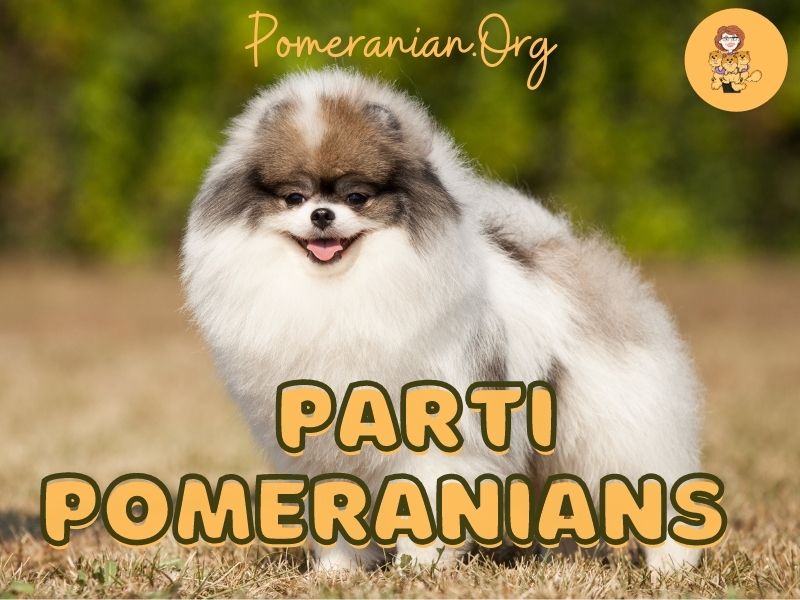
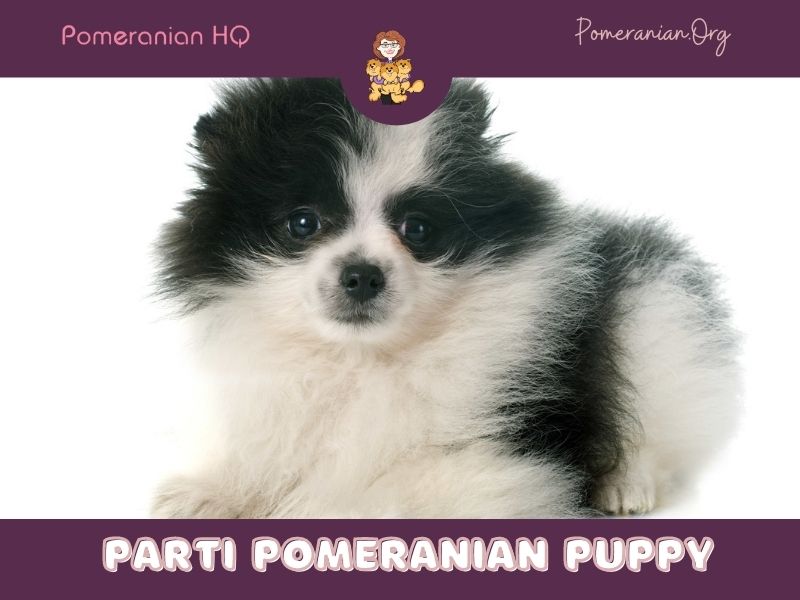
A parti-colour Pomeranian has a white coat with clearly defined patches of another colour, such as orange, black, cream, chocolate or sable. The size, shape and placement of these coloured patches vary, making every parti Pomeranian’s markings unique.
Parti Describes the Coat Pattern
A parti Pomeranian is not a separate breed or type of Pomeranian. The word parti simply describes its distinctive combination of white and coloured areas. A well-bred parti should possess the same correct breed type, soundness and temperament expected of every Pomeranian.
The preferred amount and distribution of white may vary between kennel club standards. Anyone planning to show a parti Pomeranian should check the breed standard and registration requirements applying in their own country.
Parti Pomeranian Colors, Markings and Show Standards
Parti is one of the original Pomeranian coat patterns and has appeared throughout the breed’s history. A parti Pomeranian combines white with clearly defined patches of another recognized color or pattern. However, the markings accepted in the show ring differ between the United States, Australia, the United Kingdom and countries using the FCI standard.
Parti combinations may include orange and white, black and white, cream and white, chocolate and white, sable and white, black and tan with white, and other colors or patterns permitted by the relevant kennel club.
Parti Patterns in the United States
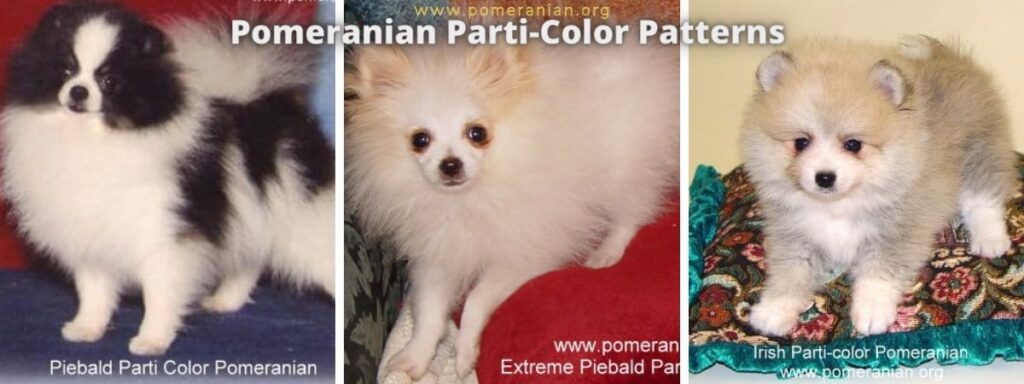
The American Pomeranian Club describes three general parti patterns:
- Extreme piebald: A predominantly white Pomeranian with color mainly on the head and at the base of the tail.
- Piebald: A white Pomeranian with clearly defined patches of color on the head, body and base of the tail.
- Irish: A predominantly colored Pomeranian with white on areas such as the legs, chest and collar.
Under the American Kennel Club standard, a parti Pomeranian has a white base coat with any permitted color or pattern. A white blaze on the head is preferred, while excessive ticking in the white areas is considered undesirable.
Parti Pomeranians in Australia and the United Kingdom
The Australian and United Kingdom standards require the colors of a correctly marked parti Pomeranian to be distributed in patches over the body. White or tan feet, legs or chest on an otherwise whole-colored Pomeranian do not make the dog a correctly marked parti. These markings are generally described as mismarks.
Consequently, an Irish-marked Pomeranian recognized as a parti in the United States would generally be considered mismarked under the Australian and United Kingdom standards.
The Australian and United Kingdom standards also state that when whole-colored and parti-colored exhibits are otherwise equal in quality, preference should be given to the whole-colored exhibit.
Parti Pomeranians Under the FCI Standard
The Fédération Cynologique Internationale describes parti Pomeranians as having “coats with patches.” White must be the base color, with patches in one recognized color or pattern. The patches should preferably be distributed over the entire body.
Permitted patch colors and patterns include black, brown, gray-shaded, orange, orange sable, cream, cream sable, black and tan, black and silver, and brown and tan.
The FCI does not officially classify parti Pomeranians as extreme piebald, piebald or Irish. Definite white markings on an otherwise non-white Pomeranian are listed as a disqualifying fault.
What Is a Mismarked Pomeranian?
A mismark is usually a whole-colored Pomeranian with an unwanted or incorrectly placed white marking, such as a white chest, foot or toe. Whether a particular marking is accepted depends on the breed standard used in the country where the dog is registered and exhibited.
Show standards differ between countries. Always consult the current breed standard applying where your Pomeranian will be registered and shown.
These differences do not mean that parti Pomeranians are not purebred. Parti is an original Pomeranian pattern, but its correct appearance is defined differently by individual kennel clubs.
Whatever the pattern, markings must never be considered more important than the complete Pomeranian. Health, soundness, temperament and correct breed type should always take priority over coat color.

Parti Pomeranian Genetics Explained
Parti coloring is inherited, but its genetics are more complex than the simple statement that “parti is recessive to solid color.” The principal gene associated with piebald or parti white spotting in many dog breeds is MITF, short for microphthalmia-associated transcription factor.
The MITF gene helps control the development and movement of pigment-producing cells. Where these cells reach the skin, the growing hair can contain pigment. Where pigment-producing cells are absent, the hair grows white.
White Is the Absence of Pigment
The white areas of a parti Pomeranian are not produced by a white pigment. They are areas in which the hairs lack pigment. The colored patches are controlled by the Pomeranian’s other coat-color genes.
How Parti Coloring Is Inherited
In Pomeranians, parti coloring is generally treated as a recessive form of white spotting. A Pomeranian normally needs to inherit a parti-associated variant from both parents to display the parti pattern. A dog that inherits only one copy may appear solid-colored but can pass the variant to its puppies.
This explains how two apparently solid-colored Pomeranians can produce a parti puppy. If both parents carry the parti-associated variant, each can pass its copy to the same puppy.
Genetic laboratories do not all use identical letters when reporting white spotting. Some reports use S and sp, while others use N and S. Breeders should always read the definitions supplied with the particular laboratory report rather than relying on the letters alone.
A carrier is not a parti Pomeranian. A carrier may have an entirely solid-looking coat but possess one copy of a tested parti-associated variant that can be passed to its offspring.
Possible Results From Parti Breedings
The following percentages explain the expected inheritance when parti behaves as a simple recessive trait and the parents’ DNA results are known. These are probabilities for each individual puppy—not a guaranteed division of every litter.
| Mating | Expected Genetic Results | Expected Parti Puppies |
|---|---|---|
| Clear solid × clear solid | All puppies expected to be clear of the tested variant | None expected from that tested variant |
| Clear solid × carrier | Approximately 50% clear and 50% carriers | None expected |
| Clear solid × parti | All puppies expected to carry one copy | None expected |
| Carrier × carrier | Approximately 25% clear, 50% carriers and 25% with two copies | Approximately 25% |
| Carrier × parti | Approximately 50% carriers and 50% with two copies | Approximately 50% |
| Parti × parti | All puppies expected to inherit two copies | All genetically expected to be parti, although their markings may differ greatly |
Percentages are probabilities, not litter guarantees. A carrier-to-carrier mating could produce no parti puppies in one small litter and several in another. Each puppy represents a separate genetic event.
What Determines the Color of the Patches?
The white-spotting genetics determine where pigment is absent, but they do not independently determine whether the colored patches will be orange, black, chocolate, cream, sable, black and tan or another permitted color or pattern.
The color inside the patches is controlled by other coat-color genes inherited from the parents. For example, a Pomeranian must inherit the genetic requirements for chocolate coloring before its pigmented patches can be chocolate. Parti genetics place white over the underlying color or pattern; they do not create that underlying color.
Why the Exact Markings Cannot Be Predicted
DNA testing may help identify whether a Pomeranian has zero, one or two copies of a tested MITF variant. However, it cannot reliably predict the exact size, shape or position of the colored patches on a future puppy.
Other genetic modifiers can influence how extensively white is expressed. This helps explain why puppies with similar test results may look very different. One may have large, evenly distributed patches, while another may be almost entirely white or have considerably more color.
Even puppies in the same litter can have completely different markings. Breeders cannot use a DNA result to guarantee a white blaze, a colored head, balanced body patches or any other particular arrangement.
Can Parti Remain Hidden for Generations?
A parti-associated variant can pass quietly through multiple generations when it is carried by solid-looking Pomeranians. It may become visible again when two carriers are bred together or when a carrier is bred to a parti.
There is no fixed number of generations for which parti must remain hidden. It may reappear in the next generation, remain unseen for many generations or be lost from a particular family if carriers do not pass the variant to their offspring.
DNA Testing and Its Limitations
DNA color testing can help breeders identify a known MITF variant associated with piebald or parti white spotting. This is particularly useful when a solid-looking Pomeranian has parti dogs in its pedigree or when a breeder is planning a mating that could produce parti puppies.
However, canine white spotting is genetically complex. Not every white marking or pattern in every breed has precisely the same genetic cause. A test normally identifies a particular known variant; it does not analyze every possible gene or modifier capable of affecting white markings.
DNA testing is a valuable breeding tool, but it does not replace pedigree knowledge or firsthand experience. Results must be interpreted together with the parents’ appearance, their relatives, previous puppies and the markings seen throughout the bloodline.
Parti Is Not Merle
Parti and merle are genetically different patterns. Parti produces areas of white combined with colored patches and is primarily associated with white-spotting genetics. Merle alters the distribution of pigment within colored areas and is associated with a different gene.
A Pomeranian should not be described as merle merely because it has irregular patches, ticking or unusual shading. Parti is one of the breed’s original patterns, while merle is not a traditional Pomeranian pattern in Australia.
Breeding Parti Pomeranians Responsibly
Understanding the inheritance of parti coloring can help breeders plan litters, but color must never become the principal reason for a mating. A beautifully marked puppy is not necessarily a correctly constructed, healthy or breeding-quality Pomeranian.
Responsible preservation breeders consider the complete dog, including health testing, temperament, soundness, movement, pedigree, family health history and correct Pomeranian breed type. DNA color results should support a carefully planned breeding program—not replace experienced judgment.
Showing a Parti Pomeranian
Parti Pomeranians can be exhibited in countries where the pattern is recognized, provided the dog is registered correctly and its markings comply with the applicable breed standard. As explained above, the definition of a correctly marked parti differs between kennel clubs.
A parti Pomeranian should be judged as a complete dog. Correct breed type, sound construction, balanced movement, head qualities, coat texture, temperament and presentation remain far more important than having especially attractive markings.
Markings Can Affect the Overall Impression
Well-placed patches can create an attractive, balanced appearance. Uneven markings may sometimes make a dog appear less balanced than it truly is, but color should never distract from an objective assessment of the Pomeranian underneath the coat.
Before entering a parti Pomeranian in a show, check the current standard used by the organizing kennel club. A marking accepted in the United States may be treated differently in Australia, the United Kingdom or an FCI country.
A beautiful pattern cannot compensate for poor breed type. The best show prospect is a healthy, sound and correctly constructed Pomeranian whose markings also satisfy the relevant breed standard.
Are Parti Pomeranians Purebred or Rare?
Parti Pomeranians are purebred Pomeranians. Parti colouring has appeared in the breed for many generations and does not mean that a Pomeranian has been crossed with another breed.
Parti Pomeranians may be less commonly seen than orange or orange sable Pomeranians, but they should not automatically be described as rare or sold at an inflated price simply because of their markings.
Colour does not determine quality. A parti Pomeranian should be valued for its health, temperament, soundness, pedigree and correct breed type—not merely for an attractive or unusual pattern.
Showing a Parti Pomeranian
Parti Pomeranians can be exhibited in countries where the pattern is recognized, provided the dog is registered correctly and its markings comply with the applicable breed standard. As explained above, the definition of a correctly marked parti differs between kennel clubs.
A parti Pomeranian should be judged as a complete dog. Correct breed type, sound construction, balanced movement, head qualities, coat texture, temperament and presentation remain more important than particularly attractive markings.
From an Early Pomeranian Breed Standard
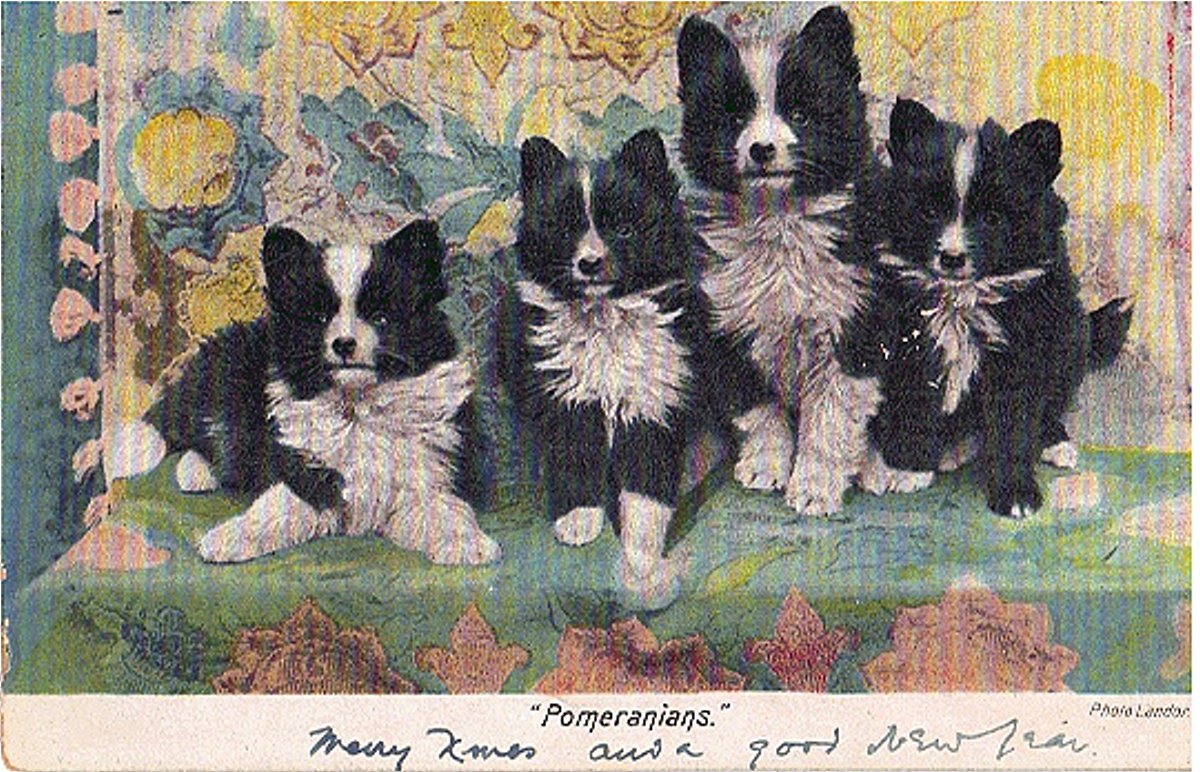
“In mixed classes where whole-colored and parti-colored Pomeranians compete together, the preference should, if all other points be equal, be given to the whole-colored specimen.”
This historical wording demonstrates that parti Pomeranians were recognized and exhibited alongside whole-colored Pomeranians. However, it also reveals the traditional show-ring preference given to whole-colored dogs when the competing exhibits were otherwise considered equal.
Markings Can Affect the Overall Impression
Well-placed patches can create an attractive and balanced appearance. Uneven markings may make a Pomeranian appear less balanced than it truly is, but color should never distract from an objective assessment of the dog beneath the coat.
Before entering a parti Pomeranian in a show, check the current standard used by the organizing kennel club. A pattern accepted in the United States may be assessed differently in Australia, the United Kingdom or an FCI country.
A beautiful pattern cannot compensate for poor breed type. The best show prospect is a healthy, sound and correctly constructed Pomeranian whose markings also satisfy the applicable breed standard.

Responsible Breeding and Choosing a Parti Pomeranian Puppy
A responsible breeder never plans a litter for unusual coloring alone. Parti markings may be beautiful, but health, temperament, soundness, correct Pomeranian breed type and knowledge of the pedigree must always come first.
Parti Pomeranians have the same general care needs and potential breed-related health concerns as other Pomeranians. The coat pattern does not make them a separate variety, size or type of Pomeranian.
What to Look for in a Responsible Breeder
- Registration with a recognized kennel club
- A thorough understanding of the Pomeranian breed standard
- Appropriate health screening and DNA testing of breeding dogs
- Careful consideration of temperament, soundness and breed type
- Detailed knowledge of the pedigree and health of related dogs
- Clean, well-socialized puppies raised with suitable veterinary care
- Honest information about the puppy’s quality, registration and intended future
- Continuing advice and support after the puppy leaves for its new home
Do Parti Pomeranian Puppies Cost More?
A parti puppy should not automatically cost more merely because its markings are advertised as rare, exotic or unusual. Price alone is not evidence of quality, and especially dramatic markings do not guarantee good health, correct construction or a suitable temperament.
Choose the breeder before choosing the color. A healthy, confident and well-bred puppy from a knowledgeable breeder is far more important than obtaining a particular arrangement of patches.
Never select a puppy from photographs of its markings alone. Ask about the parents, health testing, temperament, socialization, registration and the breeder’s experience with Pomeranians.
Hearing Concerns and Heavily White Puppies
It is incorrect to assume that every predominantly white parti Pomeranian will have a hearing problem. However, if there is any concern about a puppy’s response to sound, the puppy should be examined by a veterinarian. Formal Brainstem Auditory Evoked Response (BAER) testing may be recommended to assess hearing accurately.
The complete Pomeranian matters most. Responsible breeding protects health, temperament, soundness and breed type while allowing us to appreciate the beauty and individuality of the parti pattern.

Do Parti Pomeranian Colors and Markings Change?
A parti Pomeranian’s basic pattern is present from birth, but its appearance can change considerably as the puppy matures. The general location of the white and colored areas usually remains recognizable, although the color, shading and apparent size of individual patches may develop over time.
These changes are particularly noticeable when a parti puppy’s colored patches contain orange, cream or sable. Darker puppy shading may gradually lighten, while sable tipping can become less obvious as the adult coat develops. Black and chocolate patches generally retain their basic color, although sun exposure, coat condition and seasonal shedding can affect their appearance.
The Pattern Stays, but Its Appearance Develops
A colored patch does not normally move to a different part of the body. However, it may appear larger, smaller or differently shaped as the puppy grows and the long adult coat replaces the shorter puppy coat.
Changes During the Puppy Uglies
Like every Pomeranian, a parti puppy passes through the adolescent coat change often called the “puppy uglies.” During this stage, the puppy coat is shed and the adult double coat begins to grow. The markings may temporarily look uneven, less distinct or surprisingly different simply because the coat is sparse and changing in length.
Once the adult coat develops, the longer guard hairs can make colored patches spread visually into neighboring white areas. A patch that appeared small and sharply outlined on a young puppy may look fuller or softer around the edges in the mature coat.
Ticking in the White Coat
Some parti Pomeranians develop small colored spots, known as ticking, within areas that appeared completely white when they were born. Ticking may become more noticeable as a puppy matures and can vary from a few tiny spots to more extensive speckling.
Ticking is different from the large, clearly defined patches that form the principal parti pattern. Whether ticking is desirable in the show ring depends on the breed standard under which the Pomeranian is exhibited. The American standard regards excessive ticking as undesirable.
A puppy photograph cannot guarantee the exact appearance of the mature parti coat. Experienced breeders can offer guidance, but the final depth of color, sable shading, ticking and visual balance of the markings become clearer as the adult coat develops.

Grooming and Caring for a Parti Pomeranian Coat
A parti Pomeranian has the same double coat and general grooming requirements as every other Pomeranian. The coat consists of a soft, dense undercoat covered by longer, harsher-textured guard hairs. Regular grooming prevents tangles, removes loose undercoat and helps the coat retain its characteristic full appearance.
The white areas of a parti coat can make dirt, staining and discoloration more noticeable, especially around the eyes, mouth, feet and underside. However, frequent bathing or harsh whitening products can dry the skin and damage the coat.
Basic Parti Pomeranian Grooming
- Brush and comb the coat thoroughly several times each week.
- Pay particular attention behind the ears, beneath the legs, around the trousers and under the tail.
- Use a suitable moisturizing dog shampoo and conditioner when bathing.
- Rinse the coat thoroughly so no product residue remains.
- Dry the coat completely while brushing it gently against the direction of growth.
- Keep the nails short and regularly check the ears, eyes and teeth.
- Remove small tangles carefully rather than pulling or cutting unnecessarily.
Keeping the White Areas Clean
Light staining on the feet or underside can often be managed by wiping the affected areas with a damp cloth and drying them thoroughly. Regular attention is preferable to repeatedly using strong stain-removing or bleaching products.
Tear staining should not simply be covered with grooming products. Persistent or excessive staining may be associated with overflowing tears, irritation, allergies, blocked tear drainage or another health concern. A veterinarian should examine any Pomeranian with ongoing eye discharge, redness, discomfort or an unpleasant odor.
Protecting the Colored Patches
Black, chocolate and other dark patches may develop a faded or reddish appearance after prolonged sun exposure. Coat damage, dryness and seasonal shedding can also affect the richness of the color. Good nutrition, appropriate grooming and protection from excessive sun help maintain healthy skin and coat, although genetics largely determine the natural depth of color.
Never shave a parti Pomeranian simply to make coat care easier. Close clipping can damage the double coat and may result in uneven regrowth, altered texture or prolonged failure of the hair to return normally.
A clean, well-conditioned coat allows the contrast between the white base and colored patches to look its best. Nevertheless, healthy skin and coat condition are always more important than attempting to create unnaturally bright white areas or intensified color with harsh products.
Common Myths About Parti Pomeranians
Parti Pomeranians are sometimes surrounded by misleading claims about their ancestry, rarity, health and value. Understanding the facts can help prospective owners avoid exaggerated advertising and make decisions based on the quality of the complete Pomeranian.
Myth: Parti Pomeranians Are Crossbred
Fact: Parti is one of the original Pomeranian coat patterns. A properly registered parti from purebred parents is a purebred Pomeranian, not evidence of crossing with another breed.
Myth: Every Parti Pomeranian Is Rare
Fact: Parti Pomeranians may be seen less frequently than orange or orange sable Pomeranians, but the pattern has existed in the breed for generations. The word “rare” should not be used automatically to justify an inflated price.
Myth: Parti Is a Separate Type
Fact: Parti describes a coat pattern, not a different size, variety or type of Pomeranian. A parti should have the same correct breed type, structure, temperament and double coat as any other Pomeranian.
Myth: Two Solid Pomeranians Cannot Produce Parti
Fact: Two solid-looking Pomeranians may produce parti puppies when both carry the relevant inherited white-spotting variant. The pattern can remain hidden in a bloodline for several generations.
Myth: Parti and Merle Are the Same
Fact: Parti and merle are genetically different. Parti creates unpigmented white areas beside colored patches, while merle changes the distribution of pigment within colored areas of the coat.
Myth: Unusual Markings Mean Better Quality
Fact: Attractive markings do not guarantee health, sound construction, correct movement or breed type. A dramatically marked puppy is not automatically a show-quality or breeding-quality Pomeranian.
Are All White Marks Evidence of Parti?
No. A small white patch on the chest, a white toe or white feet on an otherwise solid-colored Pomeranian may be considered a mismark rather than a correctly marked parti. The precise interpretation depends on the breed standard used in the country where the dog is registered or exhibited.
Owners should also remember that American, Australian, United Kingdom and FCI standards do not define acceptable parti markings in exactly the same way. A pattern recognized in one country may be treated differently in another.
Remember: Parti coloring is neither a guarantee of exceptional quality nor a reason to dismiss a Pomeranian. Each dog should be assessed according to its health, temperament, soundness, pedigree and adherence to the complete breed standard.
Frequently Asked Questions About Parti Pomeranians
What is a parti Pomeranian?
A parti Pomeranian has white in its coat together with clearly defined patches of another recognized color or pattern. The precise markings required for a correctly marked parti differ between American, Australian, United Kingdom and FCI breed standards.
Are parti Pomeranians purebred?
Yes. Parti is one of the original coat patterns found in the Pomeranian breed. A parti puppy produced by registered purebred parents is a purebred Pomeranian. The pattern is not evidence that another breed has been introduced.
Are parti Pomeranians rare?
Parti Pomeranians are generally less common than orange and orange sable Pomeranians, but the pattern is not new. Parti dogs have appeared throughout the breed’s history. Availability varies according to bloodlines and the breeding programs in a particular country.
Can two solid-colored Pomeranians produce a parti puppy?
Yes. Two solid-looking Pomeranians can produce parti puppies when both parents carry the relevant inherited white-spotting variant. A carrier may show no obvious parti pattern but can pass the variant to its offspring.
Can a solid Pomeranian carry the parti gene?
Yes. A Pomeranian may inherit one copy of a tested parti-associated variant while appearing solid-colored. DNA testing can sometimes identify these carriers, although results must be interpreted according to the particular test and laboratory.
What colors can a parti Pomeranian be?
Parti combinations may include black and white, orange and white, cream and white, chocolate and white, sable and white, or white combined with another color or pattern permitted by the applicable breed standard. The Pomeranian’s other coat-color genes determine the color appearing inside the pigmented patches.
Is a white chest or white foot considered parti?
Not necessarily. Under the Australian and United Kingdom standards, white or tan feet or a white or tan chest on an otherwise whole-colored Pomeranian do not constitute a correctly marked parti. These markings are generally regarded as mismarks. American rules differ, particularly in their recognition of Irish parti markings.
Can parti Pomeranians be shown?
Yes, parti Pomeranians can be exhibited where the pattern is recognized, provided their registration and markings comply with the applicable breed standard. Owners should check the current requirements in the country where the dog will be shown.
Do parti Pomeranian markings change with age?
The basic location of the patches is present at birth and usually remains recognizable. However, color depth, sable shading, ticking and the apparent size of the patches may change as the puppy grows and develops its adult coat.
Are parti Pomeranians more likely to have health problems?
Parti Pomeranians generally face the same breed-related health concerns as other Pomeranians. The coat pattern alone does not make a dog unhealthy. If there is any concern about hearing in a predominantly white puppy, a veterinarian may recommend formal BAER hearing testing.
Are parti and merle Pomeranians the same?
No. Parti and merle are genetically different patterns. Parti produces unpigmented white areas beside colored patches, while merle alters pigment within colored areas of the coat.
Do parti Pomeranians require different grooming?
No. They have the same double coat and grooming needs as other Pomeranians. White areas may show dirt and staining more readily, but harsh whitening products and excessive bathing should be avoided.
Should a parti Pomeranian puppy cost more?
A puppy should not automatically cost more simply because it has dramatic or unusual markings. Health, temperament, pedigree, responsible breeding and overall Pomeranian quality are more important than coat pattern.
The most important consideration: A parti Pomeranian should be valued as a complete dog—not simply for the size, color or arrangement of its patches.
Final Thoughts on Parti Pomeranians
Parti Pomeranians are not a modern novelty or a separate variety of Pomeranian. They are part of the breed’s history, appearing in early records, paintings and breed standards long before today’s interest in unusual coat colors.
The parti pattern results from inherited white spotting combined with the Pomeranian’s underlying coat color. Although DNA testing can help identify known genetic variants, it cannot reliably predict the exact position, size or balance of a puppy’s future markings.
Breed standards also differ considerably. A pattern accepted as parti in the United States may be considered mismarked in Australia or the United Kingdom. Anyone intending to breed or exhibit a parti Pomeranian should therefore consult the current standard applying in their own country.
Denise Leo’s Perspective
During more than 50 years of breeding, exhibiting and judging Pomeranians, I have seen fashions in colors and markings come and go. A beautifully marked parti can be extremely attractive, but color must never be allowed to overshadow health, soundness, temperament and correct Pomeranian breed type.
A responsible breeder looks beyond the patches and considers the entire dog. Correct construction, free movement, a typical Pomeranian head, a sound temperament, a healthy double coat and a carefully researched pedigree are all more important than producing a particular color combination.
Prospective owners should also avoid paying inflated prices simply because a puppy is promoted as “rare,” “exotic” or uniquely marked. Choose an experienced and responsible breeder first, then select a puppy whose health, temperament and suitability make it the right companion for your home.
Parti markings may make each Pomeranian visually distinctive, but the qualities beneath the coat are what make it an excellent representative of the breed and a much-loved companion.
Copyright Pomeranian.org. All Rights Reserved.
References and Further Reading:
[1] Official Standard of the Pomeranian (AKC). American Kennel Club, 2011.
[2] English Kennel Club Pomeranian Breed Standard, 2017.
[3] Denise Leo, The Pomeranian Handbook.
[4] Milo G. Denlinger, “The Complete Pomeranian.”
[5] Kimbering Pomeranians “1891-1991”.
[6] William Taplin’s “The Sportsman’s Cabinet.”
[7] E. Parker “The Popular Pomeranian.”
[8] Lilla Ives “Show Pomeranians.”
Learn All About Pomeranians in The Pomeranian Handbook