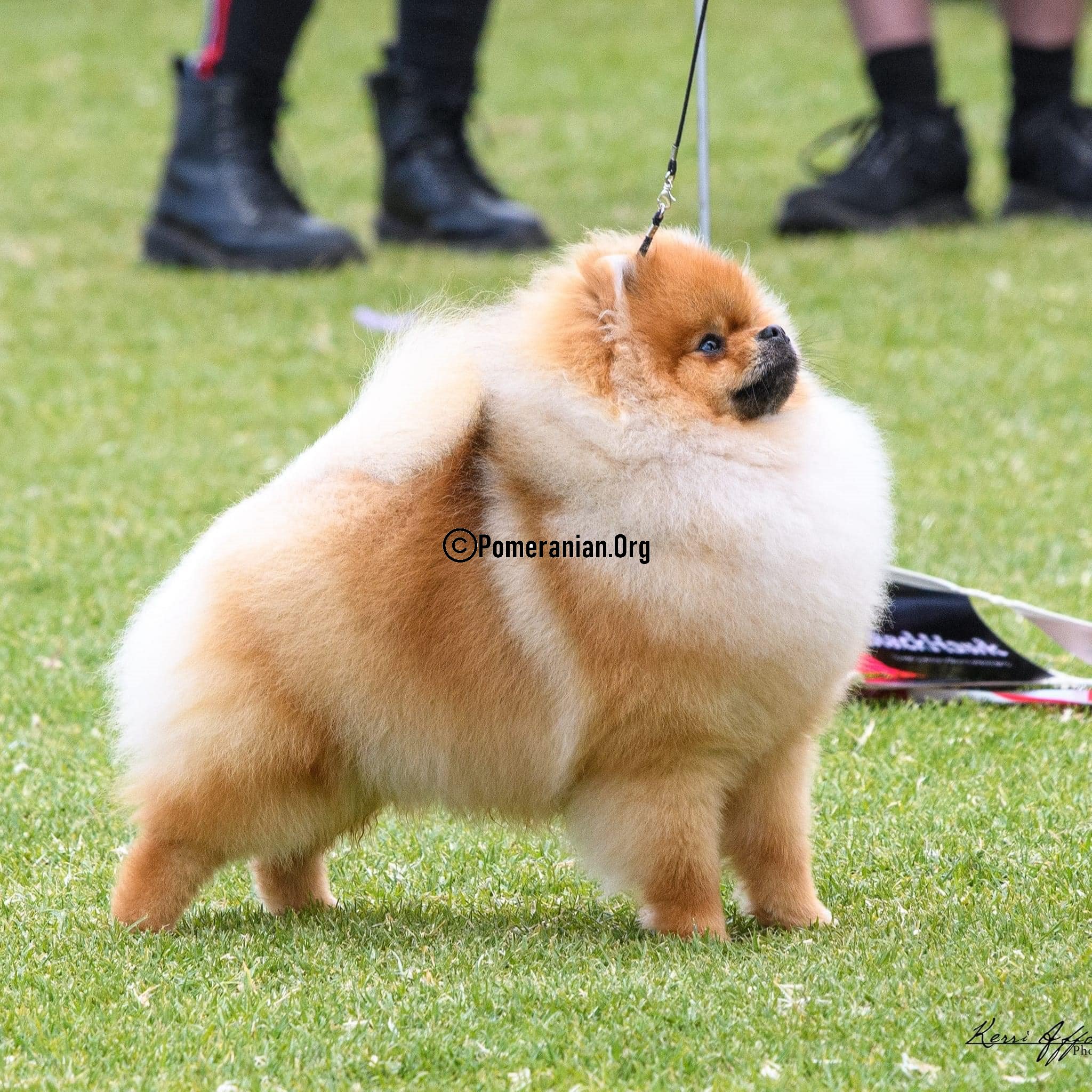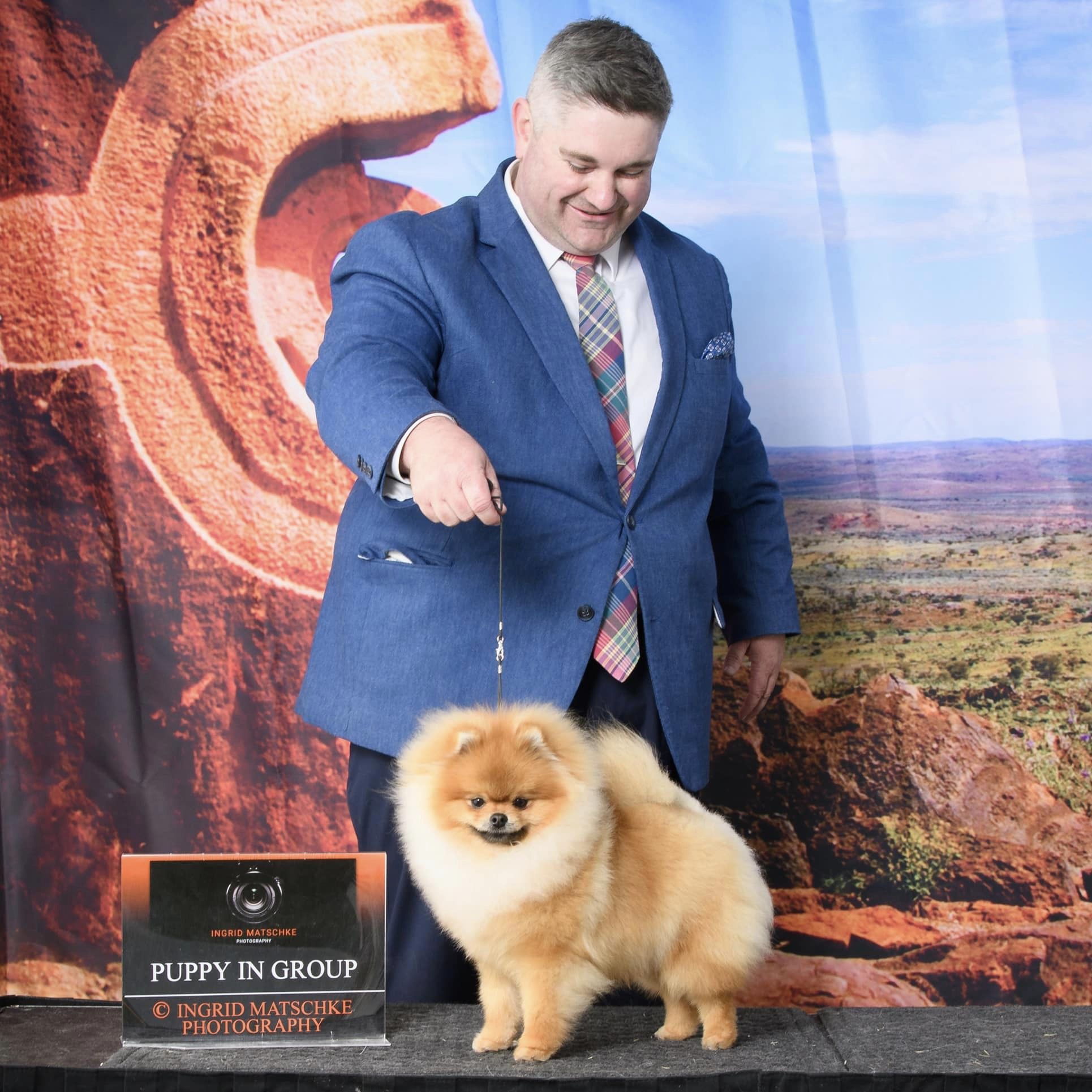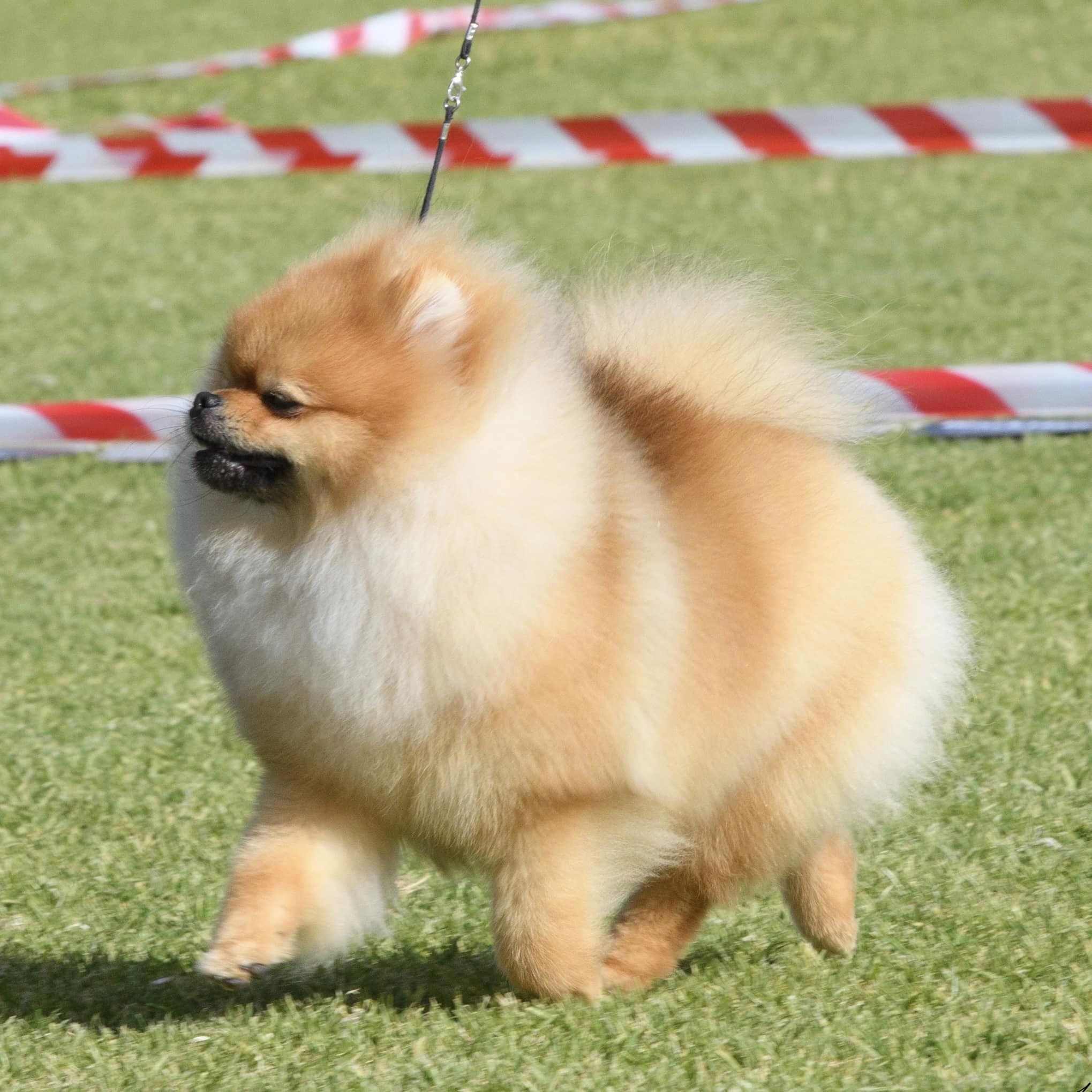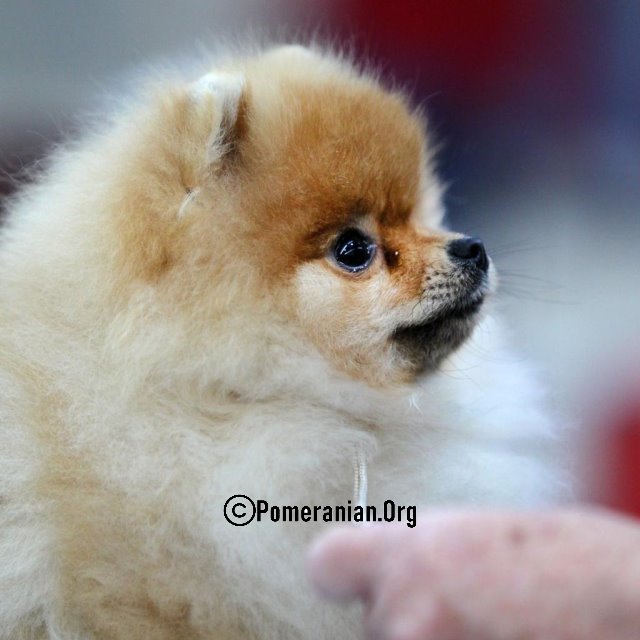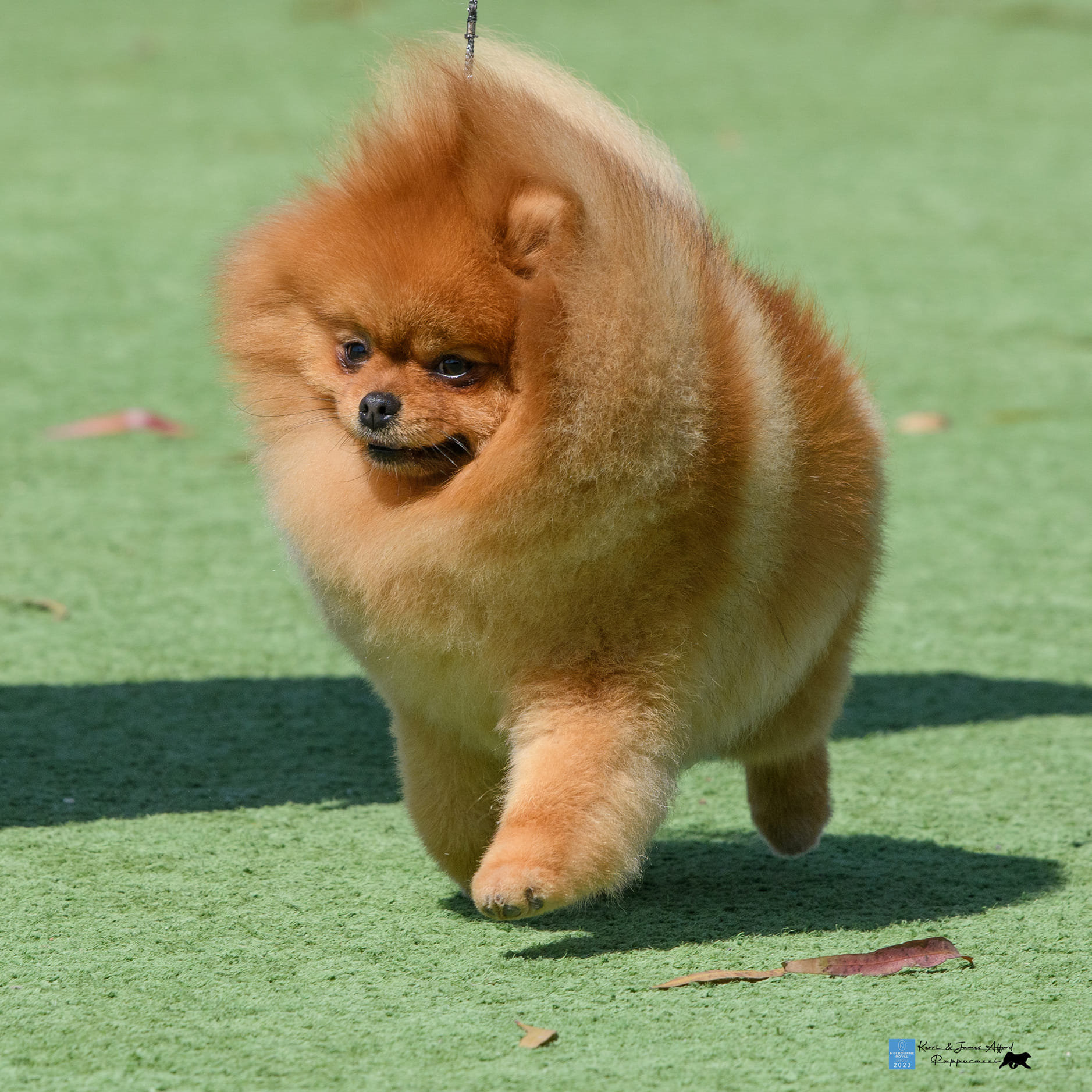

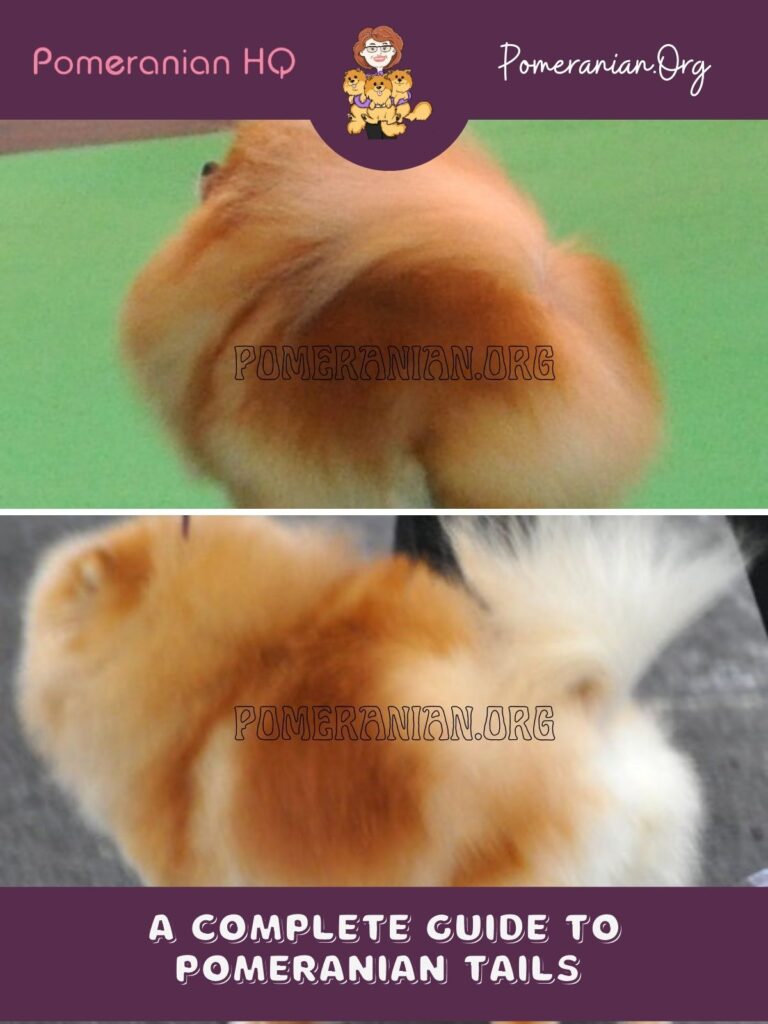
The Pomeranian tail is one of the breed’s most distinctive features. Heavily plumed and set high, the correct Pomeranian dog tail turns over the back and is carried flat and straight, with its long hair spreading across the back like a fan.
Although people commonly describe the Pomeranian tail shape as curled, a correct tail should not form a tight curl like the tail of some other Spitz breeds. The way the tail is set and carried contributes greatly to the Pomeranian’s compact outline and characteristic appearance.
This guide is written by Denise Leo, Pomeranian specialist, published author, judge, breeder and exhibitor with over 50 years of experience. Drawing on decades of studying, breeding and assessing Pomeranians, Denise explains the correct Pomeranian tail shape, why Pomeranian tails turn over the back, what it means when a Pomeranian’s tail is down and how to care for its beautiful plume.
Pomeranian Tail Quick Facts
- The correct Pomeranian tail is heavily plumed and set high.
- It turns over the back and is carried flat and straight.
- The long tail hair spreads across the back in a fan shape.
- A Pomeranian tail should not form a tight or corkscrew curl.
- A tail that suddenly hangs down may indicate fear, discomfort, pain or injury.
What Does a Pomeranian Tail Look Like?
The correct Pomeranian tail is set high and turns over the back from its root. It should lie flat and straight along the back rather than forming a tight curl or hanging loosely to one side.
Long, harsh, straight hair covers the tail and spreads across the back to create a full, fan-shaped plume. In a mature, well-coated Pomeranian, some of this tail hair may extend towards the dog’s head and help create the breed’s compact, rounded outline.
Three features determine the appearance of a Pomeranian dog’s tail:
- Tail set: The position where the tail joins the body should be high.
- Tail carriage: The tail should turn over and lie flat along the back.
- Tail plume: The long, abundant hair should spread attractively across the back.
The tail-bone and the surrounding hair are not the same thing. The underlying tail determines its set and carriage, while the profuse coat creates the beautiful Pomeranian plume seen from the outside.
What Is the Correct Pomeranian Tail Shape?
The correct Pomeranian tail shape begins with a high tail set. From the root, the tail turns upwards and forwards before lying flat and straight along the back. The tail should help complete the dog’s compact outline without appearing low-set, twisted or tightly curled.
Breed standards describe the Pomeranian tail slightly differently, but they agree on its essential features:
- The Australian and UK standards describe a high-set tail that turns over the back, lies flat and straight, and is covered with long, harsh, spreading hair.
- The American Kennel Club standard describes the tail as heavily plumed, set high and lying flat and straight on the back. A low tail set is considered a major fault.
- The FCI standard states that the tail is set high, turns forward over the back and lies firmly against it. A double curl at the tip is tolerated.
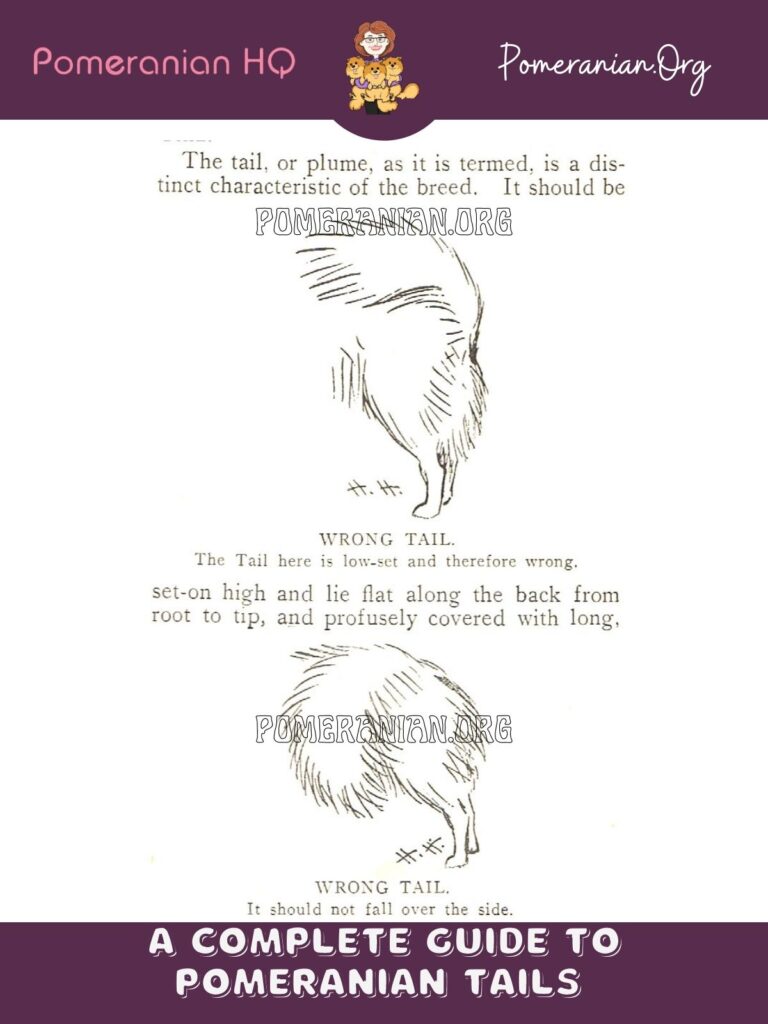
A tail that falls to one side may be caused by the way the tail is set or turned at its root. The plume can sometimes disguise this, particularly on a heavily coated Pomeranian, which is why experienced breeders and judges assess both the visible tail carriage and the structure beneath the coat.
Correct Pomeranian tail carriage contributes significantly to breed type. A low-set or poorly carried tail can lengthen the dog’s appearance and spoil the compact outline required in a quality Pomeranian.
Tail – heavily plumed, set high and lies flat and straight on the back. Major Fault – Low tail set.
American Kennel Club Pomeranian Breed Standard
Tail:
The Pomeranian Club UK Pomeranian Breed Standard
Characteristic of breed, high set, turned over back and carried flat and straight, profusely covered with long, harsh, spreading hair.
Tail: The tail is set on high and of medium length. It reaches
FCI : German Toy Spitz / Pomeranian Breed Standard
upwards and rolls forward over the back, straight from the root. It lies firmly over the back and is covered with very bushy hair. A double curl at tip of tail is tolerated.
Why Do Pomeranian Tails Curl Over Their Backs?
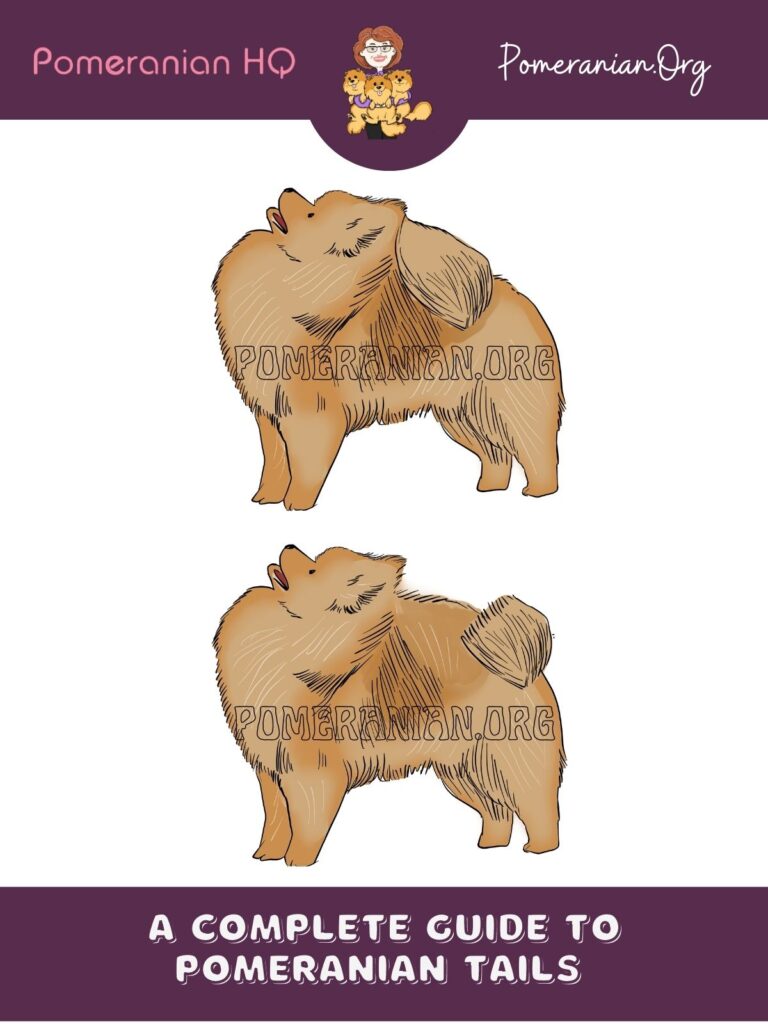
Pomeranian tails turn over their backs because the breed inherited this characteristic tail carriage from its Spitz ancestors. A high-set tail carried over the back is a familiar feature among many Spitz breeds and has been maintained through generations of selective breeding.
People commonly refer to this as a Pomeranian tail curl. However, the correct Pomeranian tail does not form a tight spiral or corkscrew. It rises from a high-set root, turns forward and lies flat along the back.
A dog’s tail is a flexible continuation of its spine, consisting of small vertebrae surrounded by muscles, tendons, ligaments and nerves. Together, these structures allow the Pomeranian to lift, lower and move its tail while retaining the breed’s characteristic carriage.
The abundant plume makes the curve appear more pronounced than it may be beneath the coat. When the long Pomeranian tail hair spreads across the back, it creates the full, fan-shaped appearance associated with the breed.
That distinction is important. The tail lying flat and straight along the back is a characteristic feature of the Pomeranian breed, not merely a general Spitz curl.
Replace the previous section with:
Why Do Pomeranian Tails Curl Over Their Backs?
Pomeranian tails turn over their backs because this carriage was inherited from the breed’s Spitz ancestors and preserved through generations of selective breeding. However, the correct Pomeranian tail is different from the tightly curled tails seen in many other Spitz breeds.
The tail is described in the Pomeranian breed standard as a characteristic of the breed. The Pomeranian is the only dog breed whose standard requires the tail to turn over and lie flat and straight along the back. This distinctive tail carriage is an essential part of correct Pomeranian breed type.
Although people commonly search for the term Pomeranian tail curl, the tail should not form a tight spiral or corkscrew. It rises from a high-set root, turns forward and lies firmly along the back. The long, abundant tail hair then spreads across the back to create a full, fan-shaped plume.
Correct Pomeranian tail set and carriage contribute significantly to the breed’s compact, rounded outline. A low-set, twisted or tightly curled tail changes this outline and does not create the distinctive appearance required by the Pomeranian breed standard.
When Do Pomeranian Puppies’ Tails Go Over Their Backs?
Pomeranian puppies are born with their tails hanging naturally behind them. As a puppy grows and gains strength, the tail gradually begins to lift and turn forward over the back.
Many Pomeranian puppies start carrying their tails over their backs at approximately three to four weeks of age. By five to six weeks, the characteristic Pomeranian tail shape is usually becoming much more apparent. However, development varies, and some puppies take longer to establish consistent tail carriage.
A young puppy may temporarily lower its tail when sleeping, feeling tired, exploring an unfamiliar place or reacting to something frightening. The tail should normally return over the back when the puppy feels relaxed, confident and alert.
If an older puppy persistently carries its tail down, appears unable to lift it or shows signs of pain when the tail is touched, veterinary examination is advisable. The tail should never be forced, pulled or manually curled into position.
What Dog Breeds Carry Their Tails Up Over The Back?
These dog breeds carry their tails over the back:
- Akita
- Shiba Inu
- Samoyed
- Pug
- Alaskan Malamute
- American Eskimo
- Norwegian Elkhound
- Keeshond
- Chow Chow
- Basenji
- German Spitz
- Finnish Spitz
- Siberian Husky
- Icelandic Sheepdog
- Swedish Lapphund

We will retain “What Dog Breeds Carry Their Tails Up Over the Back?” and improve the surrounding sections without repeating its information.
Why Is My Pomeranian’s Tail Down?
A Pomeranian tail may temporarily hang down because the dog is tired, frightened, uncertain or uncomfortable in its surroundings. When the dog feels relaxed and confident again, the tail will usually return to its normal position over the back.
Even a Pomeranian with a correctly set tail may drop it occasionally. This is particularly noticeable at dog shows, during travel or when the dog enters an unfamiliar environment. Temporary low tail carriage caused by emotion does not necessarily indicate an incorrect Pomeranian tail set.
Other possible reasons for a Pomeranian’s tail being down include:
- Tiredness or overexertion
- Fear, anxiety or stress
- Pain or injury affecting the tail
- Discomfort around the lower back or hindquarters
- Anal gland discomfort
- Prolonged confinement
- Illness or general weakness
A tail that suddenly becomes limp, painful or impossible for the dog to lift requires veterinary attention. Contact your veterinarian if the lowered tail persists or is accompanied by swelling, crying, difficulty sitting, reluctance to move or any other sign of pain.
Why Is My Pomeranian Not Wagging Its Tail?
A Pomeranian may stop wagging its tail when it is frightened, tired, stressed or feeling unwell. Some Pomeranians also wag their tails less when resting or concentrating, so a temporary absence of wagging is not always a cause for concern.
Consider the dog’s complete body language rather than the tail alone. Ear position, facial expression, posture, movement and behaviour can provide further clues about how the Pomeranian is feeling.
Possible reasons a Pomeranian may not wag its tail include:
- Fear or anxiety
- Tiredness after physical activity
- Pain or injury involving the tail
- Lower back or hindquarter discomfort
- Anal gland problems
- Illness or weakness
- A strained tail muscle
- Stress caused by a change in surroundings or routine
Seek veterinary advice if your Pomeranian suddenly stops wagging its tail and the change continues, particularly if the tail hangs limply or the dog appears painful. Do not pull, bend or repeatedly lift the tail to test it, as this could worsen an injury.
Why Is My Pomeranian’s Tail Limp?
A limp Pomeranian tail may result from pain, injury or strain affecting the muscles and tissues around the base of the tail. One possible cause is limber tail, a temporary and painful condition in which the dog suddenly has difficulty lifting or wagging its tail.
Limber tail can occur after:
- Unusually strenuous exercise
- Swimming, particularly in cold water
- Exposure to very cold or wet conditions
- Prolonged confinement
- Overuse of the tail muscles
A dog with limber tail may carry the tail down from its base, avoid wagging it or appear uncomfortable when sitting or lying down. However, these signs can also be caused by a fracture, spinal pain, anal gland problems or another medical condition.
A veterinarian should examine any Pomeranian whose tail suddenly becomes limp or painful. Do not attempt to massage, straighten or reposition the tail before the cause has been identified. Veterinary attention is especially important if there is swelling, an obvious injury, difficulty walking or severe pain.
Keep your existing “What Dog Breeds Carry Their Tails Up Over the Back?” section after the grooming section. Then add:
Can Pomeranians Feel Pain in Their Tails?
Yes, Pomeranians can feel pain in their tails. A dog’s tail is a flexible continuation of the spine and contains small vertebrae, muscles, tendons, ligaments, blood vessels and nerves.
Tail pain may be caused by:
- Pulling, twisting or bending the tail
- A fall or other physical injury
- Rough play with another dog
- A sprain or muscle strain
- A fracture or dislocation
- A bite, wound or skin infection
- Severe matting that pulls against the skin
- Discomfort affecting the lower back or anal glands
Signs of Pomeranian tail pain can include crying when touched, reluctance to sit, a tail held down, reduced wagging, swelling or repeatedly licking the affected area.
Never lift or restrain a Pomeranian by its tail. If the tail suddenly changes position or appears painful, avoid manipulating it and arrange a veterinary examination. Prompt treatment is especially important when there is swelling, bleeding, loss of movement or an obvious injury.
Why Does My Pomeranian Have a Tail Without Hair?
A Pomeranian tail without hair is not a normal tail characteristic, although the plume can temporarily appear thinner during a coat change. The cause may be as simple as damaged or matted hair, but persistent thinning or baldness requires closer investigation.
Possible causes of Pomeranian tail hair loss include:
- Normal puppy coat development
- Seasonal or hormonal shedding
- Hair breakage caused by mats or incorrect grooming
- Repeated rubbing or friction
- Fleas, mites or other parasites
- Allergies or skin infections
- Excessive licking, biting or chewing
- Hormonal disorders
- Alopecia X
Examine the skin for redness, scales, sores, darkening, odour or signs that the dog is chewing the area. A Pomeranian that is losing hair from the tail and other parts of the body should be examined by a veterinarian so the underlying cause can be identified.
If the hair loss is symmetrical, does not appear itchy and is accompanied by darkening skin, read our detailed guide to Pomeranian Alopecia X. This condition is covered separately to avoid repeating the same information here.
How Do You Groom a Pomeranian Tail?
A Pomeranian tail should be groomed carefully because its long plume can tangle, mat and break easily. Regular grooming helps protect the ends of the tail hair, encourages healthy coat growth and preserves the full, fan-shaped appearance of the plume.
Apply a very small amount of lightweight grooming oil through the tail coat each day, concentrating particularly on the dry ends. The oil helps condition the hair and protect it from friction, splitting and breakage. Use only a light application, as too much oil can make the coat heavy and greasy.
To groom a Pomeranian tail correctly:
- Support the tail gently without pulling or bending it.
- Apply a small amount of light grooming oil through the plume and its ends.
- Divide the tail hair into small sections.
- Begin brushing at the ends and work gradually towards the base.
- Use a quality pin brush to separate and smooth the long hair.
- Check carefully with a wide-toothed metal comb for remaining tangles.
- Pay particular attention to the underside and base of the tail, where mats can form.
- Keep the hair around the rear clean and completely dry.
Daily gentle brushing distributes the light oil through the tail, stimulates the skin and removes tangles before they damage the hair. Protecting the ends is particularly important because broken tail hair can take considerable time to regain its former length.
Never drag a brush through a knot. Apply additional conditioner or grooming oil and gently separate the tangle with your fingers before using a comb. Do not shave the Pomeranian’s tail to make grooming easier, as regrowth can be slow and unpredictable.
Pomeranian Tail FAQs
What Is the Correct Pomeranian Tail Shape?
The correct Pomeranian tail is heavily plumed, set high, turned over the back and carried flat and straight. This distinctive tail carriage is a characteristic of the breed.
Why Do Pomeranian Tails Curl Over Their Backs?
Pomeranians inherited over-the-back tail carriage from their Spitz ancestors. However, a correct Pomeranian tail should lie flat and straight along the back rather than forming a tight curl or ring.
Are Pomeranian Puppies Born With Curled Tails?
No. Pomeranian puppies are born with their tails hanging naturally behind them. Many begin carrying their tails over their backs at approximately three to four weeks of age as they grow stronger.
Is It Normal for a Pomeranian’s Tail to Be Down?
A Pomeranian may temporarily lower its tail when tired, frightened, uncertain or relaxed. A tail that suddenly becomes limp, painful or impossible to lift should be examined by a veterinarian.
Why Does My Pomeranian Have a Tail Without Hair?
A Pomeranian tail without hair may result from coat damage, matting, parasites, allergies, skin infections, hormonal disorders or Alopecia X. Persistent hair loss should be investigated by a veterinarian.
Should Pomeranian Tail Hair Be Curly?
No. Correct Pomeranian tail hair should be long, abundant, harsh in texture and straight. A curly-haired Pomeranian does not have the correct coat texture described in the breed standard.
Can You Put a Pomeranian’s Tail Into a Ponytail?
A tight Pomeranian ponytail is not recommended because elastic bands can pull, break or damage the delicate tail hair. Gentle daily grooming and a light coat oil are safer ways to protect the plume.
Can Pomeranians Feel Pain in Their Tails?
Yes. A Pomeranian tail contains bones, muscles, tendons, ligaments, blood vessels and nerves. Never pull, twist or lift a Pomeranian by its tail.
What Makes the Pomeranian Tail Unique?
The heavily plumed tail, set high and carried flat and straight along the back, is a defining characteristic of the Pomeranian. Correct tail set and carriage contribute greatly to the breed’s distinctive outline.
Gentle daily grooming, protection of the tail hair and prompt attention to any sudden change will help keep the Pomeranian tail healthy and beautiful.
Copyright Pomeranian.org. All Rights Reserved.
N.B. This article regarding Pomeranian health issues was written in consultation with our resident veterinarian.
Dr. Muqeet Mushtaq
DVM, University of Animal and Veterinary Sciences, 2019
MSc. (Hons.) (Animal Breeding & Genetics), University of Agriculture Faisalabad, 2021
📚 References & Further Reading
- [1] AKC Pomeranian Breed Standard (2011)
- [2] English Kennel Club Breed Standard
- [3] The Pomeranian Handbook – Denise Leo
- [4] Denlinger, The Complete Pomeranian
- [5] Kimbering, 1891–1991
- [6] Taplin, The Sportsman’s Cabinet
- [7] Parker, The Popular Pomeranian
- [8] Ives, Show Pomeranians