
DVM, University of Animal and Veterinary Sciences, 2019
MSc. (Hons.) Animal Breeding & Genetics, University of Agriculture Faisalabad, 2021
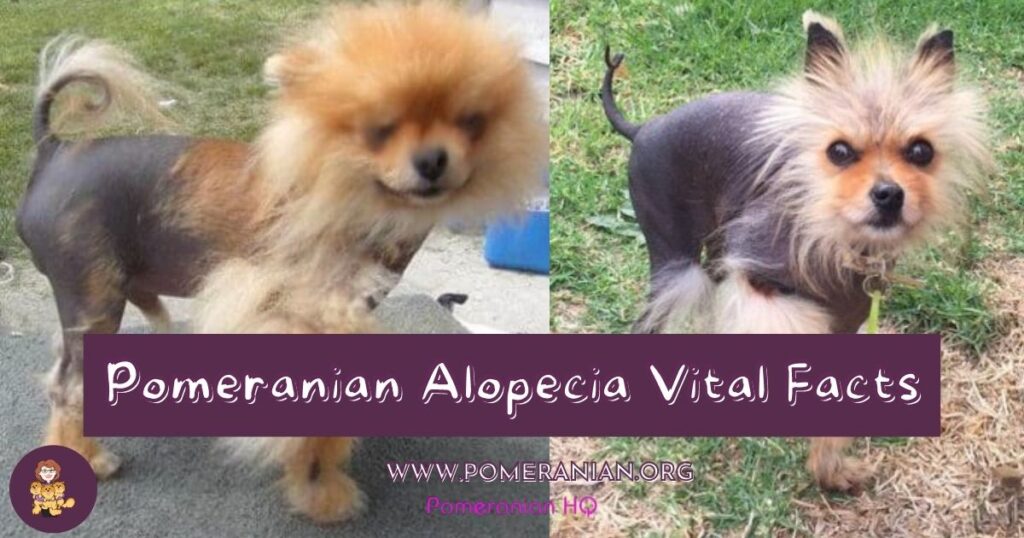
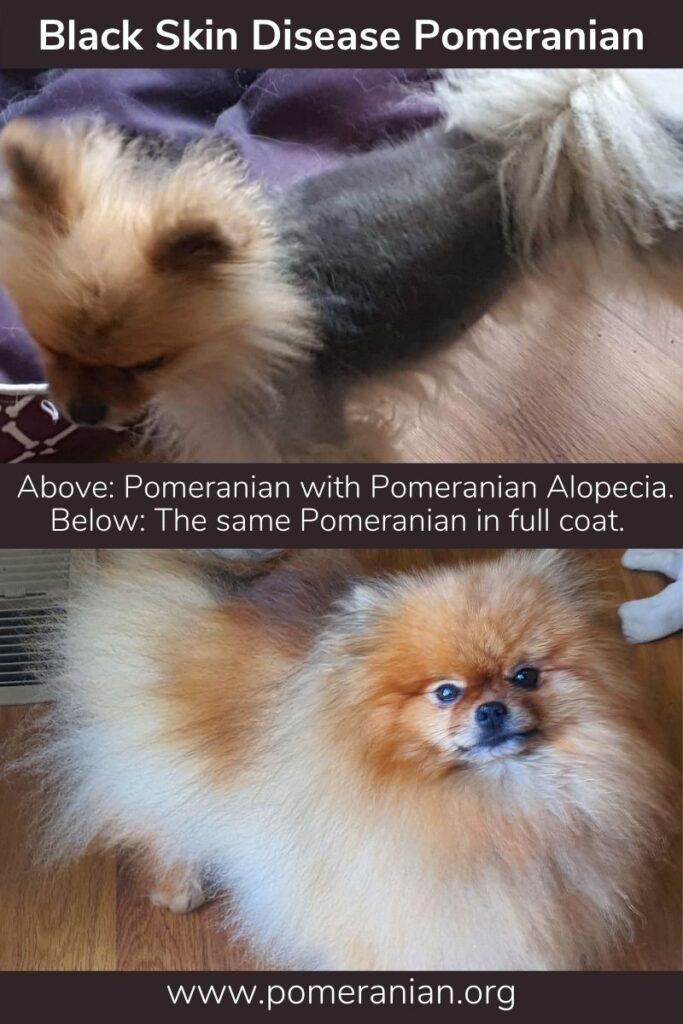
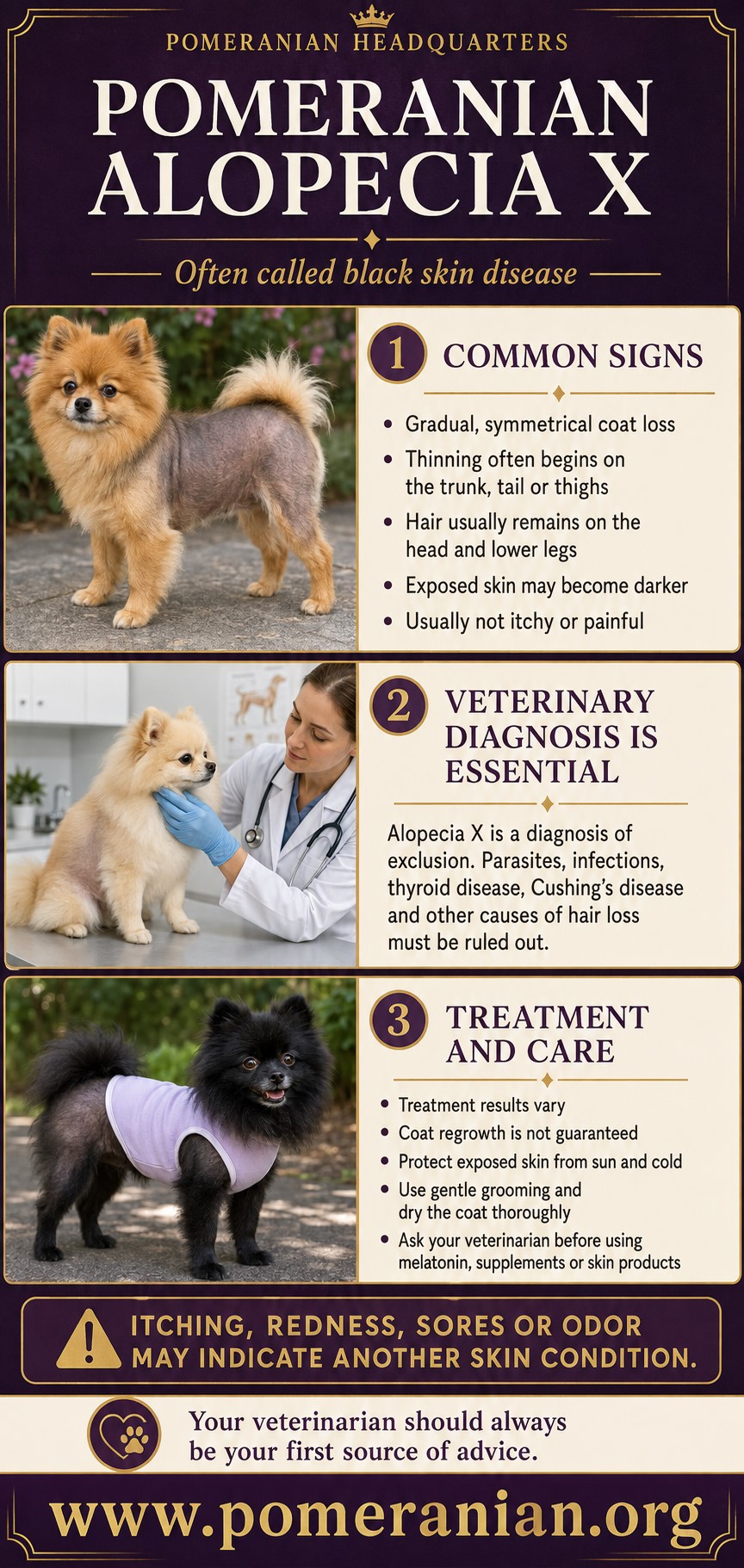
Alopecia X, often called black skin disease in Pomeranians, causes progressive, usually symmetrical coat loss over the body. The exposed skin may gradually become darker, while the coat on the head and lower legs is often retained.
Alopecia X is not diagnosed by appearance alone. Many other conditions—including parasites, skin infections, thyroid disease and Cushing’s disease—can cause similar hair loss. Your veterinarian should therefore be the first person you contact if your Pomeranian’s coat becomes thin, patchy or fails to regrow.
Alopecia X usually does not make an otherwise healthy dog feel unwell and is generally not itchy. However, itching, redness, odor, sores, increased thirst, changes in appetite or lethargy may indicate another medical problem requiring prompt veterinary attention.
Speak to Your Veterinarian First
Alopecia X cannot be diagnosed from coat loss or darkened skin alone. Parasites, skin infections, allergies, thyroid disease, Cushing’s disease and other medical conditions can cause similar symptoms. If your Pomeranian’s coat is thinning, becoming patchy or failing to regrow, arrange a veterinary examination before trying supplements, shampoos or home treatments.
What Is Alopecia X in Pomeranians?
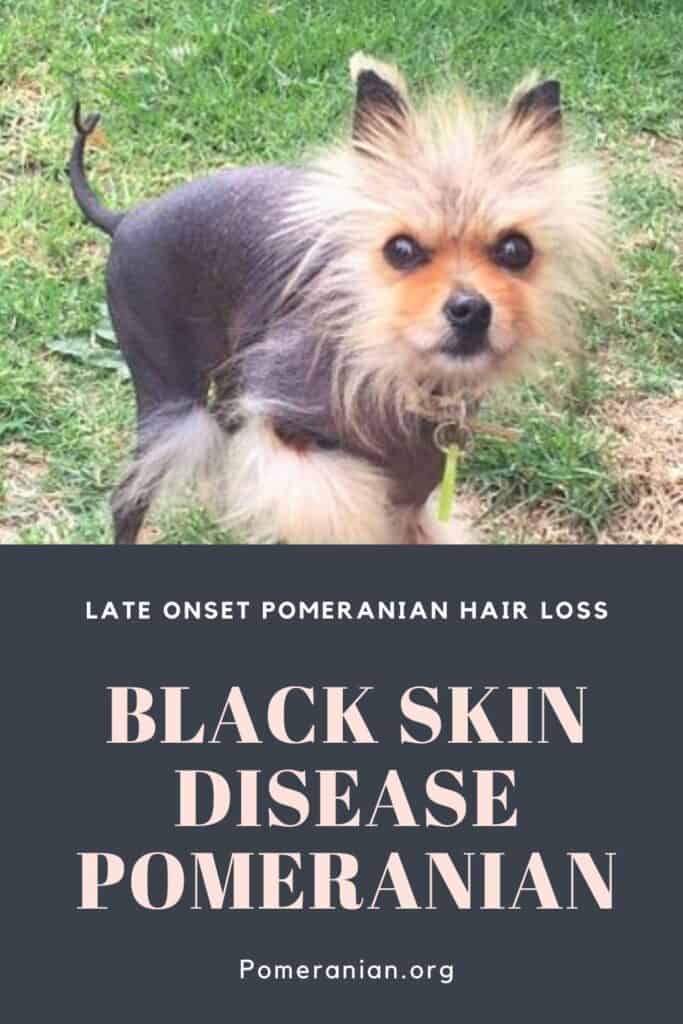
Alopecia X is a coat disorder that interrupts the normal hair-growth cycle. It is commonly called black skin disease because the exposed skin may gradually darken as the coat is lost. However, not every affected Pomeranian develops black skin, and darkened skin alone does not confirm the condition.
The hair loss is usually gradual, symmetrical and non-itchy. It commonly begins around the tail, back of the thighs or trunk before spreading across more of the body. The coat on the head and lower legs is generally retained.
The exact cause remains uncertain, which is why the condition is called Alopecia “X.” Pomeranians and several other Nordic or Spitz-type breeds appear predisposed. Alopecia X is a diagnosis of exclusion, meaning a veterinarian must first rule out other possible causes of coat loss before making the diagnosis.
Signs of Alopecia X in Pomeranians
Alopecia X usually develops gradually. The first change may be a dry, dull or woolly coat that no longer has the normal harsh guard hairs. Some owners initially notice thinning around the tail, backs of the thighs or hindquarters.
Common signs include:
- Gradual, symmetrical hair thinning or loss
- Coat loss over the trunk, neck, tail and backs of the thighs
- Retention of hair on the head and lower legs
- A dry, soft or cotton-like coat
- Failure of the coat to regrow normally after clipping
- Darkening of the exposed skin
- No obvious itching, redness or discomfort
Alopecia X generally affects the dog’s appearance without causing other signs of illness. If your Pomeranian is itchy, develops sores or has red, scaly or odorous skin, another condition or a secondary infection may be present. Changes such as increased thirst, frequent urination, altered appetite, weight changes or lethargy also require veterinary investigation.
When Pomeranian Hair Loss May Be Something Else
Not every Pomeranian with a thinning coat or darkened skin has Alopecia X. Hair loss is a symptom shared by many different conditions, some of which require medical treatment.
Possible causes include:
- Fleas, mites or other parasites
- Bacterial or fungal skin infections
- Allergies and skin inflammation
- Hypothyroidism
- Cushing’s disease
- Nutritional deficiencies
- Color dilution alopecia
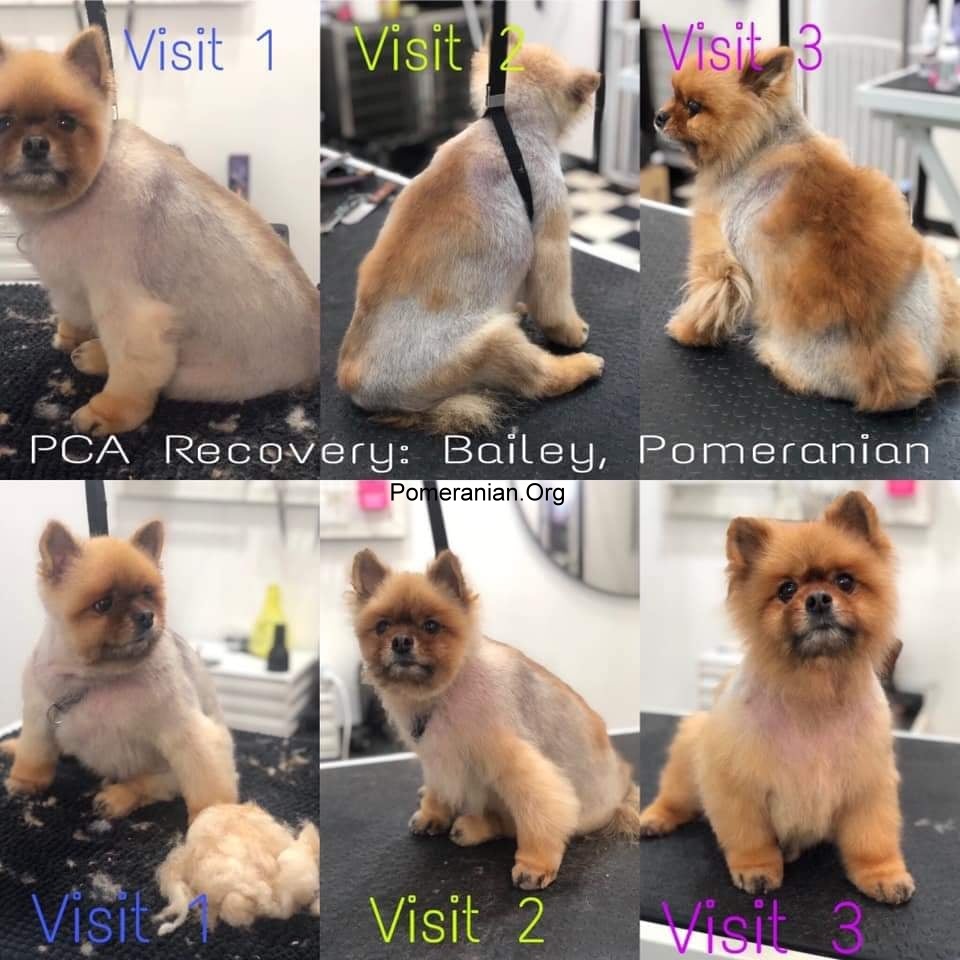
- Post-clipping alopecia
- Seasonal coat changes
- Friction from collars, harnesses or clothing
The pattern of hair loss can provide useful clues, but appearance alone cannot confirm the cause. Itching, redness, odor, sores, excessive licking or broken hairs are not typical signs of uncomplicated Alopecia X and should be investigated.
Arrange a veterinary examination whenever your Pomeranian develops unexplained coat loss. Early assessment can identify treatable conditions and prevent owners from using unsuitable shampoos, supplements or home remedies.
How Is Alopecia X Diagnosed?
There is no single test that can conclusively diagnose Alopecia X. It is a diagnosis of exclusion, which means a veterinarian must assess the dog and rule out other likely causes of hair loss first.
Your veterinarian will examine the pattern of coat loss, the condition of the skin and whether your Pomeranian has itching or other signs of illness. You may also be asked when the hair loss began, how quickly it progressed and whether the coat failed to regrow after clipping.
Depending on your dog’s symptoms, testing may include:
- Skin scrapings or hair examination for parasites
- Tests for bacterial or fungal infections
- Blood and urine tests
- Thyroid testing
- Tests for Cushing’s disease when clinically indicated
- A skin biopsy to examine the hair follicles
A biopsy can support a diagnosis, but its findings are not always unique to Alopecia X. The diagnosis is generally made from the characteristic coat-loss pattern, the dog’s medical history and the exclusion of other diseases. Referral to a veterinary dermatologist may be helpful when the diagnosis remains uncertain.
Veterinary Treatment Options for Alopecia X
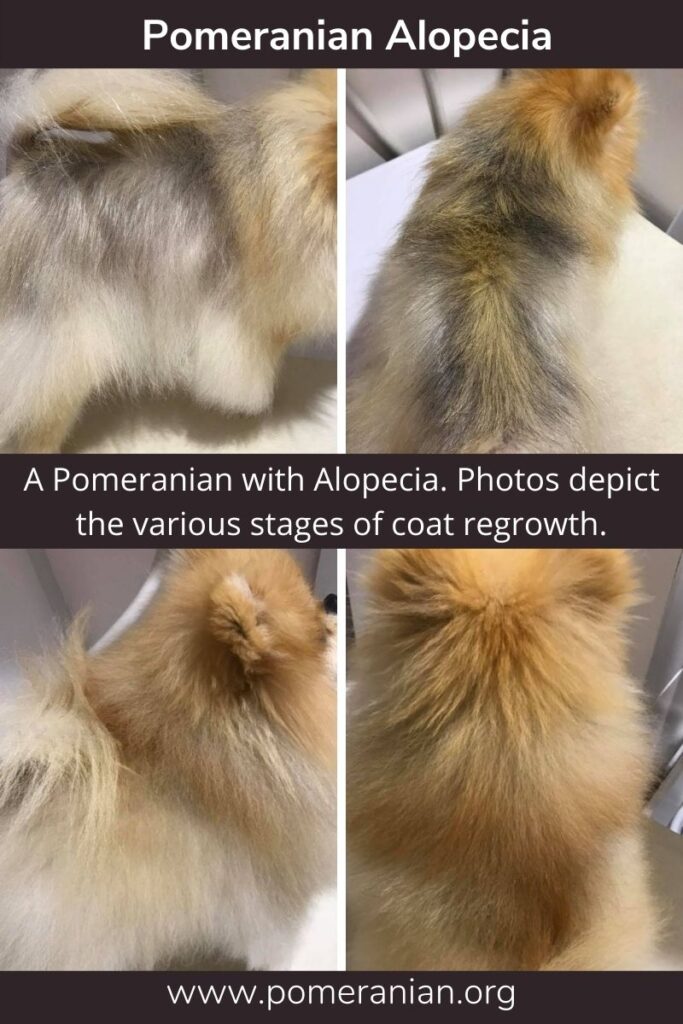
There is currently no treatment guaranteed to restore the coat of every Pomeranian with Alopecia X. Some dogs regrow a substantial amount of hair, others show only limited improvement, and any regrowth may be temporary.
Treatment should be planned with your veterinarian and may include:
- Desexing: Spaying or neutering may stimulate coat regrowth in some entire dogs, although the response is unpredictable.
- Melatonin: Some dogs may respond to veterinarian-supervised melatonin. The correct product and dose must be determined by your veterinarian, as some human products contain xylitol, which is highly toxic to dogs.
- Deslorelin implants: A veterinary specialist may consider this treatment in selected entire male dogs.
- Other specialist therapies: Certain medications or procedures have been investigated, but results are variable and some carry significant risks. These should only be considered under the care of a veterinary dermatologist.
Diet changes, probiotics, oils, frequent bathing and supplements have not been proven to cure Alopecia X. A complete and balanced diet and gentle skin care can support general health, but they should not replace veterinary diagnosis or treatment.
Because Alopecia X is primarily cosmetic and does not usually affect a dog’s general health, the potential benefits of treatment must always be weighed against possible side effects. For many Pomeranians, protecting the exposed skin and maintaining comfort may be safer than pursuing aggressive treatment.
Can a Pomeranian’s Coat Grow Back?
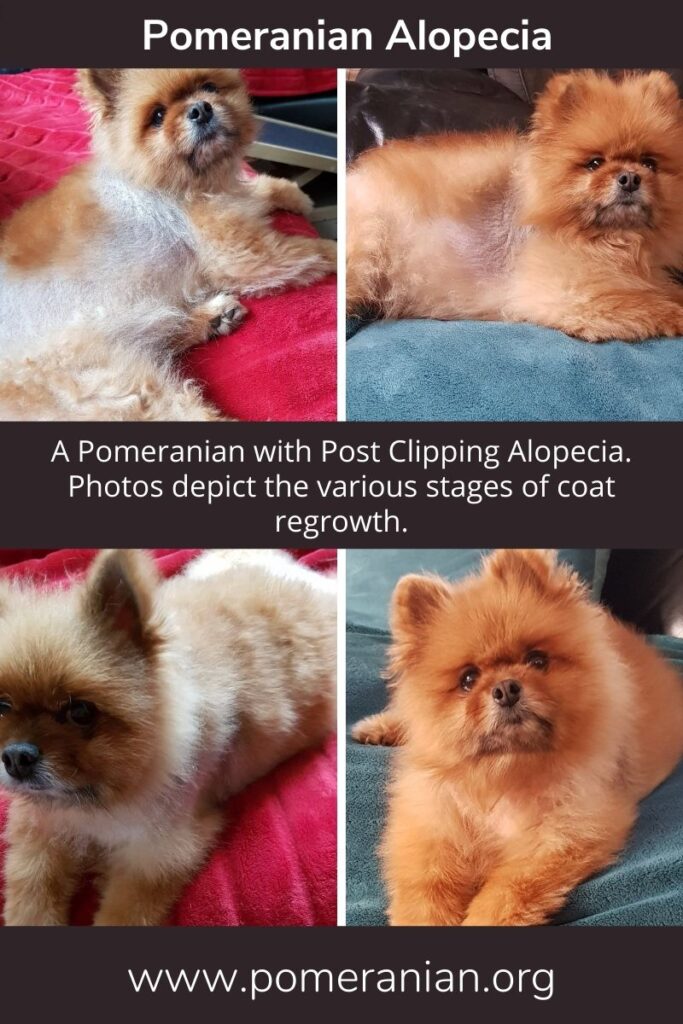
Some Pomeranians with Alopecia X regrow part or all of their coat, but it is impossible to predict which dogs will respond to treatment. Regrowth may take several months and can begin as fine, soft hair before a fuller coat develops.
Even after successful regrowth, the coat may not return to its previous color, texture or density. Some dogs retain their new coat for years, while others experience another episode of hair loss. A treatment that works once may not produce the same result again.
Photographing your Pomeranian every four to six weeks under similar lighting can help you and your veterinarian assess progress. Avoid repeatedly changing treatments, as coat growth is slow and improvements may take time to become visible.
A failure to regrow coat does not mean your Pomeranian cannot enjoy a happy and comfortable life. Alopecia X generally affects appearance rather than overall health, provided the exposed skin is protected, and any secondary problems are treated promptly.
Caring for a Pomeranian With Coat Loss
A Pomeranian with Alopecia X may need additional protection because the exposed skin no longer has a full double coat to shield it from sun, cold and irritation.
Helpful care includes:
- Protect exposed skin from strong sunlight and avoid prolonged outdoor exposure during the hottest part of the day.
- Ask your veterinarian to recommend a dog-safe sunscreen if protection is needed. Do not use human sunscreen without veterinary approval.
- Use soft, lightweight clothing outdoors when appropriate, ensuring it does not rub or overheat the dog.
- Provide a warm coat during cold weather.
- Use gentle bathing products recommended by your veterinarian.
- Dry the skin and remaining coat thoroughly after bathing.
- Check regularly for redness, sores, scaling, odor, or other signs of infection.
- Keep bedding soft, clean and dry.
Avoid vigorous scrubbing, frequent exfoliation, undiluted essential oils and heavily fragranced products. These may irritate exposed skin and will not restart the hair-growth cycle.
Contact your veterinarian if the skin becomes itchy, inflamed, painful, broken, or odorous. These are not typical signs of uncomplicated Alopecia X and may indicate a secondary skin problem.
Bathing, Conditioning and Drying a Pomeranian With Alopecia X
Bathing can help keep exposed skin clean and remove loose coat, but it does not cure Alopecia X or restart the hair-growth cycle. Ask your veterinarian how often your Pomeranian should be bathed and which products are suitable, particularly if the skin is dry, sensitive or affected by a secondary infection.
Use a gentle, dog-formulated shampoo and rinse thoroughly, as residue can cause irritation. Avoid harsh clarifying shampoos, vigorous exfoliation, undiluted essential oils and heavily fragranced products unless your veterinarian has specifically recommended them.
Follow with a moisturizing dog conditioner to support the remaining coat and help reduce dryness, tangles and breakage. Apply it gently without scrubbing the exposed skin, leave it on for the recommended time and rinse well.
Drying the Coat Correctly
A Pomeranian should be dried thoroughly after every bath. Leaving the dense undercoat damp may encourage matting, unpleasant odors and skin irritation.
Use a dog dryer on a comfortable setting, keeping the nozzle moving and safely away from the skin. Direct the airflow through the coat in small sections while gently brushing with a pin brush. This separates the hair, removes loose undercoat and ensures moisture is not trapped close to the skin.
Take extra care over bald or thinly coated areas. Use lower airflow and a cool or comfortably warm temperature because exposed skin can become irritated or overheated easily. Never direct concentrated air into the dog’s eyes, ears, nose or mouth.
A human hair dryer is generally unsuitable because it may become too hot and can burn delicate skin. Stop immediately if your Pomeranian appears uncomfortable, and ask your veterinarian or an experienced Pomeranian groomer to demonstrate safe drying technique if you are uncertain.
I recommend the CHAOLUN Dog Dryer High-Velocity Professional Pet Dog Blow Dryer 3.2HP – Dog Hair Grooming Dryer.
c) Specialty Conditioner
It’s normal for shampoos designed to restore the health of his coat and skin to be extremely luxurious, and you might assume he won’t need a conditioner.
However, regardless of the products you use to wash your dog, hair cuticles can open so a great conditioner will help smooth them again because it’s essential to keep all remaining fur in great shape.
I recommend DERMagic Peppermint & Tea Tree Oil Shampoo & Conditioner 12 fl. oz.
I recommend a matching conditioner DERMagic Peppermint & Tea Tree Oil Shampoo & Conditioner 12 fl. oz.

Diet and Nutrition for a Pomeranian With Alopecia X
No particular food, raw diet or supplement has been proven to cure Alopecia X. However, a complete and balanced diet is important for maintaining healthy skin and supporting the growth of any coat your Pomeranian can produce.
Choose a good-quality food appropriate for your dog’s age, weight and health. Protein, essential fatty acids, vitamins and minerals all contribute to normal skin and coat condition. Nutritional deficiencies or an unbalanced diet can worsen coat quality, even when they are not the original cause of hair loss.
Home-cooked food should not simply replace commercial dog food unless the recipe has been formulated by a board-certified veterinary nutritionist. Meat, vegetables and supplements combined without professional guidance may still be deficient in calcium, essential fatty acids, trace minerals or other important nutrients. Raw diets also carry nutritional and food-safety risks and are not a recognized treatment for Alopecia X.
Omega-3 fatty acids may support general skin health, but they do not cure the condition. Ask your veterinarian whether fish oil is appropriate and what dose your individual dog requires. Excessive supplementation can cause digestive upset, add unnecessary calories and interact with certain medications.
A food allergy is more likely to cause itching, redness or recurrent skin and ear infections than the typical non-itchy, symmetrical hair loss associated with Alopecia X. If your veterinarian suspects a food reaction, they may recommend a properly controlled elimination diet rather than frequent changes between different foods.
Fresh water, a healthy body weight and consistent, balanced nutrition are more valuable than repeatedly changing diets or adding numerous supplements. Any dietary treatment should form part of a veterinarian-guided plan after other causes of coat loss have been investigated.
Should a Pomeranian With Alopecia X Be Bred?
A Pomeranian diagnosed with Alopecia X should not be used for breeding. Although the exact cause has not been established, breed predisposition and the occurrence of the condition within related dogs suggest that inherited factors may be involved.
Because Alopecia X may not become apparent until after a dog reaches maturity, an affected Pomeranian could already have produced puppies before coat loss begins. Breeders should therefore keep detailed health records and consider the coat history of parents, siblings and offspring when making future breeding decisions.
As a preservation breeder with more than 50 years of experience, I believe breeding decisions must consider long-term health as well as appearance, temperament and breed type. Removing affected dogs from breeding programs is the responsible approach while the inheritance of Alopecia X remains uncertain.
Frequently Asked Questions About Pomeranian Alopecia X
Is Alopecia X painful or itchy?
Alopecia X is generally not painful or itchy, and affected dogs are usually otherwise healthy. Itching, redness, sores, odor or discomfort may indicate another skin condition or a secondary infection and should be examined by a veterinarian.
Why is it called black skin disease?
The name refers to the darkening, or hyperpigmentation, that may develop where the coat has been lost. Not every affected Pomeranian develops black skin, and darkened skin alone does not confirm Alopecia X.
Is Alopecia X contagious?
No. Alopecia X cannot be passed to people or other animals through contact.
Can Alopecia X be cured?
There is no guaranteed cure. Some Pomeranians experience coat regrowth following veterinary treatment, while others do not respond. Any regrowth may also be temporary.
Does shaving cause Alopecia X?
Shaving does not necessarily cause Alopecia X, but some double-coated dogs experience delayed or incomplete coat regrowth after clipping. Avoid shaving a Pomeranian unless it is medically necessary.
Can diet cure black skin disease?
No particular food, raw diet or supplement has been proven to cure Alopecia X. Feed your Pomeranian a complete and balanced diet and discuss dietary changes or supplements with your veterinarian.
Can I give my Pomeranian melatonin?
Only under veterinary direction. Your veterinarian must determine whether melatonin is appropriate and recommend a suitable product and dose. Some human products contain xylitol, which is highly toxic to dogs.
Should I bathe my Pomeranian more frequently?
Bathing frequency depends on your dog’s skin and any other medical conditions. Excessive bathing or harsh products may cause irritation, so follow the routine recommended by your veterinarian.
Will my Pomeranian’s coat grow back?
Some Pomeranians regrow a partial or complete coat, while others remain thinly coated. Improvement may take several months, and regrown hair can later be lost again.
Final Thoughts on Pomeranian Alopecia X
Alopecia X can be distressing for owners, but affected Pomeranians can still live happy, comfortable lives. Because many medical conditions can cause similar coat loss, your veterinarian should always be your first source of advice.
With more than 50 years of breeding and caring for Pomeranians, I understand how concerning coat loss can be. Protect your dog’s exposed skin, provide gentle grooming and balanced nutrition, and follow a veterinarian-guided treatment plan. Coat regrowth is never guaranteed, but your Pomeranian’s comfort, health and quality of life are what matter most.
⚠ Veterinary Disclaimer
The information provided in this article is intended for educational and general informational purposes only and is not a substitute for professional veterinary advice, diagnosis, or treatment.
Always seek the advice of your veterinarian or another qualified animal health professional with any questions you may have regarding your dog’s health or medical condition.
Never ignore professional veterinary advice or delay seeking treatment because of something you have read on this or any other website.
If your Pomeranian is showing signs of illness, discomfort, skin irritation, or an adverse reaction to medication or treatment, contact your veterinarian promptly.
Copyright Pomeranian.Org. All Rights Reserved.
References and Further Reading:
Denise Leo, The Pomeranian Handbook.