
Have you come across the term “Throwback Pomeranian” and wondered what it actually means? You’re not alone. It’s one of the most misunderstood phrases in the Pomeranian world, often misused by breeders and advertisers to describe any large Pomeranian puppy.
The truth is that a Throwback Pomeranian is still a purebred Pomeranian—but not every oversized Pomeranian is a genuine throwback. Many larger dogs are simply the result of breeding programs that have not consistently selected for the correct size and type described in the Pomeranian Breed Standard.
Today’s Pomeranian is a descendant of much larger Spitz-type dogs that lived hundreds of years ago. Through generations of careful, selective breeding, the breed was gradually reduced in size to become the lively toy companion we know today. Although those larger ancestors are part of the Pomeranian’s history, responsible preservation breeders continue to breed toward the official breed standard rather than the larger dogs of the past.
As a Pomeranian breeder, exhibitor, and ANKC Specialist Breed Judge with more than 50 years of experience, I have seen countless oversized Pomeranians described as “throwbacks,” when that label is often misleading. Understanding the difference is important for anyone considering buying a Pomeranian puppy.
In this comprehensive guide, you’ll learn:
- 🐾 What a Throwback Pomeranian really is.
- 🐾 Why do some Pomeranians grow much larger than expected?
- 🐾 The history behind the breed’s larger ancestors.
- 🐾 Common myths about throwback Pomeranians.
- 🐾 Whether a Throwback Pomeranian is right for you.
- 🐾 How responsible breeders work to preserve the correct size and type of the Pomeranian.
Whether you’re researching the breed, planning to buy a puppy, or simply curious about oversized Pomeranians, this guide will help you separate fact from fiction.
🐾 Quick Answer: What Is a Throwback Pomeranian?
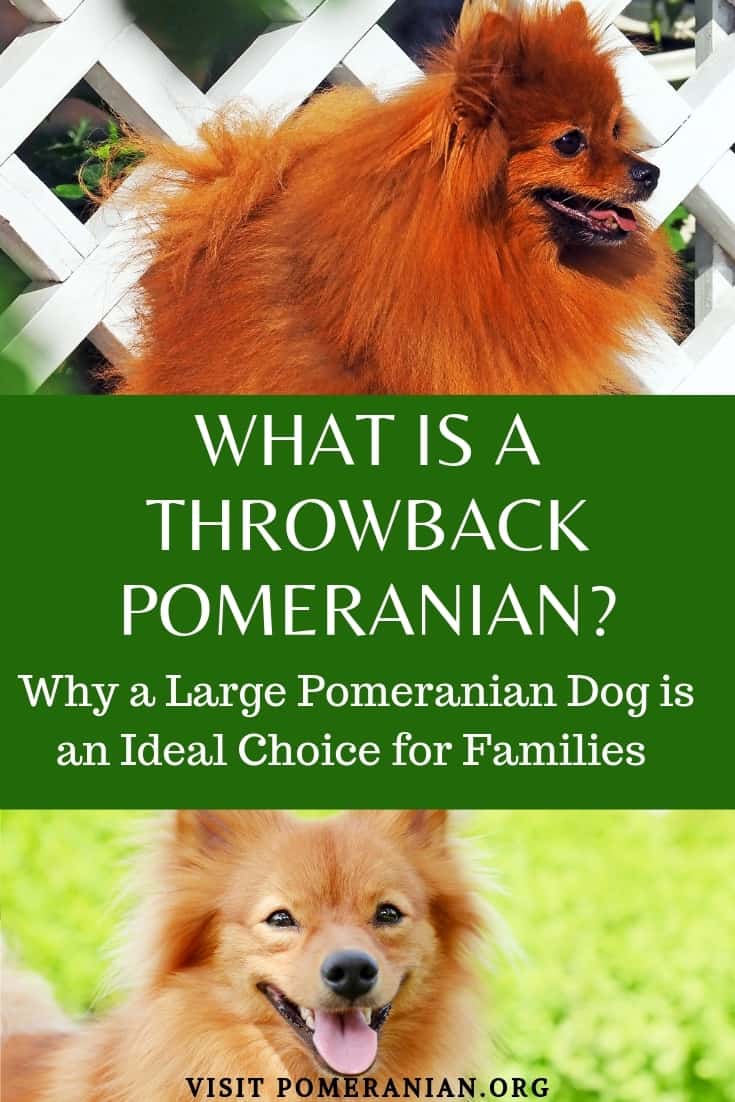
A Throwback Pomeranian is a purebred Pomeranian that grows significantly larger than the size described in the Pomeranian Breed Standard. Although these dogs are still purebred Pomeranians, they do not conform to the breed’s ideal size and type.
The term “Throwback Pomeranian” is a modern description used to refer to larger Pomeranians that more closely resemble the breed’s distant Spitz ancestors. Centuries ago, the ancestors of today’s Pomeranian were much larger working dogs, often weighing around 30 pounds (13–14 kg), before generations of selective breeding produced the small companion breed we know today. These early Spitz dogs share common ancestry with breeds such as the Siberian Husky, American Eskimo Dog, German Spitz, and other northern Spitz breeds.
Today, oversized Pomeranians are far more commonly seen from breeders who are not carefully breeding to the Pomeranian Breed Standard, including many backyard breeders and commercial breeding operations. Responsible preservation breeders carefully select breeding stock for correct size, soundness, temperament, and breed type, making true oversized Pomeranians far less common in well-planned breeding programs.
💡 Important to Know
A large Pomeranian is not automatically a “throwback.” Many oversized dogs advertised as throwbacks are simply Pomeranians that have not been selectively bred to conform to the breed standard.
The term “Throwback Pomeranian” is frequently used as a marketing term and is often misunderstood. Size alone does not determine whether a dog is a genuine throwback.
If your goal is to own a Pomeranian that closely reflects the official breed standard or to compete in conformation shows, purchasing a puppy from a reputable preservation breeder gives you the best opportunity of obtaining the correct size, structure, coat, movement, and breed type.
🐾 Throwback Pomeranian: Important Facts
The term “Throwback Pomeranian” is commonly used to describe a Pomeranian that grows much larger than the size set out in the official Pomeranian Breed Standard. However, the term is often misunderstood and sometimes used incorrectly in advertising.
Important: Not every large Pomeranian is a true throwback. Some oversized Pomeranians are purebred dogs that do not meet the breed standard, while others may be mixed breed dogs being marketed as “throwbacks.”
Oversized Pomeranians are most commonly seen where breeders are not consistently breeding to the blueprint of the breed — the Pomeranian Breed Standard. This includes many backyard breeders, puppy farms, and breeders who produce puppies without carefully selecting for correct size, structure, coat, movement, and type.
How Throwback or Oversized Pomeranians Often Differ
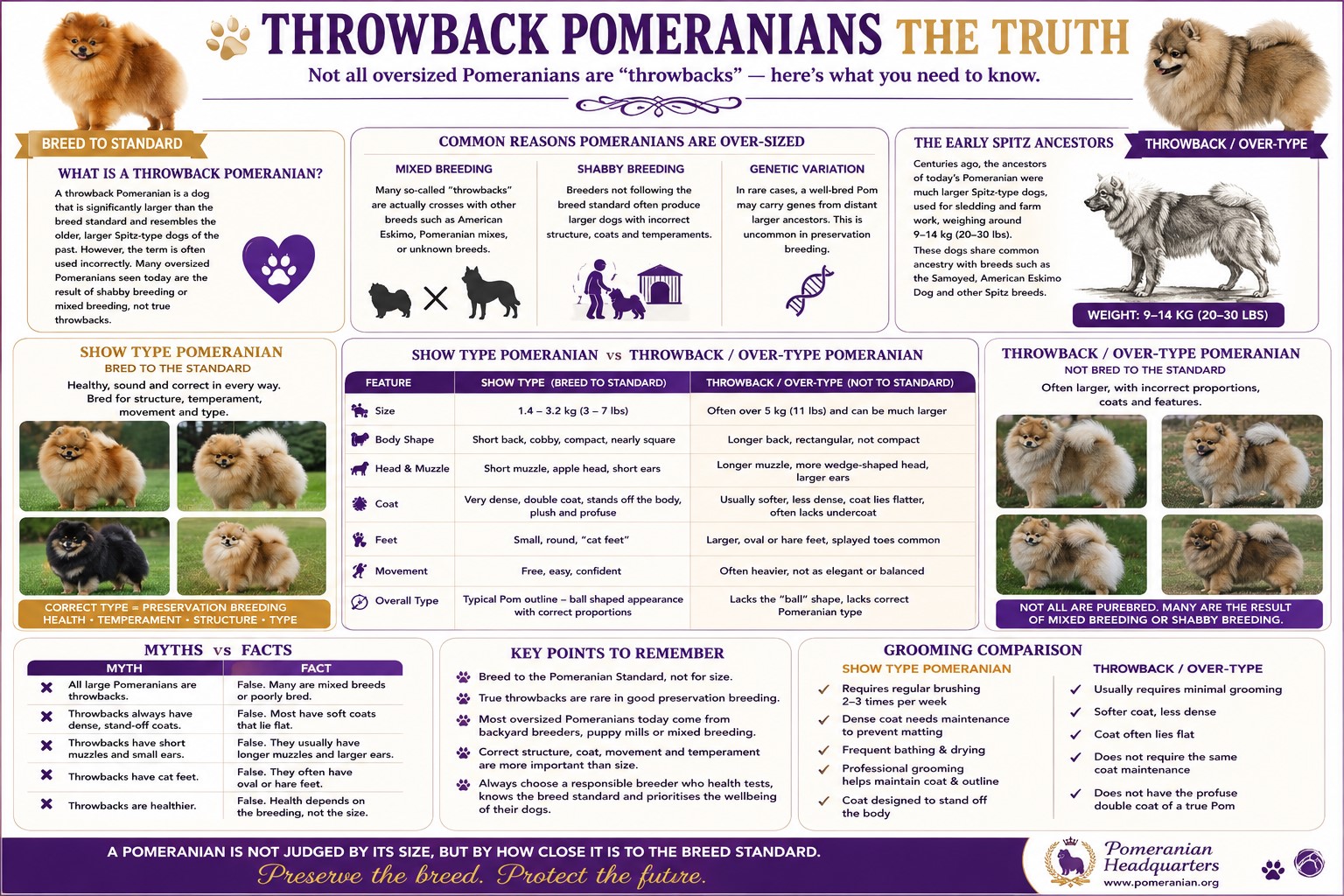
- They are often much larger than the breed standard.
- They usually have longer backs and a less compact outline.
- They may lack the correct rounded, ball-shaped Pomeranian appearance.
- Their ears are often larger.
- Their muzzles are often longer.
- Their coats are usually softer, flatter, or less dense.
- They often lack the profuse, harsh, stand-off double coat of a well-bred Pomeranian.
- They may not have the small, compact “cat feet” required by the standard.
💜 Preservation Breeder Note
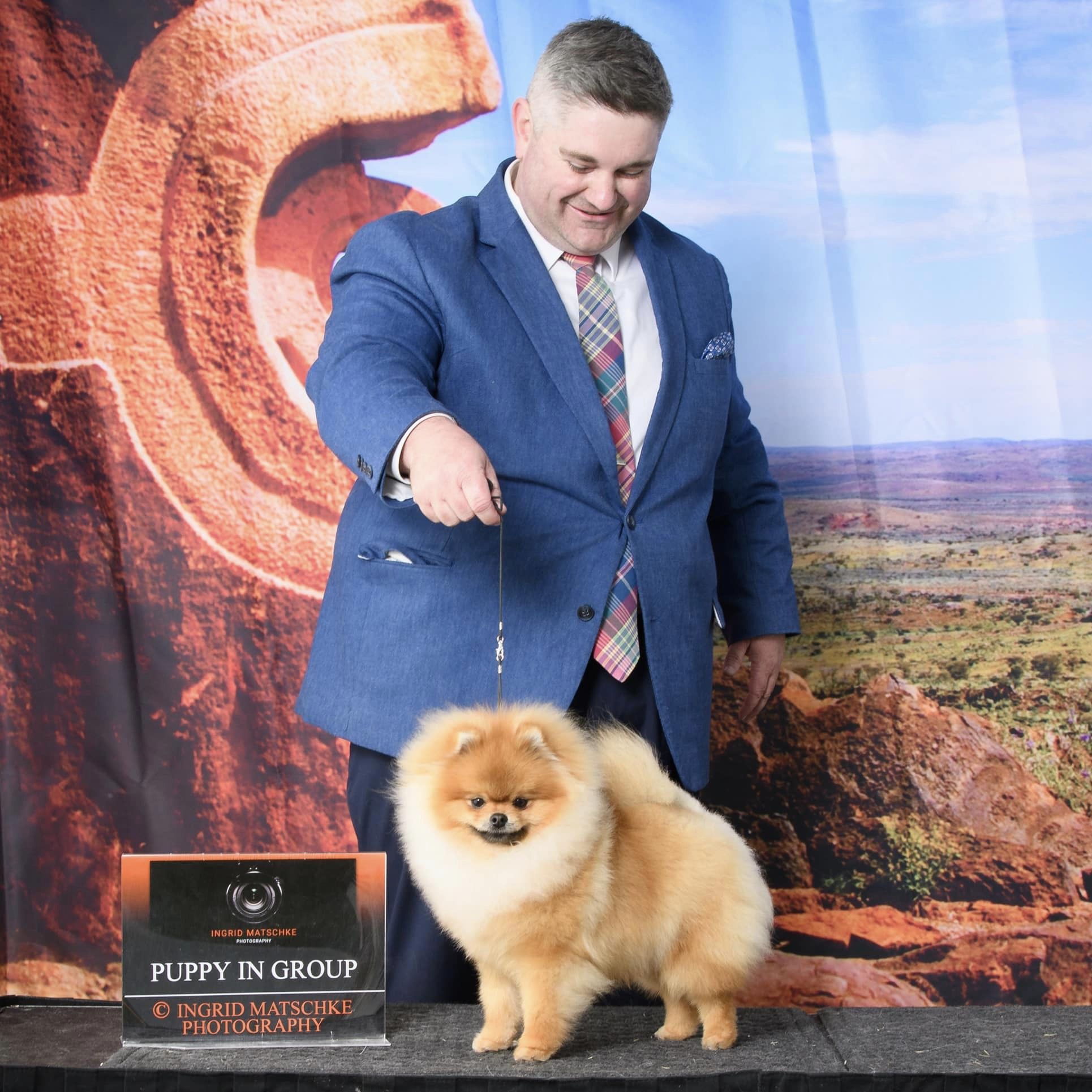
A well-bred Pomeranian is not judged by size alone. Correct breed type includes the complete picture: size, structure, coat, movement, temperament, head, ears, feet, outline, and overall balance. Responsible preservation breeders aim to breed Pomeranians that follow the breed standard, not simply dogs that are small, fluffy, or easy to sell.
Throwback Pomeranian Facts
- Throwback Pomeranians are larger than the breed standard size and genetically similar to their ancestors, Spitz-type sled dogs. The term “throwback” is a modern invention and does not officially exist as a dog breed.
- Factors contributing to your Pom’s size include genetics, background/breeding history, diet/exercise routine, and potential mixed breeding with other large Spitz breeds, such as American Eskimo Dogs or Samoyeds.
- Throwbacks typically weigh 18-20 pounds – more than double the size of normal Poms – but have similar temperaments regarding being independent yet loving companions.
- Throwback Pomeranians are usually less expensive than show-sized Pomeranian puppies due to their availability.
- These pups look cute when young, but not as much as adult dogs compared to the show-sized Pom.
- Throwbacks are often sourced from backyard breeders and cost less than preservation breeders.
- Breeding throwback Poms is more straightforward than breeding the smaller ones for shows, and they may be better suited for parents with young children because their bigger size helps protect them from injuries.
- The lifespan of these dogs is typically 12-15 years if given proper care.
- DNA testing can help determine whether your large Pom dog is purebred; they descended from medium- to large-sized Spitz dogs found in Arctic regions that were used as sled dogs, herding and hunting animals before being bred down by Queen Victoria into the small lapdogs we know today.
- Throwbacks cannot compete successfully in conformation shows since they do not meet size requirements (4 – 6 lbs) nor possess a refined look compared to other show-quality specimens.
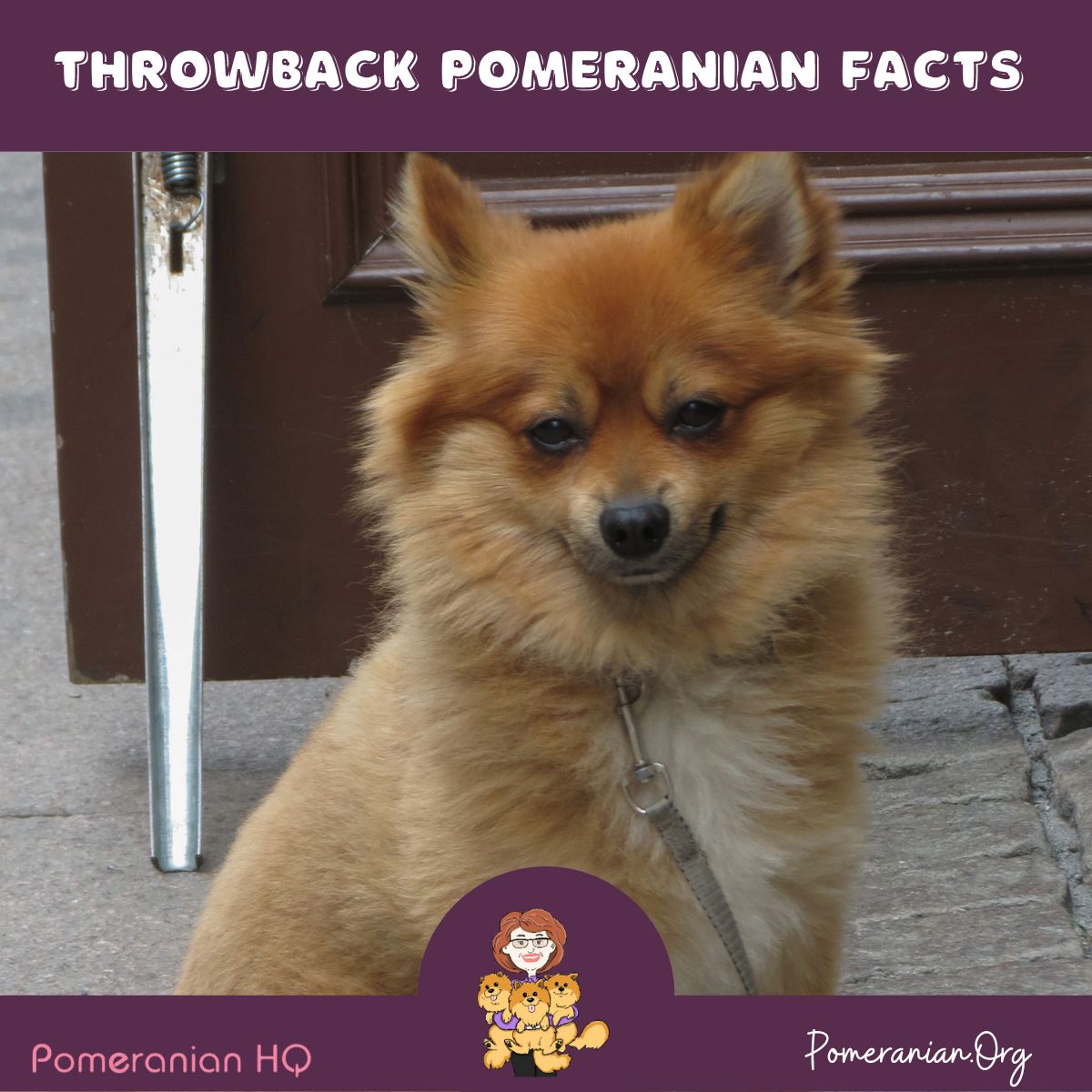
Why Do Throwback Pomeranians Occur? Understanding the Genetics and History
Many people believe that a Throwback Pomeranian is simply a modern Pomeranian that has “reverted” to its ancestors. While the term suggests this, the reality is much more complex.
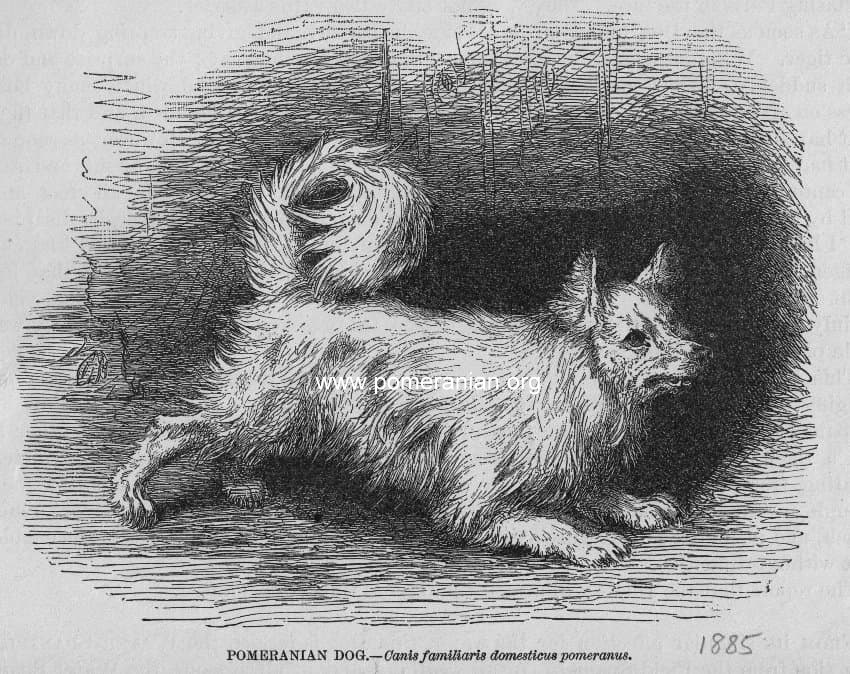
The History Behind the Pomeranian
The modern Pomeranian belongs to the Spitz family of dogs. Hundreds of years ago, the breed’s ancestors were much larger northern working dogs that were used for guarding, herding, and pulling sleds. These dogs commonly weighed between 9 and 14 kg (20–30 pounds) and bore little resemblance in size to today’s toy Pomeranian.
The dramatic reduction in size began in Europe and accelerated during the late 1800s when Queen Victoria developed a passion for the breed. During a visit to Italy, she purchased several unusually small Pomeranians and introduced them into her breeding program.
Queen Victoria’s enthusiasm for these smaller dogs had a profound influence on the breed. Breeders throughout England began selecting progressively smaller Pomeranians while still striving to retain the breed’s distinctive Spitz character, luxurious double coat, and lively temperament. Over many generations, this careful selective breeding produced the compact toy breed recognized today.
Today’s Pomeranian Breed Standard reflects more than a century of selective breeding to achieve the correct size, balance, movement, coat, and overall type.
How Genetics Influences Size
Unlike coat color, which may be controlled by relatively few genes, body size is a polygenic trait. This means that many different genes work together to influence how large or small a puppy will become.
Each puppy inherits thousands of genes from both parents. Some influence height, others affect bone, body length, substance, head shape, ear size, coat quality, and countless other characteristics. The combination inherited by each puppy is unique.
Responsible preservation breeders carefully select breeding stock that consistently produces puppies that closely match the Pomeranian Breed Standard. Over many generations, this greatly improves predictability while preserving the correct breed type.
However, when breeders are not consistently selecting for correct size and structure, greater variation is likely to occur. This is one reason oversized Pomeranians are far more commonly seen from backyard breeders, commercial breeding operations, and breeders who are not actively breeding to the official standard.
Is Every Large Pomeranian a Throwback?
No.
The term “Throwback Pomeranian” is often used as a catchphrase for any oversized Pomeranian, but that isn’t always accurate.
An oversized Pomeranian may be:
- A purebred Pomeranian that exceeds the breed standard.
- The result of generations of breeding without selecting for the correct breed type.
- A mixed-breed dog is being incorrectly marketed as a “Throwback Pomeranian.”
For this reason, size alone should never be used to identify a throwback.
Breed Type Is More Than Size
The Pomeranian Breed Standard describes far more than weight alone.
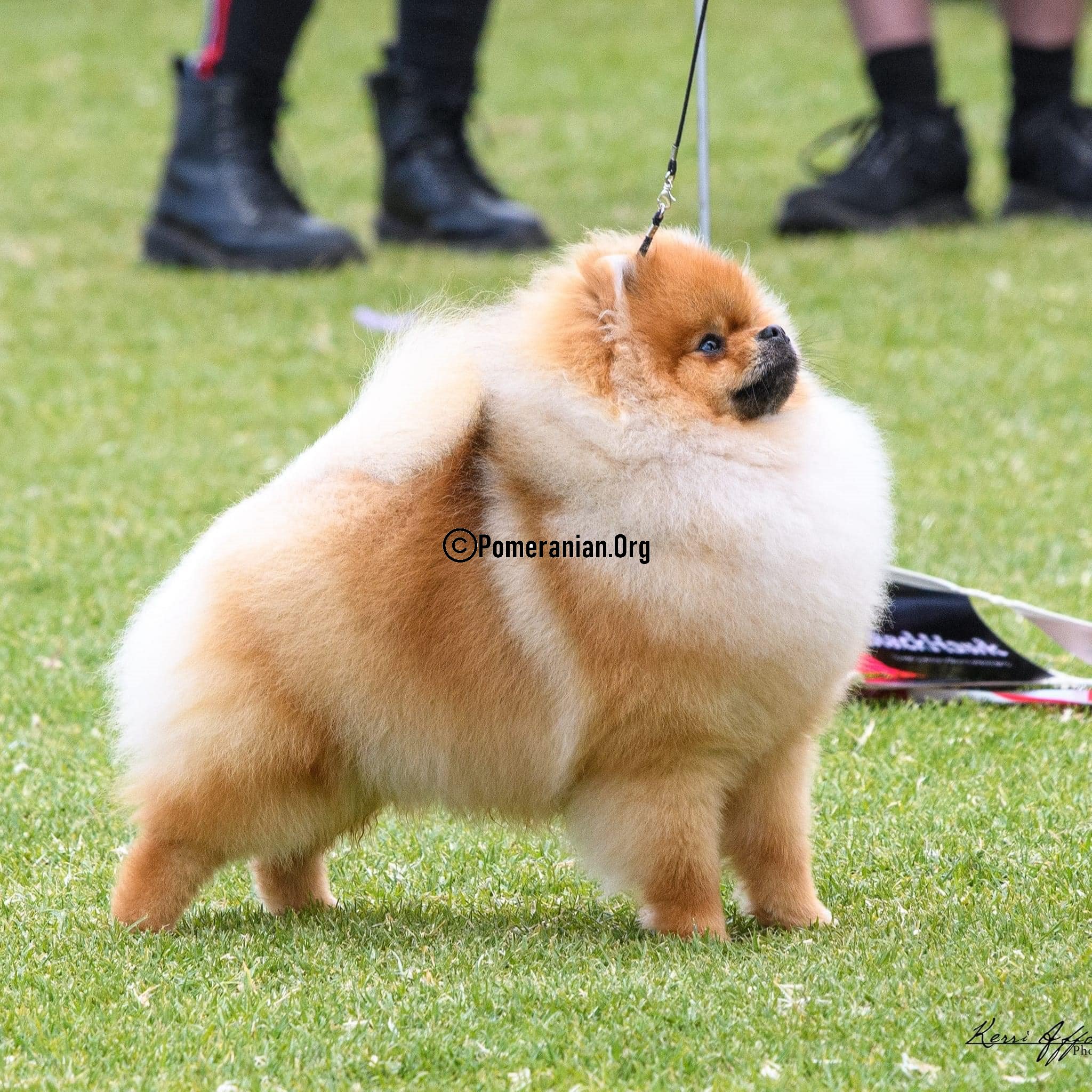
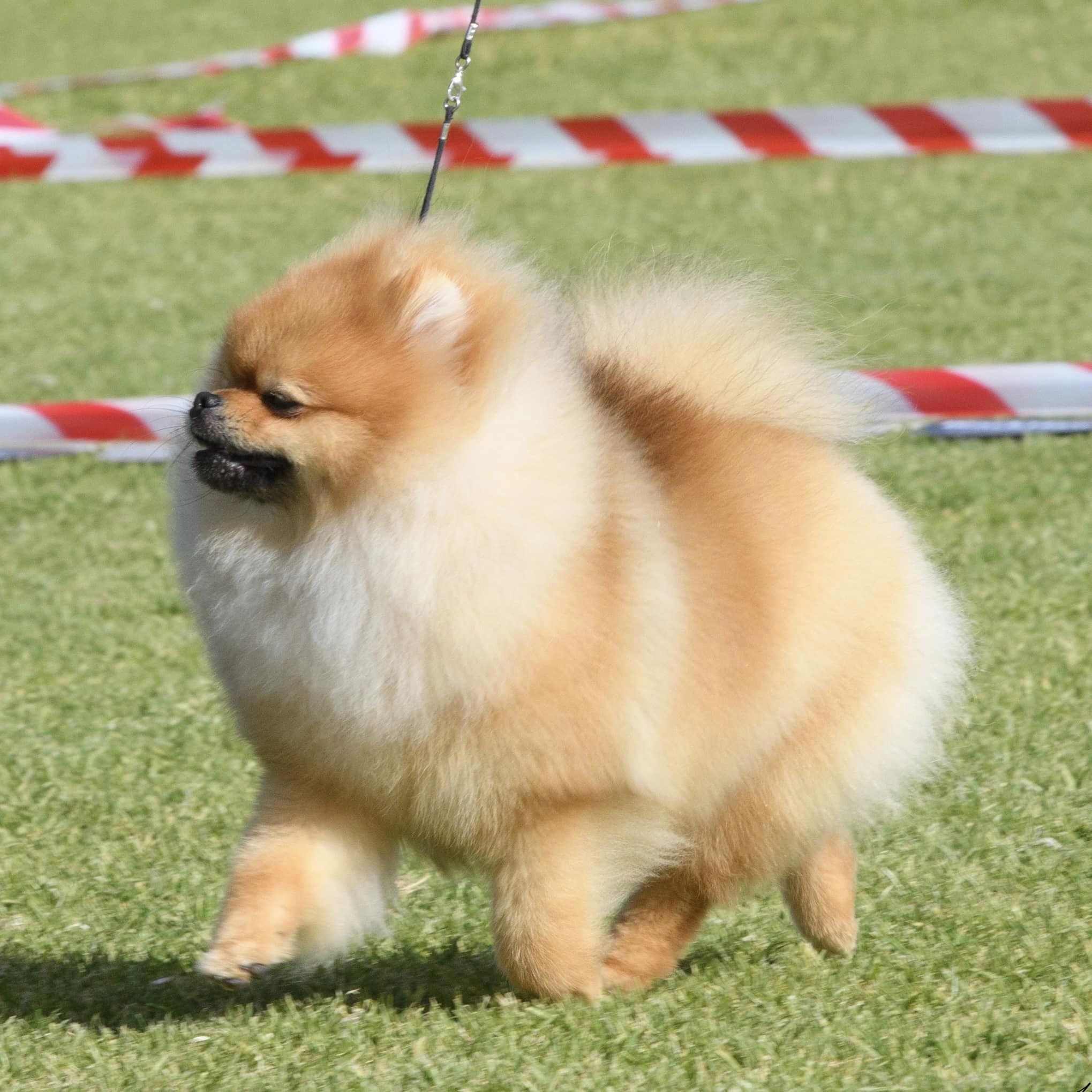
A well-bred Pomeranian should have:
- A compact, short-backed body.
- A nearly square outline.
- A beautiful, profuse double coat that stands well away from the body.
- A fox-like expression with small ears.
- A short muzzle.
- Small, compact “cat feet.”
- Free, sound movement.
- An alert, outgoing temperament.
Many oversized Pomeranians also lack these defining characteristics. They often have longer backs, larger ears, longer muzzles, flatter coats, larger feet, and a less compact outline. These differences usually reflect breeding decisions rather than simply inheriting the size of distant ancestors.
Ultimately, preserving the Pomeranian is about much more than producing small dogs. Responsible breeders strive to preserve the complete package—correct size, structure, movement, coat, temperament, and breed type—so that future generations continue to reflect the blueprint set forth in the official Breed Standard.
Why is My Pomeranian so Big?
A Pomeranian puppy is usually big because of genetics. Several factors can contribute to your Pom dog’s size, such as its background and breeding history, how healthy it eats, and how it exercises every day.
Three Reasons Why a Dog is a Large Breed Pomeranian
- He’s overweight. It’s a common problem in the Pomeranian breed and is even more likely in Poms with larger bones.
- He might be a mixed-breed dog. You may own what looks like a purebred Pom, but he could be part Pomeranian and part a larger Spitz breed, such as the American Eskimo Dog, Samoyed, Chow Chow, or Japanese Spitz, to name a few.
- Genetics. Big Pomeranian puppies are often observed in color breeding programs. Due to poor breeding practices, Pomeranian puppies from backyard breeders and puppy mills are often larger than the Pomeranian breed standard.
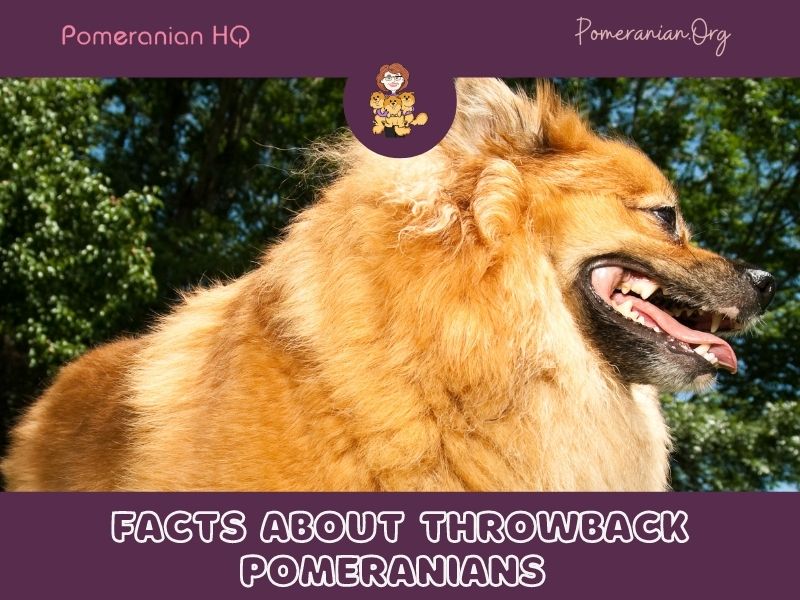
Throwback Pomeranian Size: How Big Can a Pomeranian Get?
Throwback Pomeranians have weighed between 18 and 20 pounds… and that’s certainly a giant Pomeranian. The world’s biggest Pomeranian weighs up to 20 pounds, more than double the size of normal Pomeranians.
Large Breed Pomeranian Temperament
Large Pomeranians usually have the same temperament and behavior and rarely vary. A typical Pomeranian puppy already has some throwback behaviors: it behaves independently and is always alert to its surroundings.
You’ll find that most Pomeranian puppies love traveling and are adaptable in new and different situations, a trait typical of the larger Spitz breeds. The Throwback Pomeranians are as adorable, sweet, and loving as any other puppy.
Throwback Pomeranian Price
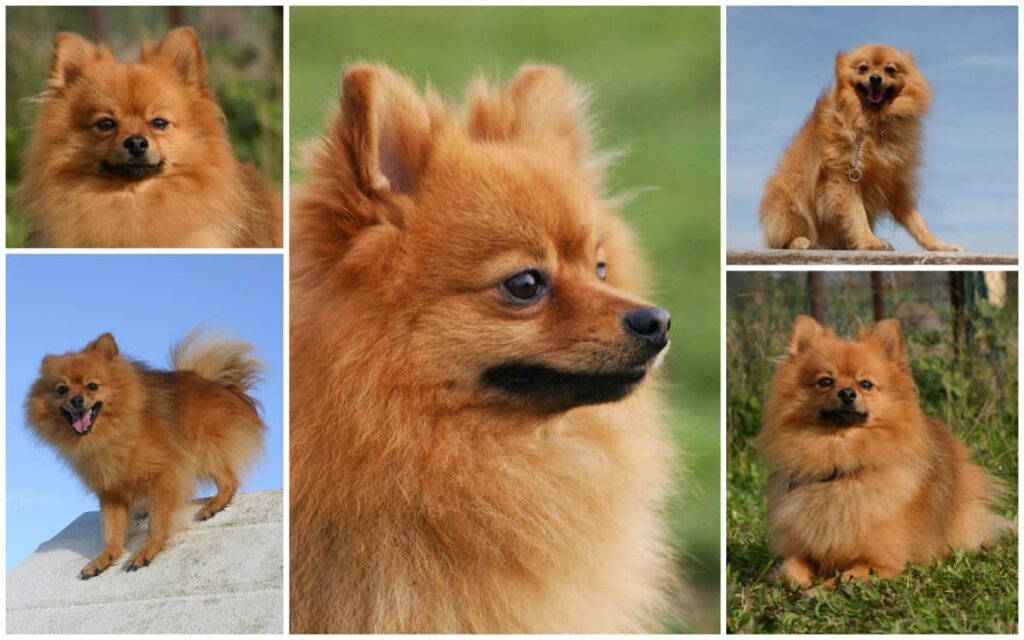
Throwback Pomeranians usually cost less than breed-standard-sized Pomeranians because they are more readily available than show-sized Pomeranian puppies, making them desirable for people who want something cute and fluffy and don’t wish to be on long breeder waiting lists.
These pups are cute and fluffy baby Pomeranian puppies, but are not as cute at one year old. These dogs aren’t as cute and fluffy as the show-sized Pomeranian when older.
As these Pomeranians are often sourced from backyard breeders, the throwback Pomeranian cost is usually much lower than if you purchased a Pomeranian puppy from a preservation breeder.
Breeding Throwback Pomeranian Puppies
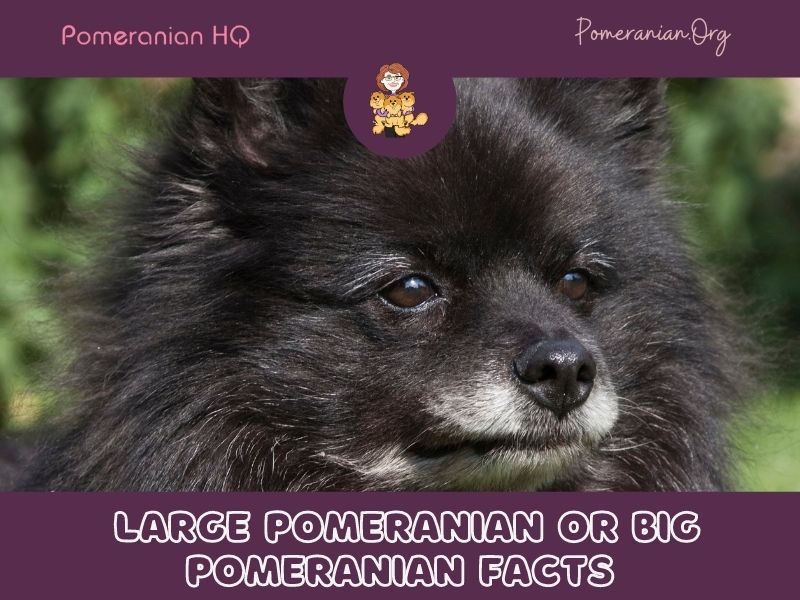
It is easier than breeding the smaller, show-sized Pomeranians. When very young, the pups still look cute to the uneducated eye, but as they mature, these dogs get bigger and bigger, long-nosed, long-backed, with long legs, big ears, lack head and leg coats, and very often have low tail sets.
Tiny Pomeranian dogs are not an economically viable breed for puppy mills and backyard breeders. Most “Pomeranians” sourced from these types of outlets seem completely different from the show Pomeranian.
Health Problems of the Bigger Size Pomeranian
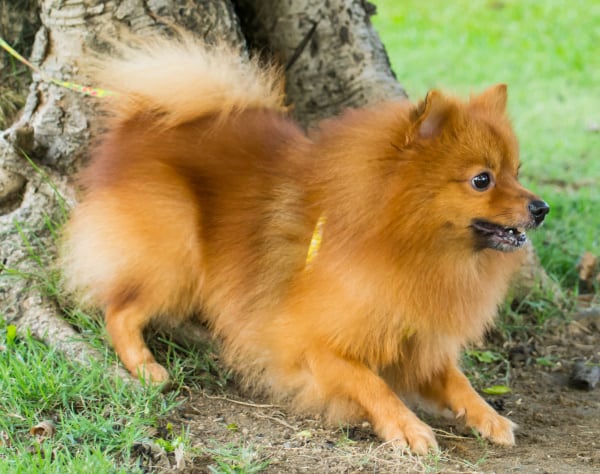
It’s widely believed that larger Pomeranian dogs don’t have health issues because their bodies are larger than those of normal Poms.
Being a larger dog often proves advantageous. A tiny dog, like a small Pom, can easily suffer from injuries after jumping off the bed or couch because the floor is a long distance for them.
A large Pom dog will have a more solid body and often stronger legs, which help protect them from having such injuries. They usually enjoy activities that include jumping from heights, among others.
The bigger Poms are better dogs for parents with young children because the dog can endure whatever the child does.
Throwback Pomeranian Lifespan
What is the lifespan of a throwback Pomeranian? A Pomeranian’s lifespan depends on many factors, including environment, diet, and genetics, but they are typically long-lived, averaging 12-15 years with proper care.
For a throwback Pom, the average lifespan would be slightly higher than that of other breeds due to their lack of inbreeding and health problems.
How To Know If a Big Pomeranian is a Purebred?
If you are concerned about whether your large Pom dog is purebred, ask your vet about doing DNA testing to work out your large Pom dog’s lineage.
It’s Impossible for Throwback Pomeranians To Be Successful Show Pomeranians
The final Pomeranian throwback fact I’ll share is a specific negative about owning this type of Pomeranian. An oversized Pomeranian can’t be involved in canine shows.
It’s because show Pomeranians should ideally weigh 4-6 pounds, whereas most so-called throwback Poms are two or three times that weight.
In addition to exceeding the breed standard size requirements, throwback Pomeranians usually lack the refined look of a Pomeranian show dog.
Some throwback Pomeranians will have flat coats rather than the fluffy double coats of dogs bred by preservation breeders. Throwbacks also often have bigger ears and a nose that’s longer and more like a fox, instead of a short, teddy-bear-style nose.
Throwback Pomeranians usually occur in litters bred by breeders who do not show their dogs.
Hence, a throwback Pomeranian won’t be successful in the conformation show rings.
Conclusion
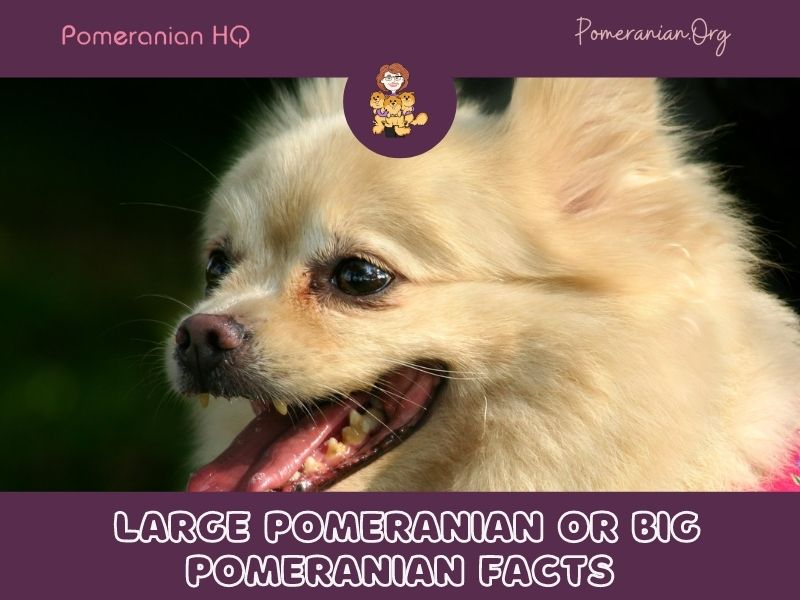
Throwback Pomeranians remind us of the breed’s fascinating history. Although they grow larger than today’s breed standard, they remain purebred Pomeranians with the same intelligence, loyalty, and lively personality.
Size alone does not determine quality, and whether your Pomeranian is a standard-sized show dog or a larger throwback companion, what matters most is responsible breeding, excellent health, and a loving home.
Copyright Pomeranian.Org. All Rights Reserved.
References and Further Reading:
[1] Denise Leo, “The Pomeranian Handbook”.
[2] Milo G. Denlinger, “The Complete Pomeranian”.
[3] Kimbering Pomeranians “1891-1991”.
[4] E. Parker “The Popular Pomeranian”.
[5] Official Standard of the Pomeranian (AKC). American Kennel Club, 2011.
[6] Official English Kennel Club Pomeranian Breed Standard, 2017.
The Pomeranian Handbook