
Bringing home a Pomeranian puppy should be a joyful experience. Unfortunately, many puppy buyers unknowingly support puppy mills or puppy farms without realizing the suffering behind the scenes. Slick websites, cute puppy photos, and emotional sales tactics can mask large-scale commercial breeding operations in which dogs are bred purely for profit.
⚠️ Quick Answer
A Pomeranian puppy mill or puppy farm is a large-scale commercial breeding operation focused on profit rather than the health and welfare of dogs. Puppies from puppy mills are often poorly socialised, unhealthy, and bred without proper health testing.
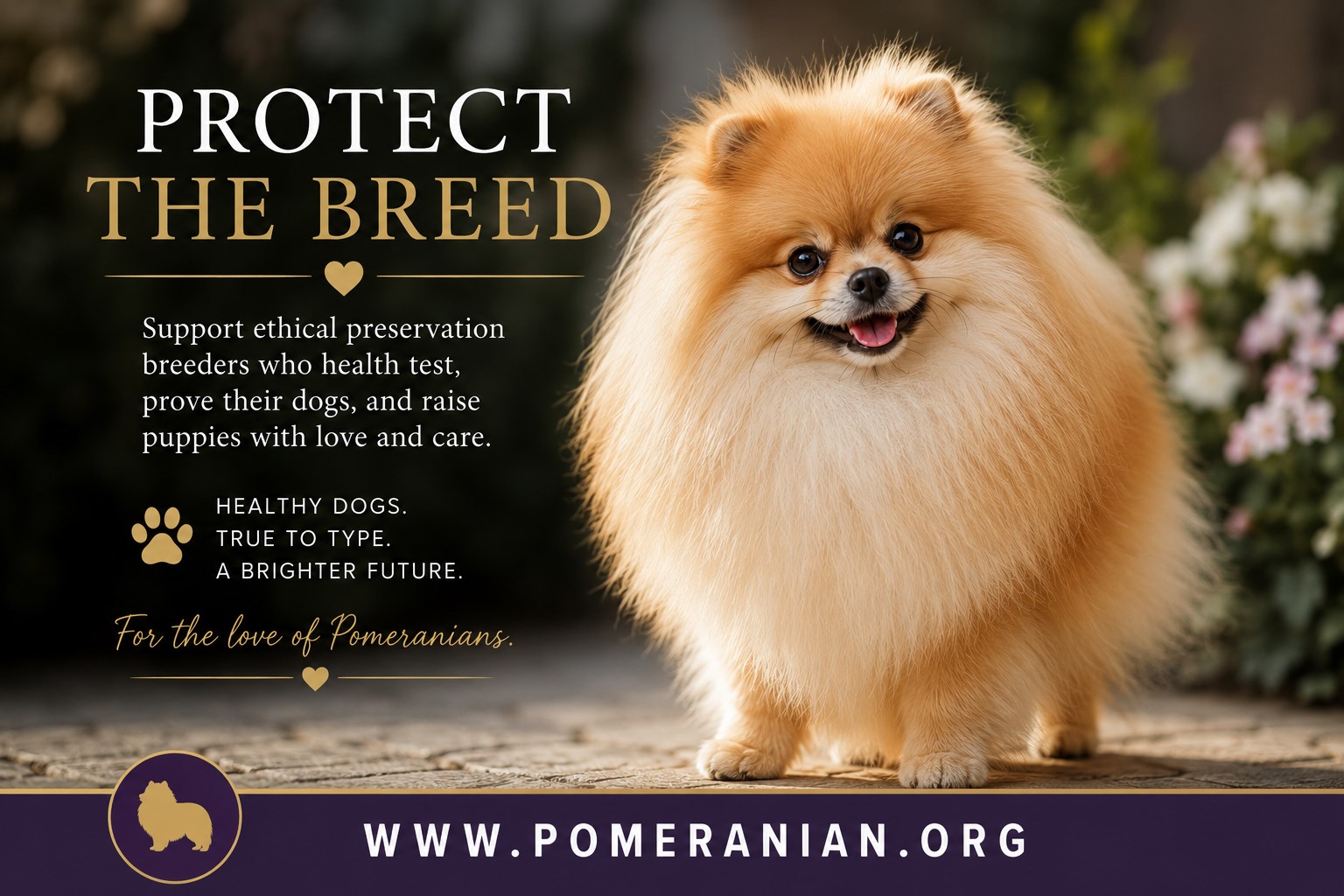
To avoid supporting puppy farms, buyers should only purchase puppies from ethical preservation breeders who health test, prove their dogs in the show ring, and raise puppies in a home environment.
Important: Responsible Pomeranian breeders focus on health, temperament, breed type, and lifelong support for their puppies — not simply producing puppies for profit.
🐾 What Is a Puppy Mill or Puppy Farm?
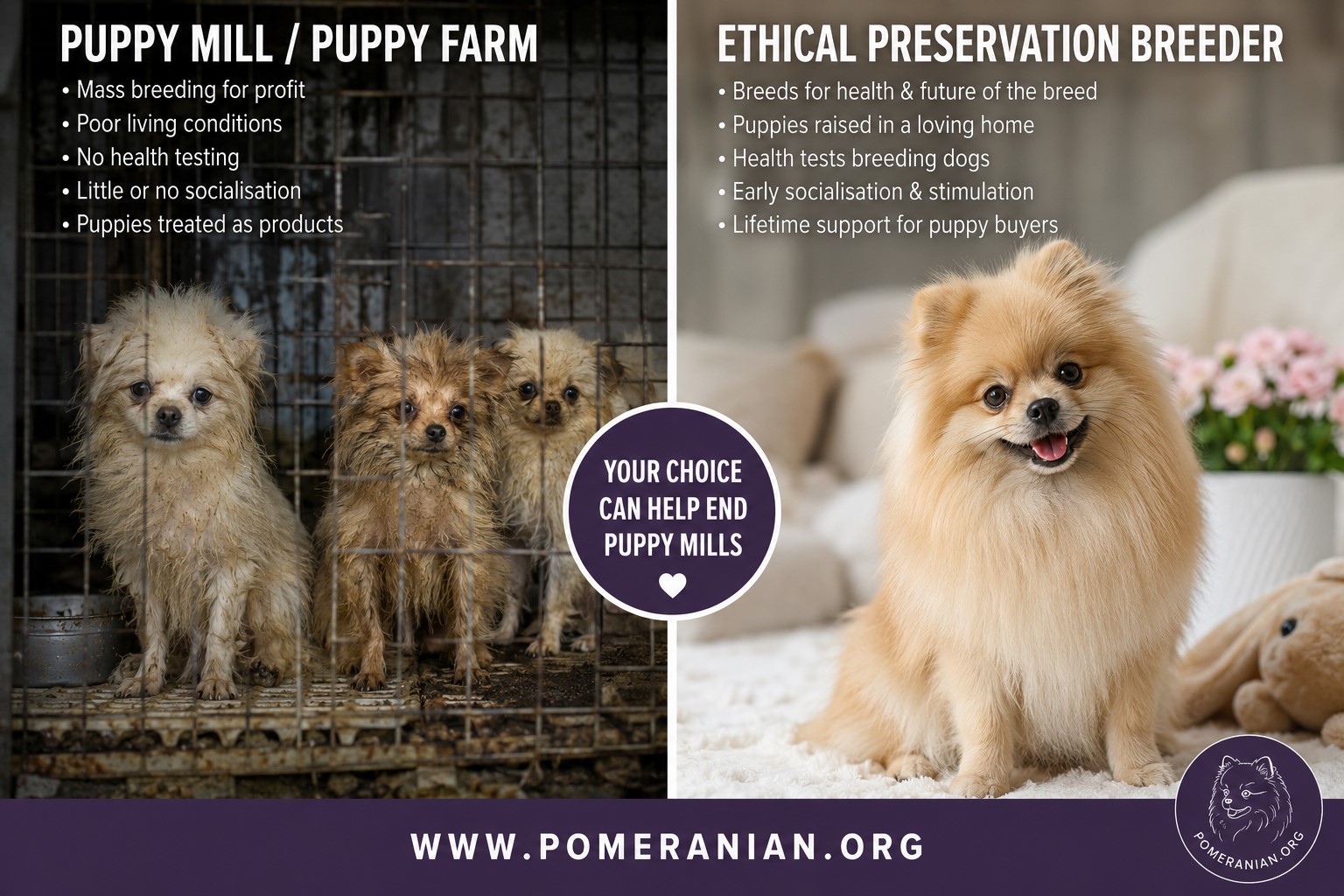
A puppy mill or puppy farm is a commercial breeding operation where dogs are bred primarily for profit rather than health, temperament, or welfare. While some facilities may appear clean or professional online, many puppy farms prioritise producing large numbers of puppies over proper care and responsible breeding practices.
⚠️ Common Signs of a Puppy Farm
- Large numbers of puppies constantly available
- Multiple dog breeds being sold
- Little or no health testing performed
- Puppies raised in kennels, cages, or sheds instead of the home
- Poor socialisation during critical development periods
- Breeding dogs kept purely for production
- Puppies sold through pet shops or online marketplaces
- No interest in screening or educating puppy buyers
Responsible preservation breeders usually breed only occasionally, health test their dogs, carefully plan litters, prove their dogs in the show ring, and raise puppies as part of the family in a home environment.
🚩 Warning Signs of a Puppy Mill or Puppy Farm
Many puppy farms appear professional online, making them difficult for inexperienced buyers to recognise. Learning the warning signs can help you avoid supporting unethical breeding operations.
1. Puppies Always Available
Responsible preservation breeders usually only have occasional litters. Puppy farms often advertise puppies available year-round because large numbers of dogs are constantly being bred.
2. Multiple Breeds for Sale
Ethical breeders usually specialise in one breed and dedicate years to understanding bloodlines, health, and breed type. Puppy farms commonly sell multiple breeds at the same time.
3. Refuses to Show Parents or Living Conditions
Responsible breeders are usually proud to show where puppies are raised and introduce buyers to the mother. Puppy farms may avoid visits, refuse video calls, or only show limited areas.
4. No Health Testing
Preservation breeders health test breeding dogs and carefully plan litters. Puppy farms often breed dogs without testing for hereditary health issues or understanding pedigrees.
5. Puppies Sold Too Cheaply
Ethically bred puppies are expensive to raise properly due to health testing, quality food, veterinary care, vaccinations, DNA profiling, registration, and proper socialisation. Extremely cheap puppies can be a major warning sign.
6. Puppies Sold Through Pet Shops or Online Marketplaces
Many puppy farms sell puppies through pet shops, classified websites, or social media marketplaces. Responsible breeders usually prefer direct communication with carefully screened buyers.
7. No Questions Asked About the Buyer
Good breeders care deeply where their puppies go and usually ask many questions about lifestyle, experience, and the home environment. Puppy farms are often focused on quick sales.
8. Puppies Poorly Socialised or Fearful
Puppies raised in poor environments may appear fearful, withdrawn, anxious, dirty, or poorly adjusted. Early socialisation is extremely important for developing confident, stable temperaments.
Important: Responsible preservation breeders focus on health, temperament, breed type, and lifelong support for every puppy they produce — not mass production or fast sales.
🐾 Preservation Breeder vs Puppy Farm
Understanding the difference between an ethical preservation breeder and a puppy farm can help protect both you and your future puppy.
| ✔️ Ethical Preservation Breeder | ⚠️ Puppy Mill / Puppy Farm |
|---|---|
| Health tests breeding dogs | Little or no health testing |
| Breeds occasionally and carefully plans litters | Constantly produces puppies for profit |
| Raises puppies inside the home environment | Often raises puppies in kennels, cages, or sheds |
| Shows and proves dogs to the breed standard | Breeds without proving quality or breed type |
| Knows pedigrees, bloodlines, and hereditary health issues | Limited understanding of genetics or breed preservation |
| Carefully screens puppy buyers | Usually sells to anyone with money |
| Provides ongoing advice and lifetime support | Little interest after the puppy is sold |
| Focuses on health, temperament, and preserving the breed | Focuses mainly on producing puppies quickly for income |
Remember: A well-bred Pomeranian puppy may cost more initially, but responsible breeding greatly improves the chances of better health, temperament, structure, and lifelong support from the breeder.
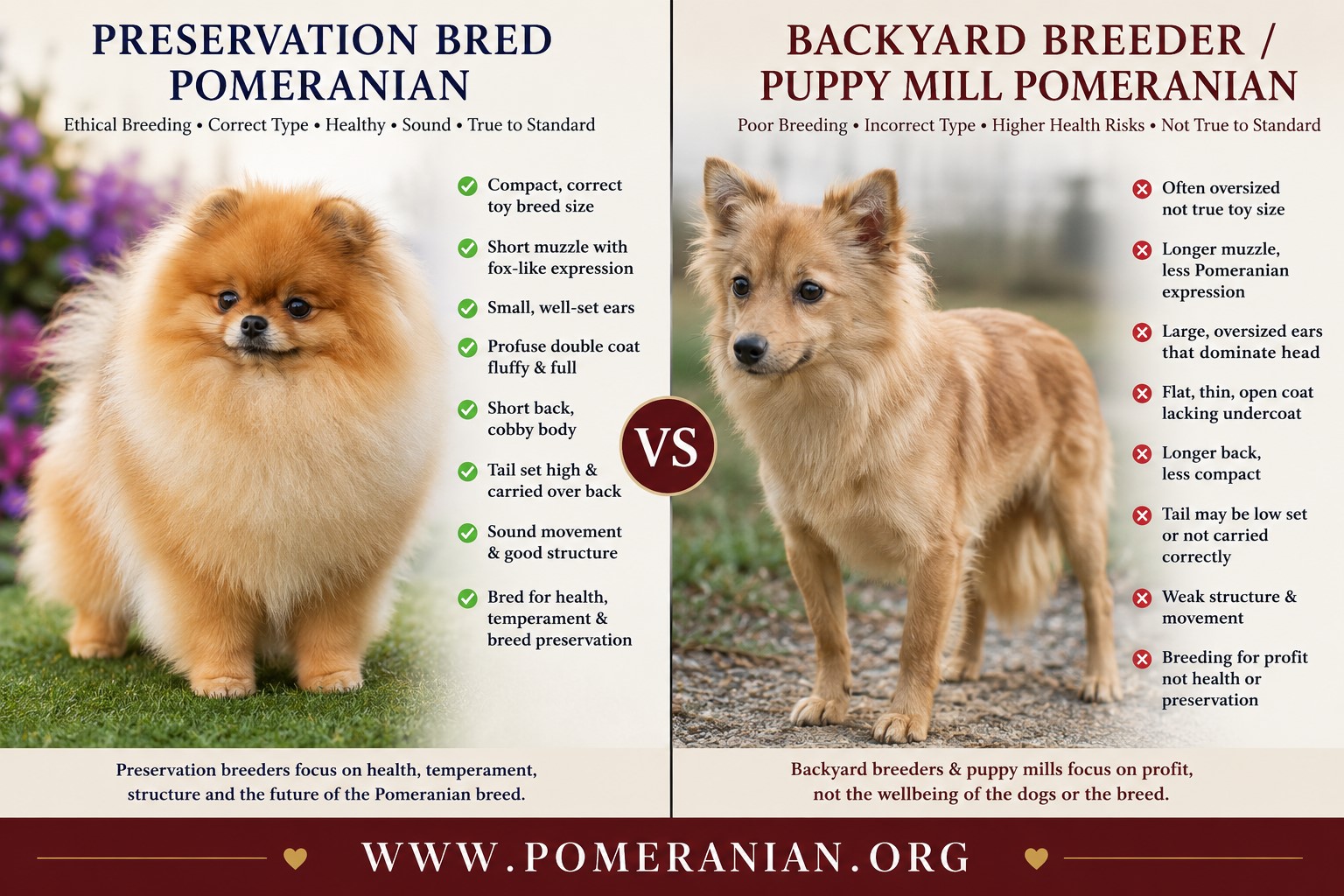
Poor Breeding Practices Have Changed the Look of Many So-Called Pomeranians
Poor breeding practices have had a serious effect on the quality and appearance of many dogs being sold today as “Pomeranians.” While every dog deserves love and kindness, not every fluffy little dog advertised as a Pomeranian is a good example of the breed.
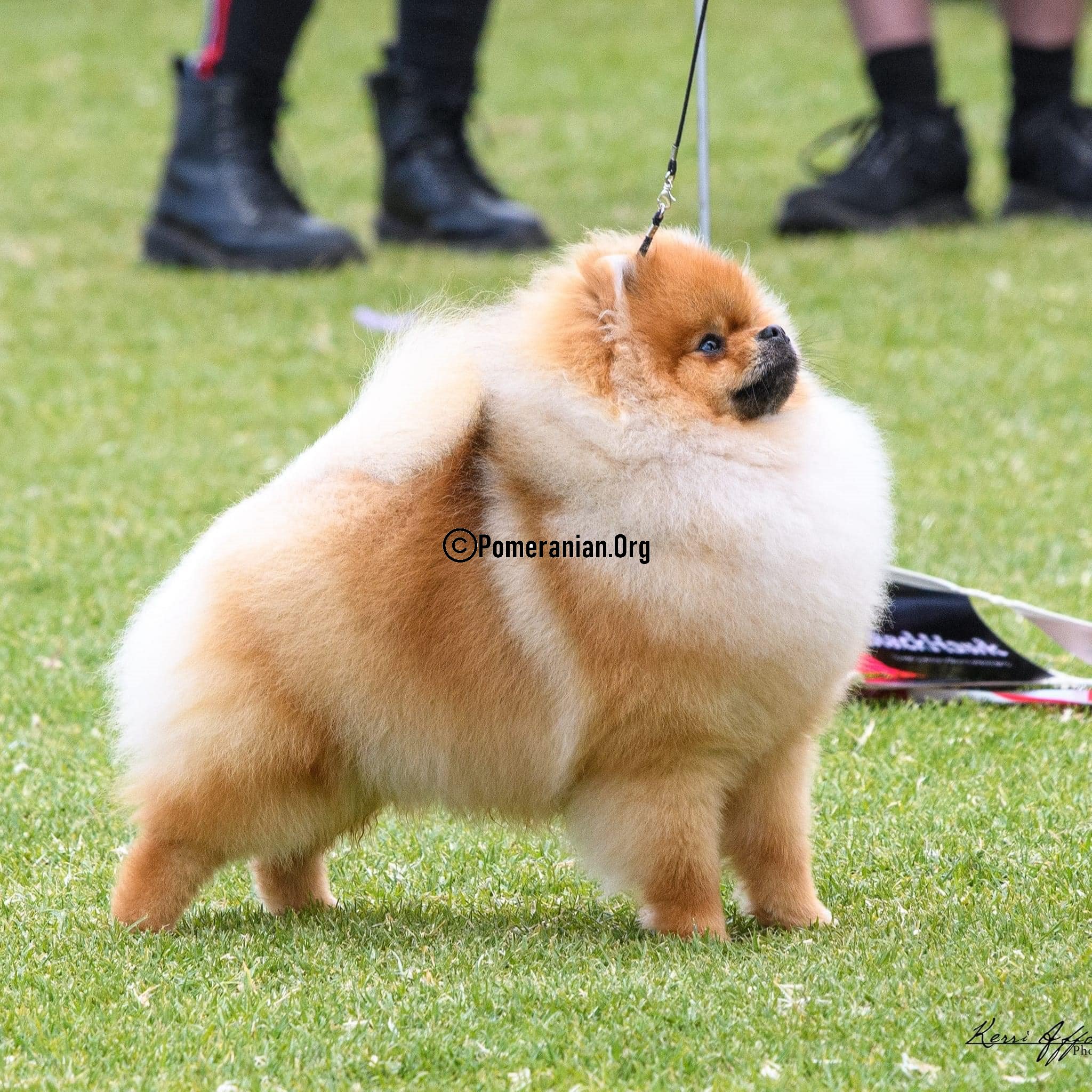
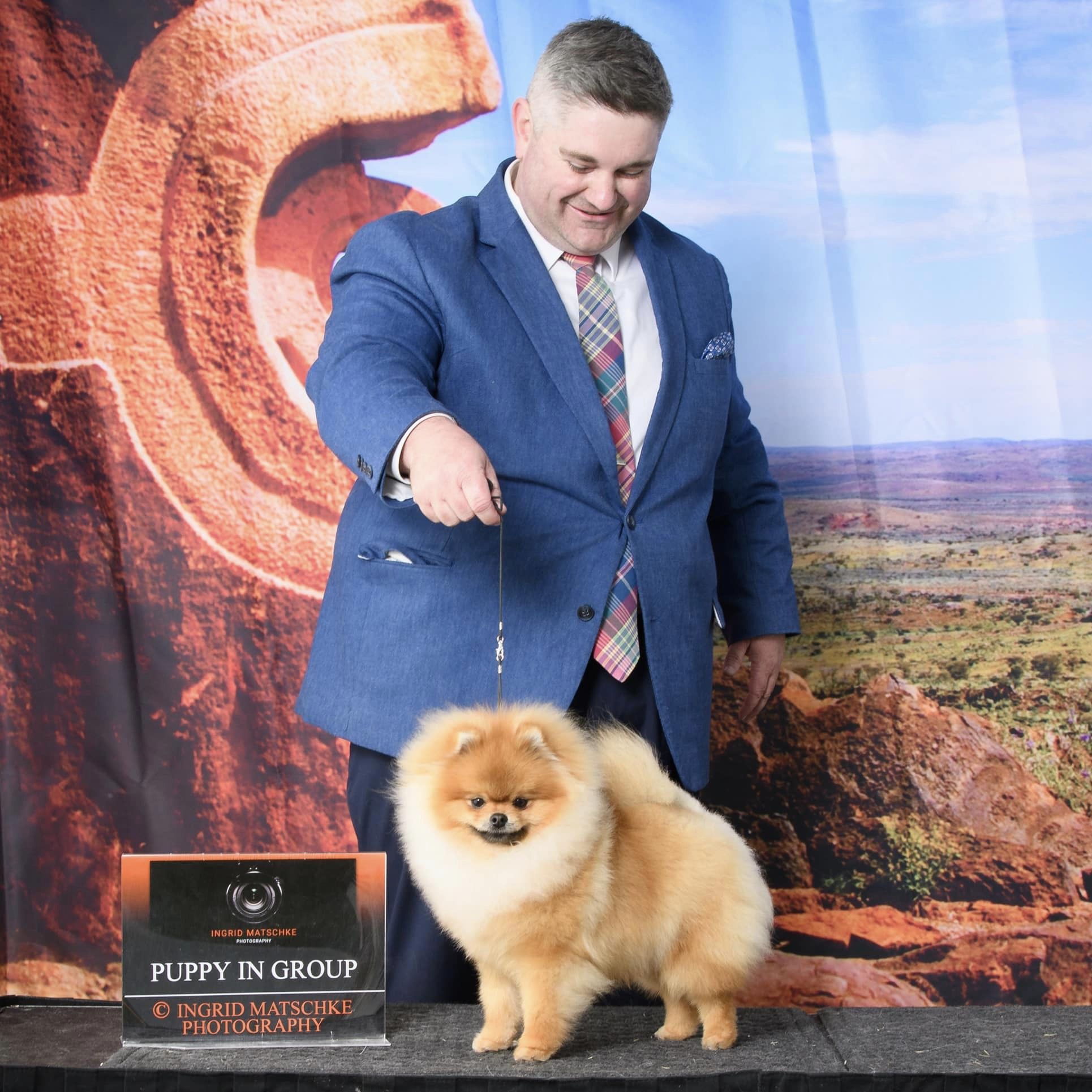
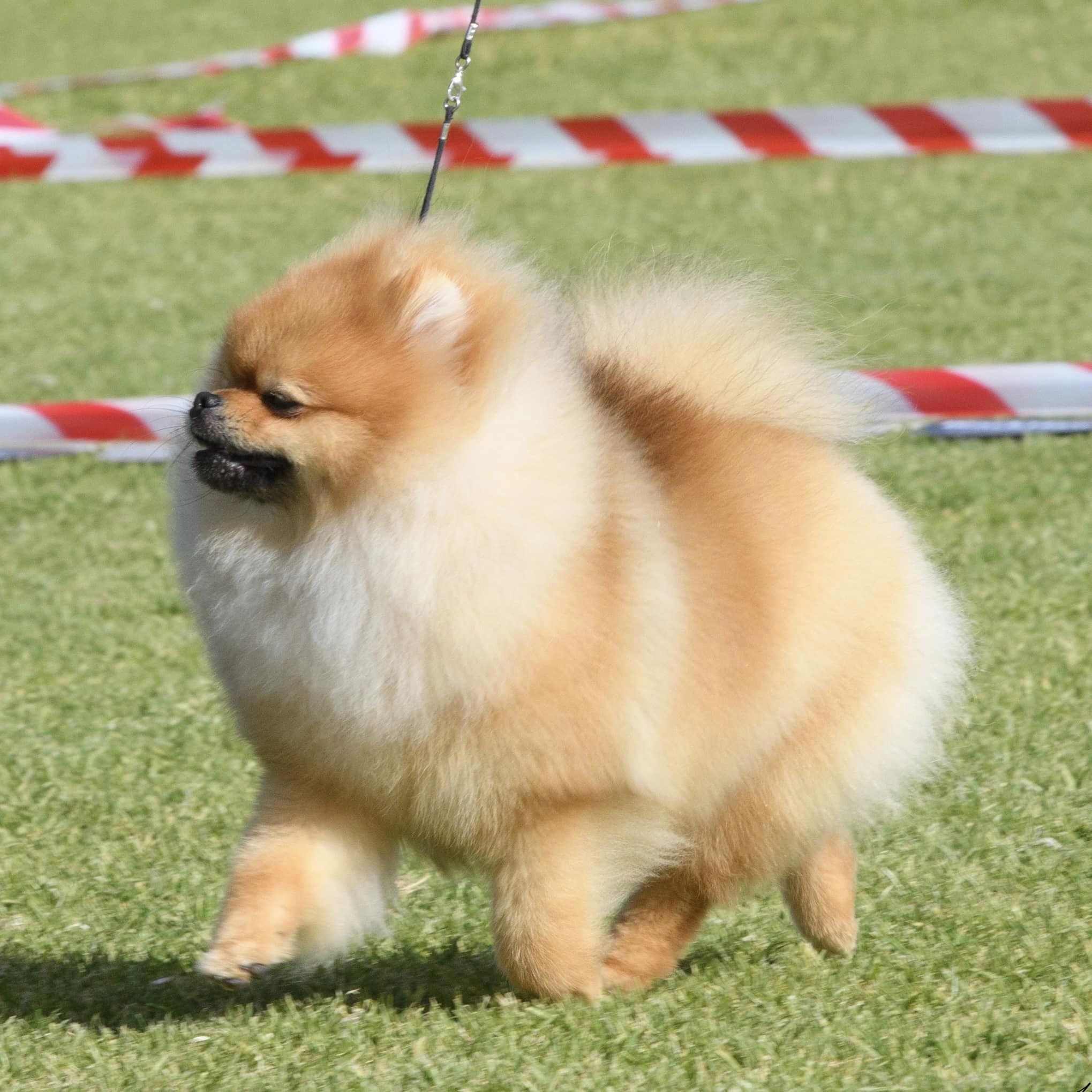
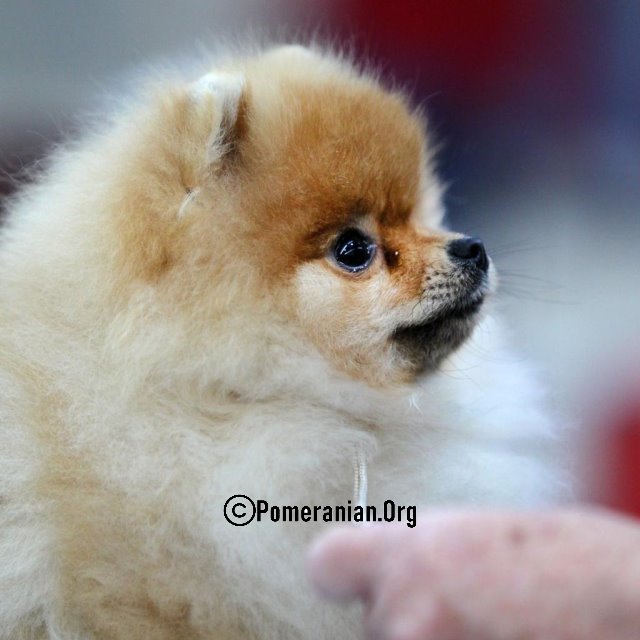
True Pomeranians should be compact, short-backed, active, alert, and distinctly toy-like. They should have a profuse double coat, a beautiful fox-like expression, small neat ears, a short muzzle, good bone for their size, and a proud, balanced outline. These qualities do not happen by accident. They are preserved by knowledgeable breeders who understand pedigrees, structure, breed type, health, temperament, and the official breed standard.
Unfortunately, puppy farms, backyard breeders, and careless commercial breeders often breed only for colour, availability, or profit. They may use whatever dogs they have access to, with little understanding of correct Pomeranian type. Over time, this can produce dogs that are much larger, flat coated, long nosed, big eared, and lacking the classic Pomeranian outline.
Why Poorly Bred Pomeranians Often Look Different
Correct Pomeranian breed type is the result of generations of careful selection. Preservation breeders study bloodlines, assess structure, and make breeding decisions with the future of the breed in mind. Puppy farmers and careless breeders often do not have this knowledge or commitment.
When dogs are bred without proper selection for breed type, the result is often puppies that may still be advertised as Pomeranians, but do not strongly resemble the breed. These dogs may grow much larger than expected, lack the correct double coat, have longer muzzles, larger ears, longer backs, or a more generic spitz-like appearance.
Common Features Seen in Poorly Bred So-Called Pomeranians
- Larger size: Many poorly bred dogs sold as Pomeranians grow well outside the expected toy breed size.
- Flat or sparse coats: Instead of the correct harsh-textured outer coat and dense undercoat, some have thin, flat, open coats.
- Large ears: Oversized ears can spoil the correct small, neat, fox-like Pomeranian expression.
- Long noses: A long, narrow muzzle changes the entire look of the head and expression.
- Longer bodies: Poor breeding may produce dogs lacking the compact, short-backed outline expected in the breed.
- Poor tail carriage: The beautiful tail carried flat over the back is an important part of Pomeranian type.
- Weak temperament: Poor socialisation and careless breeding may produce nervous, anxious, or poorly adjusted puppies.
Breeding for Colour Instead of Quality
One major problem is breeding purely for fashionable colours. Some breeders focus on producing unusual colours because they are easy to market online. Colour alone does not make a quality Pomeranian. A beautifully coloured puppy with poor structure, incorrect coat, oversized ears, a long muzzle, and weak breed type is still poorly bred.
Responsible breeders consider the whole dog. They assess health, temperament, construction, coat, movement, head type, pedigree, and how closely the dog represents the Pomeranian breed standard. Puppy farmers often focus on what sells quickly, not what protects the breed.
Why Showing Dogs Matters
Showing dogs is not just about ribbons. The show ring helps breeders compare their dogs against the breed standard and against other quality examples of the breed. Breeders who prove their dogs in the show ring are usually working to preserve correct type, soundness, movement, and temperament.
Without this outside assessment, breeders may convince themselves their dogs are excellent simply because they are cute or because buyers like them. Over time, breeding without reference to the breed standard can lead to dogs that drift further and further away from what a true Pomeranian should be.
The Difference Between a Pet and a Poorly Bred Dog
It is important to be clear: a much-loved pet Pomeranian does not need to be a show dog to be adored. Many wonderful pets are not show quality. However, there is a difference between a beloved pet from a responsible breeder and a poorly bred puppy produced without care, knowledge, or proper planning.
Responsible breeders may place puppies in pet homes because they are not suitable for showing or breeding, but those puppies still come from carefully selected parents, known pedigrees, health-focused breeding programs, and proper early care. Puppy farm puppies are often produced with none of these protections.
Why This Matters for the Future of the Breed
When buyers support puppy farms and careless breeders, demand increases for more poorly bred puppies. This damages the future of the Pomeranian breed. Over time, the public begins to think oversized, flat coated, long nosed, big eared dogs are normal Pomeranians.
Preservation breeders work hard to protect the true Pomeranian: a tiny, compact, glamorous toy spitz with correct coat, beautiful expression, sound movement, and confident temperament. Supporting ethical breeders helps preserve these qualities for future generations.
Denise Leo’s breeder note: A true Pomeranian is not simply a small fluffy dog. Correct Pomeranian type is created through generations of careful, knowledgeable breeding. Ethical preservation breeders breed with the breed standard, health, temperament, and the future of the breed in mind.
❓ Puppy Mill & Ethical Breeder FAQ
What is a Pomeranian puppy mill?
A Pomeranian puppy mill or puppy farm is a large-scale commercial breeding operation focused mainly on profit rather than the health, welfare, and preservation of the breed. Puppies are often mass produced with limited health testing, poor socialisation, and little regard for correct breed type.
How can I avoid buying a puppy mill puppy?
Research breeders carefully, ask about health testing, meet the puppy’s mother if possible, and choose breeders who raise puppies in the home environment. Ethical preservation breeders are usually involved in showing, understand pedigrees, and carefully screen puppy buyers.
Why are puppy mill puppies often cheaper?
Responsible breeding is expensive. Ethical breeders invest heavily in health testing, quality food, veterinary care, DNA profiling, vaccinations, showing dogs, and proper puppy socialisation. Puppy farms often cut corners to maximise profit.
Are pet shop puppies from puppy farms?
Historically, many pet shop puppies came from commercial breeding facilities or puppy farms. In some Australian states, laws have changed to reduce this practice. Responsible preservation breeders rarely sell puppies through pet shops.
What is a preservation breeder?
A preservation breeder is someone dedicated to protecting and improving the future of the breed. They carefully select breeding dogs based on health, temperament, pedigree, structure, and breed type while following the official breed standard.
Can puppy mill puppies have health or behaviour problems?
Yes. Puppy mill puppies may be more likely to develop hereditary health problems, poor temperaments, anxiety, fearfulness, poor coat quality, incorrect structure, and behavioural issues due to poor breeding and inadequate early socialisation.
Why do some so-called Pomeranians look oversized or flat coated?
Poor breeding practices over generations can produce dogs lacking correct Pomeranian breed type. These dogs may be larger, long nosed, flat coated, big eared, or lack the compact toy breed appearance expected in a well-bred Pomeranian.
Why do responsible Pomeranian breeders show their dogs?
Showing dogs helps breeders evaluate breeding stock against the official breed standard. It encourages breeders to preserve correct structure, movement, coat, temperament, and true Pomeranian breed type.
Conclusion
Choosing where your Pomeranian puppy comes from is one of the most important decisions you will ever make as a dog owner. Behind many cute online photos and emotional advertisements can be heartbreaking realities of poor breeding, overcrowding, lack of health testing, and puppies raised without proper care or socialization.
A well-bred Pomeranian should be healthy, confident, sound, and truly representative of the breed. These qualities are preserved by ethical preservation breeders who dedicate years — often decades — to studying pedigrees, health, structure, temperament, and the official breed standard. Responsible breeders do not simply produce puppies; they work to protect the future of the breed they love.
While a responsibly bred puppy may cost more initially, careful breeding greatly improves the chances of better health, correct breed type, stable temperament, and lifelong breeder support. Supporting ethical breeders also helps reduce demand for puppy farms and discourages cruel mass-breeding practices.
A Pomeranian is far more than just a fluffy little dog. The breed’s beauty, soundness, personality, and unique Toy Spitz characteristics have been carefully preserved through generations of selective breeding. By choosing responsibly, puppy buyers help ensure these wonderful qualities continue to be enjoyed by future generations.
Copyright Pomeranian.org. All Rights Reserved.
📚 References & Further Reading
- [1] AKC Pomeranian Breed Standard (2011)
- [2] English Kennel Club Breed Standard
- [3] The Pomeranian Handbook – Denise Leo
- [4] Denlinger, The Complete Pomeranian
- [5] Kimbering, 1891–1991
- [6] Taplin, The Sportsman’s Cabinet
- [7] Parker, The Popular Pomeranian
- [8] Ives, Show Pomeranians