
Many new Pomeranian owners wonder whether these fluffy toy dogs should spend time outdoors or if they are strictly indoor companions. While Pomeranians love exploring outdoors, their small size, delicate build, and thick double coats mean they require extra care and supervision whenever they venture outside.
In this article, we’ll cover everything you need to know about keeping your Pomeranian safe outside—when puppies can go outdoors, how weather conditions affect them, and the best precautions to take during outdoor play. With the right care, your Pom can enjoy the outdoors while staying healthy, happy, and protected.
A Pomeranian is a toy dog, and because of that, it’s not recommended that it be treated as an outdoor dog, even though it can moderately tolerate cold and hot weather. He’s much better off living inside your home with your family.
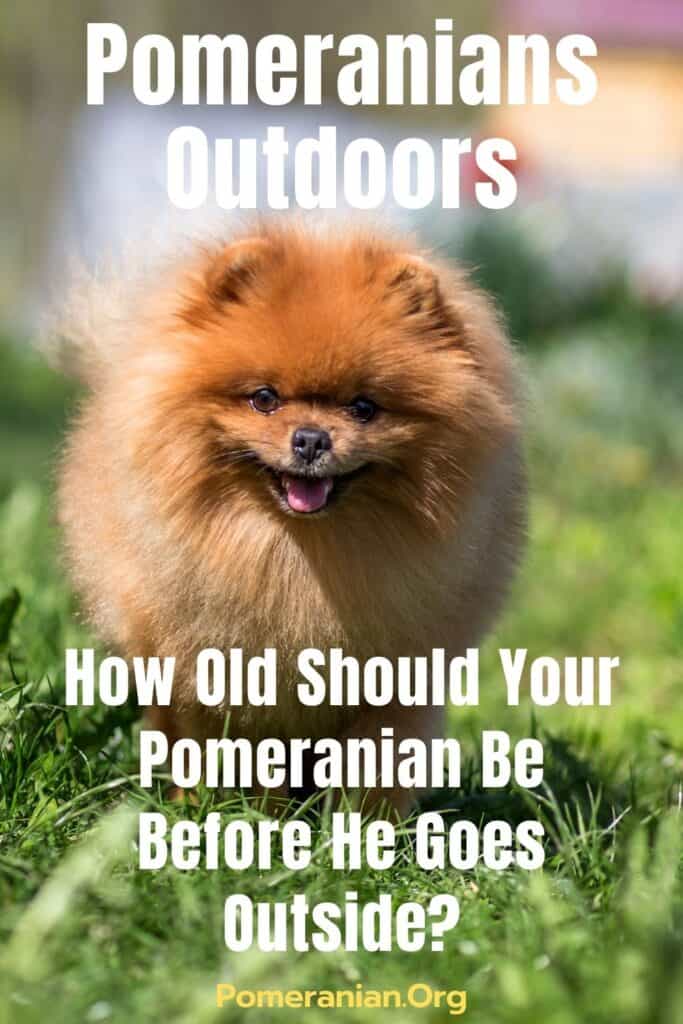
How Old Should Your Pomeranian Be Before He Goes Outside?
This question has three answers:
- Letting him outside in your yard. If other factors are covered, you can take your Pom out into your backyard when he’s eight weeks old. However, this is only if no other dogs can get in, including other dogs you own. It’s also essential that your yard is clean. i.e., you have treated the ground for weeds and fleas, etc., with necessary chemicals, and how long those chemicals remain at a toxic level. If you don’t know how long, consider using a canine playpen and a ground sheet, so he’s still outside but protected from everything on the ground.
- Carrying your Pomeranian in public. At eight weeks of age, you can take your puppy outside AS LONG AS YOU HOLD HIM AT ALL TIMES. Until he has had all the necessary shots, his feet can never touch the ground outside, except in your backyard if it’s safe. Taking your puppy out in public places until his puppy shots are complete should be avoided. This includes being out in your front yard, while walking along the footpath, at the shops, in parks, and in yards belonging to neighbours, among other places.
- On the ground in public. Vaccination periods may vary from veterinarian to veterinarian, so you must ask your veterinarian if all necessary shots have been administered before allowing your Pom to go out in public. Even after he has been given all the shots, it’s best to wait an extra two weeks in case he’s still susceptible. So it means he’ll be 12-16 weeks old before he can safely be taken outside. Then you can put him on the ground and let him explore, as long as you have him on a leash at all times while he’s out.
Pomeranians Inside
Can I keep my Pomeranian inside 100% of the time?
Some owners do keep their dogs inside all the time, but it’s very unhealthy. Unless you live in a spacious mansion, your home won’t have sufficient space for him to run around, enjoying himself, and burning off all that energy so he’s tired enough to have good quality sleep.
A small amount of sunshine each day is necessary for vitamin D production. Regular exercise is essential for your Pom’s overall well-being.

If you take him for a 20-minute brisk walk, he’ll burn off lots of energy, and that helps prevent the urge to bark and/or chew things. Plan your walks to happen at the same time every day (if possible) so he looks forward to it.
Exercise helps him fight off diseases, improves his sense of smell, hearing, and sight, is heart-healthy, and balances out his muscle tone.
Can I Stop My Pomeranian’s Fear of the Outside?
Your dog will usually be wary of new things and may react when facing something new by ignoring you and/or barking. Don’t be in a hurry to expose him to everything outside the home simultaneously, and don’t go from 0 to 100 without stops in between.
Take baby steps when introducing your Pomeranian puppy to new elements that will be in his life. Then he won’t feel bombarded. Take him for short walks and avoid possible triggers such as heavy traffic. Then gradually change the places where you walk him and include areas with noise.
Don’t keep him inside all the time; It’s only by going out into the real world that your Pom pet will learn what he can/can’t do. This means that, over time, he’ll respond less frequently to loud noises or other distractions that may previously have greatly annoyed or alarmed him to begin with.
Do Dogs Like the Rain?
Do dogs like the rain? Dogs either love running and playing in the rain, OR they refuse to get their paws wet. Obviously, you don’t want your Pom to get drowned in a torrent of rain, so it’s wise to slowly teach him that rain can’t harm him.
Take baby steps at first. Put a dog raincoat on him and/or keep him under your umbrella so he feels safe. If the weather is warm and it’s only drizzling, encourage him to go outside because the rain won’t feel so bad. The more often he gets wet, the less frightened he’ll be when it comes to rainy weather.
Putting Your Pomeranian Outdoors to Potty
When first considering how to train your dog to do his business outside, it may seem logical to train him to use a doggie door so he can come and go when he wants.
However, you should also consider a few other elements.
- Choose one part of your yard for him to do his business. If you let him roam and do it wherever he desires, that can hinder the learning process. A Pom faces numerous distractions (and potential dangers), which can prevent him from indicating to you that he needs to go outside when he needs to use the toilet. Without structure, your Pom won’t automatically associate going outside with his need to go to the bathroom as two aspects of the same event, instead of two separate events.
- Suppose you’re unable to supervise your Pomeranian when he successfully does his business in the designated area outside. In that case, you won’t have extra chances to praise his actions and even reward him, which all helps strengthen the training you’re doing with him. Otherwise, he can easily forget what he has learned. The ideal method to teach your pet anything is to acknowledge and reward the moment he does his business, and that’s impossible if you’re not outside when it happens.
- When your Pomeranian is outside, there are numerous potential dangers it may encounter. Some owners claim they always let their dogs play or do bathroom business on their own and have never had any problems. However, they’re fortunate and are in a small minority.
If your Pomeranian is left on his own outside whenever he wants to go out, it’s most likely that, at some point, he’ll have a problem with one or more of these potential dangers:
- Poms are attractive and small, so they’re potential targets for dognappers. Even if your yard is secure, there’s still the potential that you’ll lose him.
- Pomeranians are small, making them vulnerable to being viewed as prey by hawks, eagles, owls, and other wild birds. If you’re outside with your pet, he’s safe, but if he’s alone, he has little chance against large birds of prey.
- If your yard is securely fenced in, meaning your dog can’t burrow beneath it and he can’t jump over it, it still doesn’t guarantee that aggressive dogs and even coyotes may somehow get in. Poms are courageous and will often try to protect their territory. However, they’re also small and, when faced with a much larger creature, they don’t have much chance.
- Leptospirosis is an animal disease and is spread through the urine of creatures such as raccoons, deer, skunks, and other animals. If you allow your Pom to wander the yard alone, he may sniff out areas that you would never let him get near if you were outside with him. Not every dog gets all the possible vaccinations. Veterinarians generally only vaccinate against Leptospirosis if you live in an area with a high risk of exposure. For example, your home may back onto a forest. If not diagnosed early enough, this disease can kill your dog. Even if you 100% supervise your Pom when he’s in the yard, if you believe there’s a remote risk of this disease, consider discussing the vaccine with your vet for your pet.
- Insect stings. All stinging insects can affect your Pom when he’s outside. Bee stings can be painful, cause dangerous allergic reactions, and, if not diagnosed and treated quickly, can be fatal. One sad example occurred with a lady who had two Pomeranians. They were alone in the yard. After a short while, they grew quiet, and she became worried, so she went outside to make sure they were okay. A swarm of bees attacked them both, and sadly, one of them died as a result. If the lady were outside with her dogs, she could probably have picked one or both of them up and run inside. However, the lack of supervision resulted in the loss of one dog.
- Mushrooms and plants. Yards often contain toxic flowers and plants. There are currently 96 potentially poisonous weeds and plants listed.
- Running away. Jumping fences isn’t the only means of escape for dogs. Some can burrow under a wall, either by digging or pushing through a weak area. Poms and other small dogs don’t need much space from which to escape. Regardless of whether your Pom is the most beloved dog in the world, there may still be possible reasons for running away, including sexual canine instincts.
- An un-neutered male can smell the urine of an “in heat” female up to a distance of five kilometres. Females that haven’t been desexed may feel powerful urges to escape and locate males, including males that have been fixed, if they feel curious or bored, a feeling of something scary, or a chase trigger.
Pomeranians and Hypothermia
This depends on whether the dog has any protection, the temperature of the weather, and the length of time spent outdoors in the cold. If he’s soaking wet, he would rapidly develop hypothermia.
If anybody (dog or human) is outside in a temperature lower than they’re own body temperature for enough time, they would face hypothermia. A dog’s normal temp is 101 – 102.5, so 98F (38C is a hypothermic temp. In winter, if your Pomeranian trod in a puddle and got wet or was bathed and went outside before he was dry, hypothermia may set in within 15 minutes.
If he played in the snow and got his coat wet, the time would be 20-30 minutes. If his coat is dry and the weather is above freezing point (32°F) but under 40°F, he can last one hour outside. If he’s well-hydrated and active, he may be fine for up to two hours.
If the temp is below freezing and he’s active, he may last 30-45 minutes. If he has a coat, he may be able to push that time out to 60 minutes. If the temp is 10°F or below, he won’t survive more than 10 mins before hypothermia kicks in.
Pomeranian and Frostbite?
Of course he can! But he has to be outside for a long period in the winter weather, and his ear tips, tail, nose, and paws will be mostly affected. How long he can last before suffering frostbite will vary according to wind chill and temperature.
If you take him for a walk or to do his business, that won’t be enough time. If the wind speed is 15mph and the temperature is 0°F, frostbite would set in within 30 minutes. If the temperature is 5°F and the wind is 30mph, the same results would happen.
Pomeranians and Heat Stroke
A Pomeranian in heat during the summer is a serious problem, as heat stroke can occur. The timing of this event depends on various factors, including the dog’s activity level, humidity, and temperature. Many people think a thick coat (like the coat of Pomeranians) increases the risk, when the reverse is actually true.
Shaving your Pom isn’t always wise in the summer because the coat helps protect against direct sun exposure. Heat exhaustion is the first indicator, and symptoms include: weakness, panting, vomiting, and confusion.
When heat stroke starts, additional symptoms include diarrhea, disorientation, pale or red gums, heavier panting, and an increased heart rate. If untreated, heat stroke can lead to a coma and even death. Heat stroke can occur in under 30 minutes, depending on various factors.
Can a Pomeranian Safely Drink from Puddles?
No! Puddles can contain all sorts of nasties, including waterborne parasites, road salt, and ice-melt chemicals. Giardia is a parasite, but the vaccine doesn’t cure it. It merely stops shedding, which can help prevent the disease from spreading.
Dogs of all ages may get coccidia. Not all dogs get vaccinated against leptospirosis. Campylobacter and cryptosporidium can affect puppies under six months the most.
Pomeranians Outdoors Conclusion
Dogs allowed to be in your yard unsupervised face the risk of many different dangers. Consider your Pomeranian like you would a small child and protect him as much as you can. Your pet fully trusts you to keep him as safe as possible at all times.
Copyright Pomeranian.Org. All Rights Reserved.
📚 References & Further Reading
- [1] AKC Pomeranian Breed Standard (2011)
- [2] English Kennel Club Breed Standard
- [3] The Pomeranian Handbook – Denise Leo
- [4] Denlinger, The Complete Pomeranian
- [5] Kimbering, 1891–1991
- [6] Taplin, The Sportsman’s Cabinet
- [7] Parker, The Popular Pomeranian
- [8] Ives, Show Pomeranians