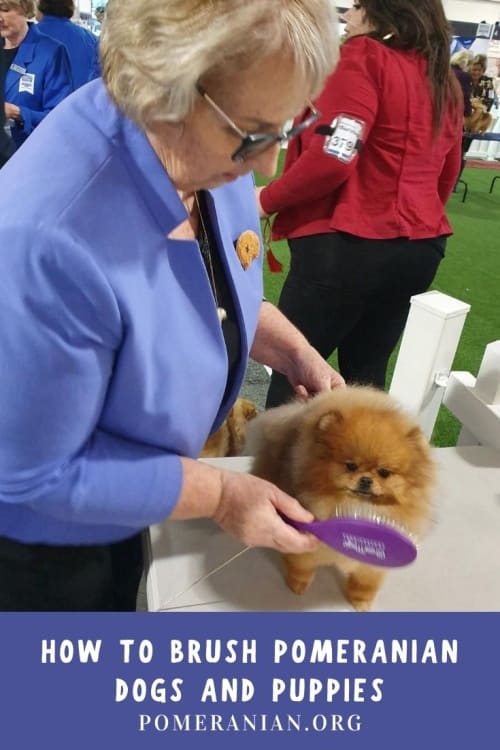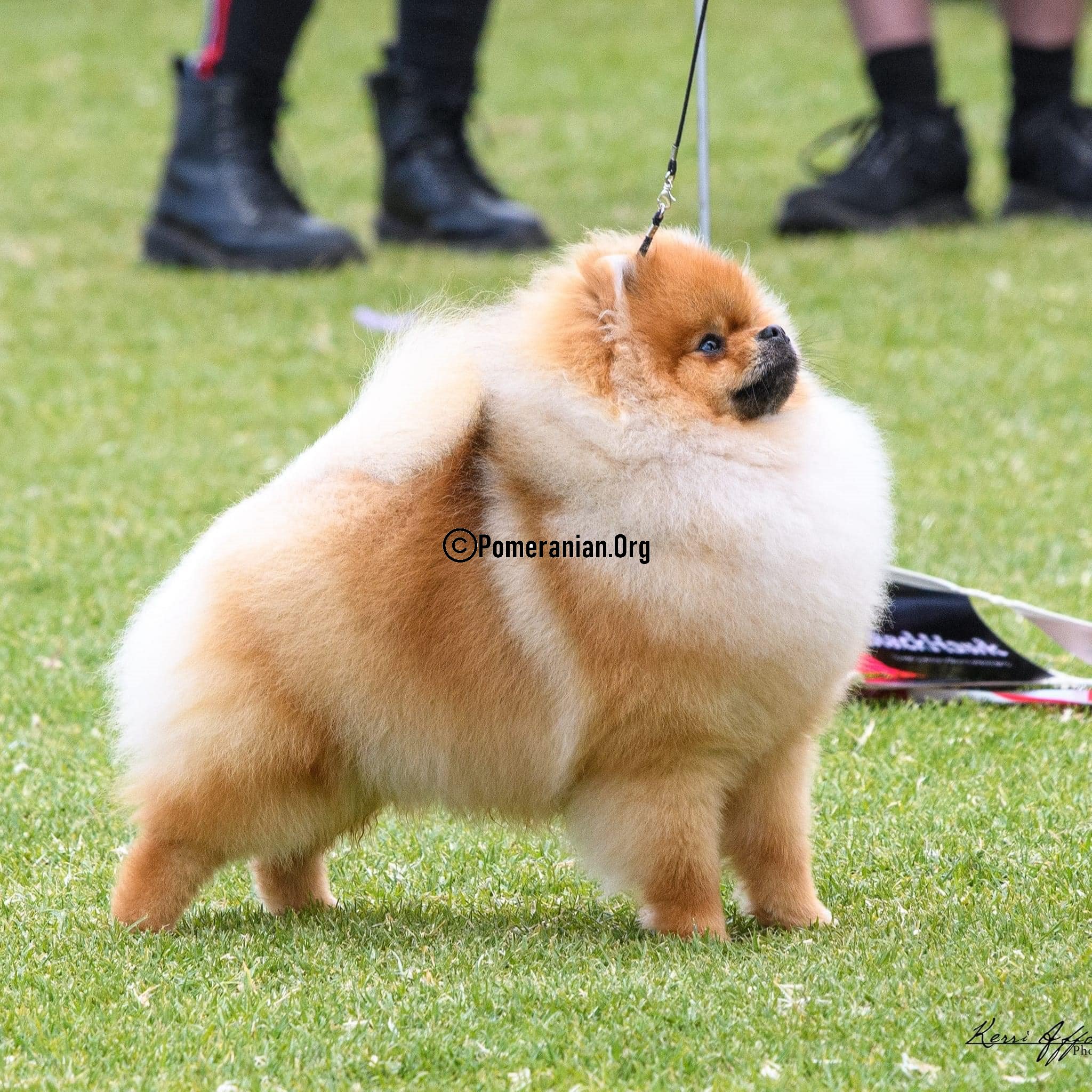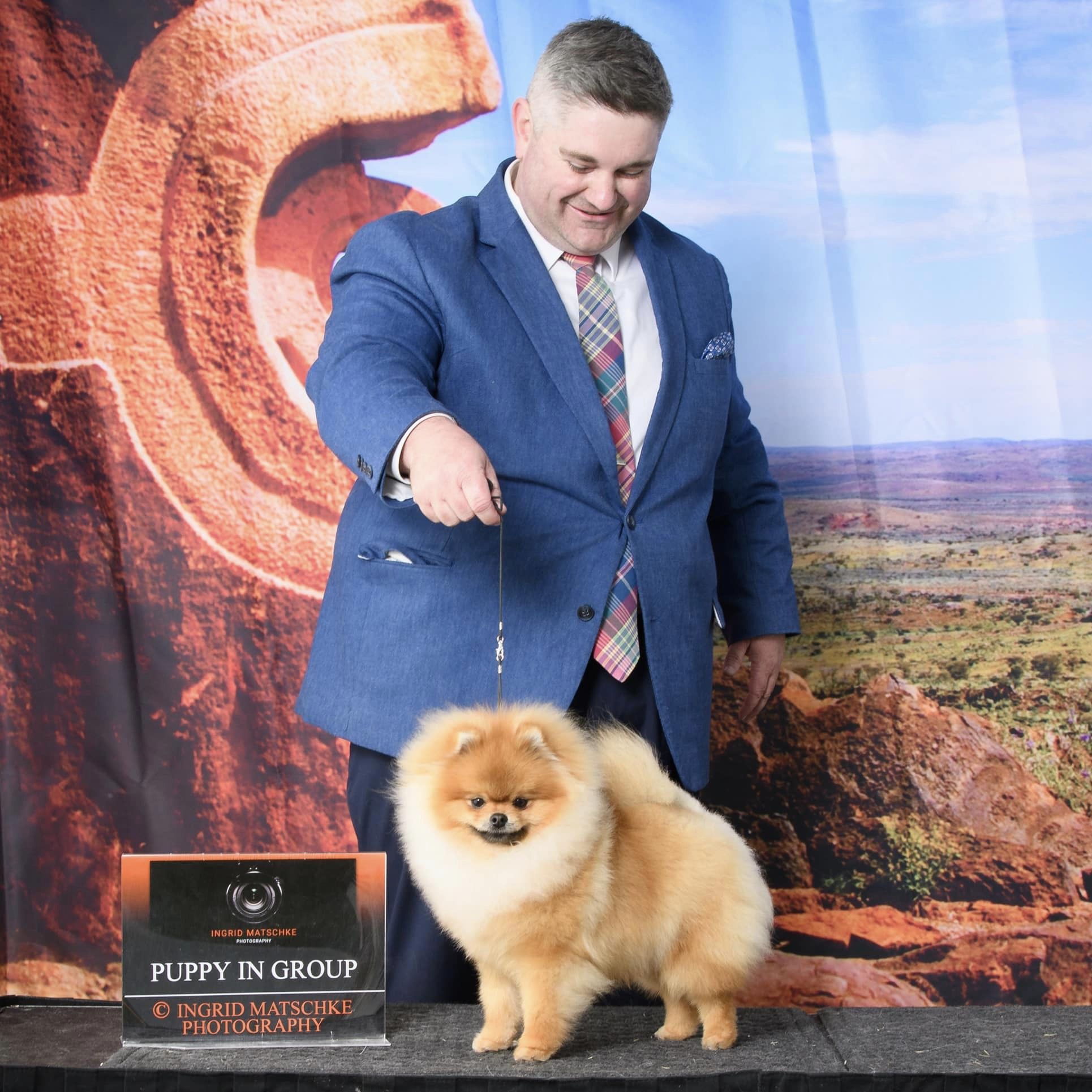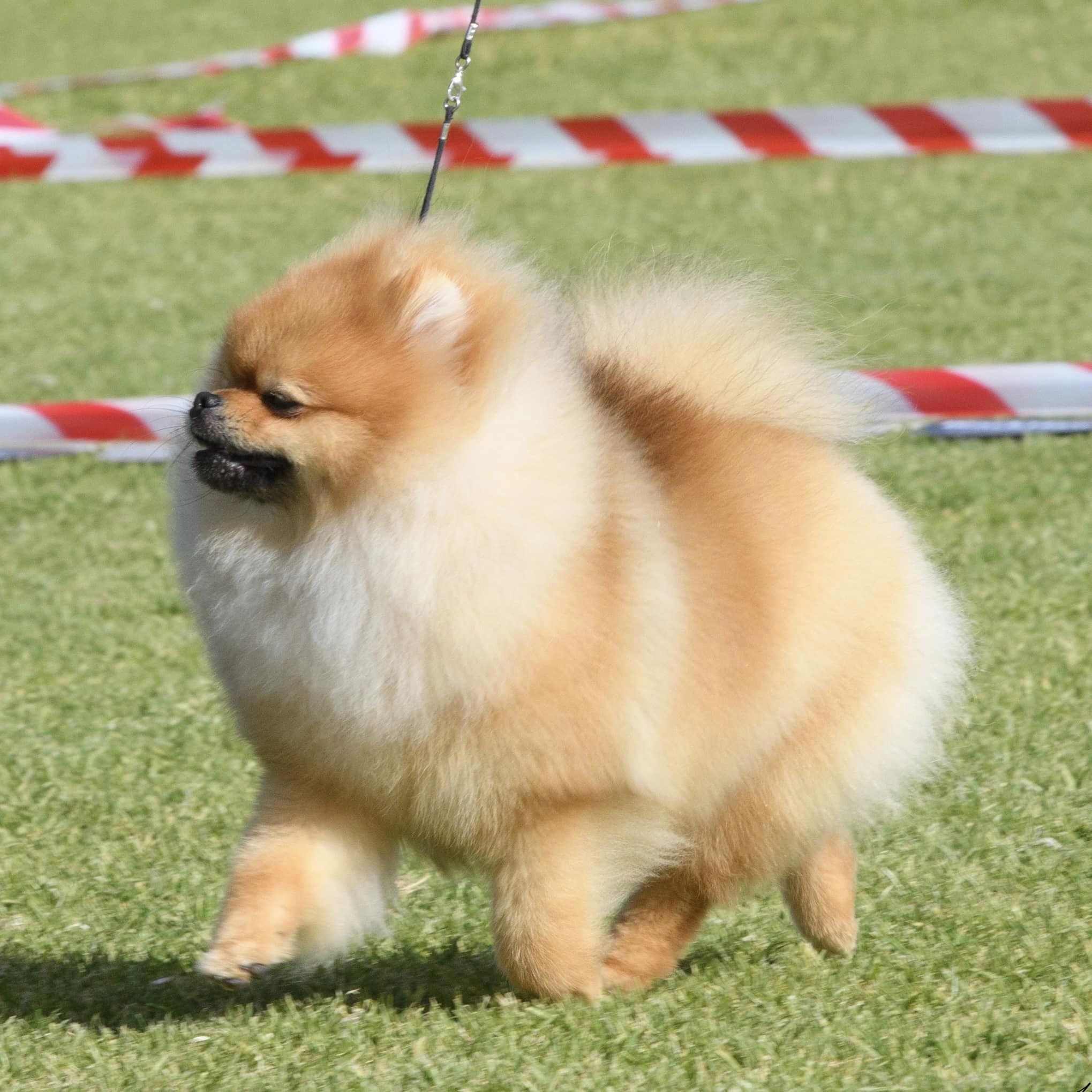

Brushing a Pomeranian correctly involves more than running a brush over the surface of the coat. Pomeranians have a thick double coat and a loose undercoat; small tangles and developing mats can remain hidden beneath the longer guard hairs. This is why learning the correct line-brushing technique is so important.
During more than 50 years of breeding, exhibiting, grooming, and judging Pomeranians, I have prepared countless coats for everyday care and the show ring. Regular, gentle brushing helps prevent painful mats, removes loose hair, distributes natural oils, and provides an opportunity to check the skin for irritation, lumps, parasites, or other changes.
“Proper brushing is essential for a Pomeranian’s coat health. Start with a high-quality slicker brush to detangle, always brushing gently to prevent skin irritation. Regular grooming not only enhances the Pomeranian’s appearance but also supports good skin and coat health.”
— Denise Leo, internationally recognized Pomeranian breed expert, preservation breeder and exhibitor with more than 50 years of experience, Pomeranian judge, and author of The Pomeranian Handbook and Pomeranian Grooming
Pomeranian Brushing: Quick Answers
How Often Should You Brush a Pomeranian?
Most adult pet Pomeranians should be thoroughly brushed two or three times each week. Daily attention may be helpful during seasonal shedding, after outdoor activities, or when the coat is especially dense and prone to tangling.
Young puppies should have short, gentle brushing sessions two or three times weekly. At this age, the main purpose is to teach the puppy that grooming is safe and enjoyable.
What Is the Best Brush for a Pomeranian?
A high-quality soft slicker brush is useful for removing loose undercoat and gently working through small tangles. A pin brush with smooth, polished metal pins is helpful for separating and maintaining the longer outer coat.
Avoid pin brushes with plastic balls on the ends because they can catch, pull, and break the Pomeranian’s coat.
Do You Need a Metal Comb?
Yes. A metal comb is essential for checking your work after brushing. Once the coat has been thoroughly line-brushed, a wide-toothed metal comb should pass from near the skin through to the ends without catching.
If the comb stops, a tangle or compacted undercoat is still present and requires further gentle attention.
Should You Brush a Pomeranian’s Coat Wet or Dry?
Do not soak the coat before brushing. A very light mist of dog-safe grooming or conditioning spray can reduce static and help protect the hair from unnecessary breakage.
The coat should be only lightly misted—not wet or saturated. Use products formulated for dogs and follow the manufacturer’s instructions.
What Is Line Brushing?
Line brushing is a technique in which the coat is separated into narrow sections so each layer can be brushed from near the skin toward the ends. This allows you to reach the undercoat instead of brushing only the visible surface.
It is the most reliable method for finding hidden tangles, removing loose undercoat, and maintaining a Pomeranian’s dense double coat.
Where Do Pomeranians Mat Most Easily?
Pay special attention to:
- Behind and underneath the ears
- The armpits
- The chest and neck
- Beneath the collar or harness
- The groin and inner thighs
- The trousers on the hindquarters
- Underneath and around the tail
- Areas where the coat becomes wet or rubs against equipment
These areas should be checked during every thorough grooming session.
Can Brushing Damage a Pomeranian’s Coat?
Yes, if the wrong tools or excessive force are used. Vigorous brushing can irritate the skin, break guard hairs, and make grooming painful.
Brush gently in small sections, support tangled hair close to the skin, and never pull a brush forcefully through a knot. The purpose is to separate and maintain the coat—not to remove as much hair as possible.
Grooming Tools Needed to Brush a Pomeranian
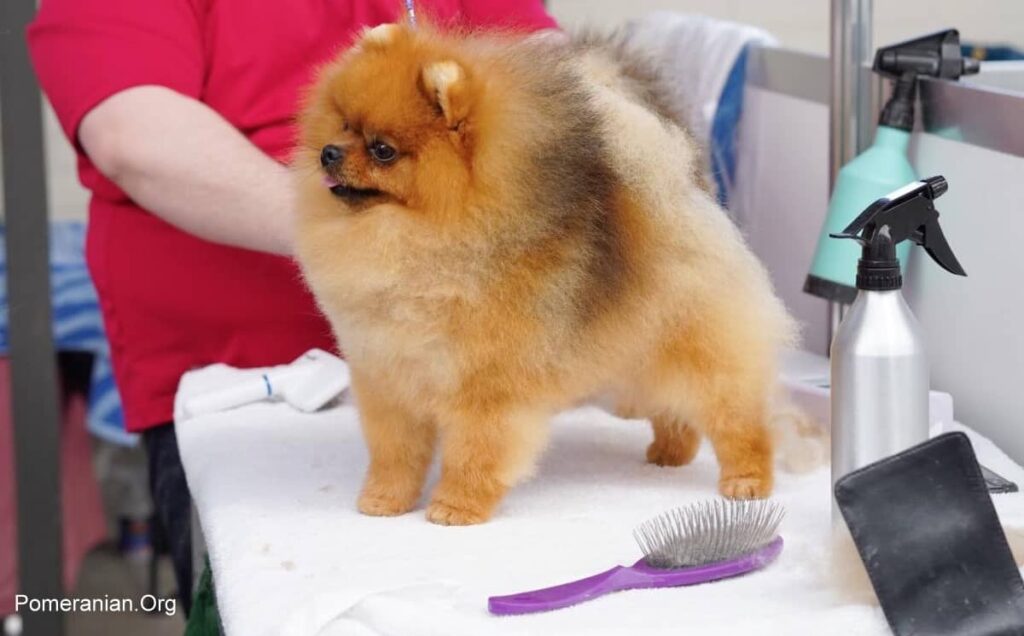
Using the correct grooming tools makes brushing safer, more comfortable, and more effective. Cheap brushes with sharp, rough, or poorly finished pins can scratch the skin and break the coat, so choose good-quality tools designed for long or double-coated dogs.
The basic tools required are a pin brush, a soft slicker brush, a metal comb, and a dog-safe grooming spray.
Pin Brush
A high-quality pin brush is useful for general coat maintenance and line brushing. Choose one with smooth, polished metal pins set into a cushioned pad.
The pins should be long enough to reach through the outer coat without scratching the skin. Avoid pin brushes with plastic or rubber balls on the ends because these tips can catch and damage the hair.
Use the pin brush gently to separate the coat and brush each narrow section from near the skin toward the ends.
Soft Slicker Brush
A soft, flexible slicker brush helps remove loose undercoat and work through small tangles. Select a size that is easy to control on a small dog.
The slicker should have fine pins that are smooth and flexible rather than hard and sharp. Always use light pressure. Repeatedly scraping the same area can cause skin irritation commonly known as slicker burn.
A slicker brush should never be used to tear through a tight knot or mat.
Metal Grooming Comb
A good-quality metal comb is an essential finishing tool. A combination comb with wider teeth at one end and finer teeth at the other is particularly useful.
Use the wider teeth to check the body coat and the finer section for smaller areas around the ears, feet, and face. The comb should glide through the coat after brushing without catching.
If the comb stops, do not force it. Return to that area with your fingers, pin brush, or soft slicker and gently separate the remaining tangle.
Dog-Safe Grooming Spray
A light grooming or conditioning spray may help reduce static, add slip, and limit unnecessary hair breakage during brushing.
Mist one section lightly before working through it. The coat should never be saturated. Choose a product made specifically for dogs and follow its dilution and application directions.
Avoid spraying directly into the eyes, nose, mouth, or ears.
Grooming Table or Non-Slip Surface
A secure grooming table can make it easier to reach every part of the coat. Pet owners may also use a stable table covered with a non-slip grooming mat.
Never leave a Pomeranian unattended on an elevated surface, even for a moment. Keep one hand on the dog or use suitable grooming support correctly.
A small Pomeranian can also be brushed safely on your lap if this is more comfortable for both you and your dog.
Optional Detangling Tools
A mat splitter or specialized dematting tool should only be used by someone who understands how to use it safely. These tools contain sharp edges and can injure the dog or remove excessive amounts of coat.
For a pet owner, fingers, a conditioning spray, a pin brush, a soft slicker, and a metal comb are usually the safest choices. Tight or extensive mats should be handled by an experienced Pomeranian groomer or veterinarian.
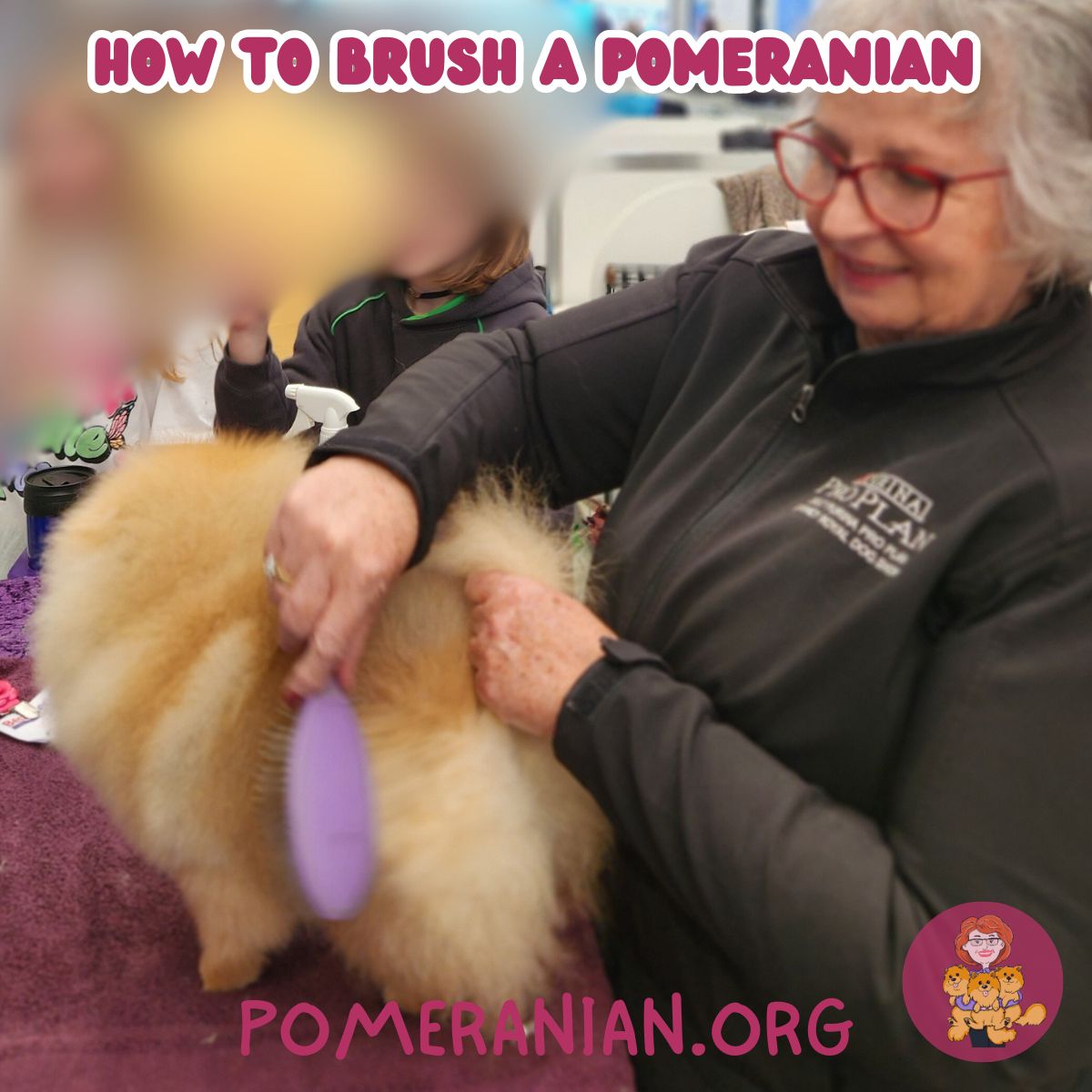
How to Brush a Pomeranian Step by Step
Allow approximately 15 to 30 minutes for a thorough grooming session, depending on the length and condition of the coat. Work slowly and gently, particularly if your Pomeranian is a puppy or is not accustomed to being brushed.
Step 1: Prepare Your Pomeranian
Choose a quiet location and place your Pomeranian on a stable, non-slip surface. Your dog may stand, lie on its side, or sit on your lap—whichever position allows you to work safely and comfortably.
Before brushing, run your hands gently over the coat. Check for:
- Knots and mats
- Skin irritation or redness
- Lumps or sore areas
- Fleas, ticks, or other parasites
- Grass seeds and small debris
- Damp or dirty areas
If your dog reacts painfully when a particular area is touched, stop and examine it carefully. Seek veterinary advice if you find a wound, swelling, inflammation, or unexplained tenderness.
Step 2: Lightly Mist the Coat
Separate the first section and apply a very light mist of dog-safe grooming spray. Hold the bottle away from the body so the product is distributed evenly.
The coat should be lightly conditioned rather than wet. Avoid spraying the face directly. Apply a small amount to your hands or brush when working around the head.
Step 3: Check for Small Tangles
Use your fingers to feel for small knots before placing a brush through the coat. Support the hair close to the skin with one hand so the skin is not pulled.
A soft slicker brush can help loosen small tangles. Begin near the ends of the hair and gradually work toward the skin using short, gentle strokes. Never drag the brush forcefully through a knot.
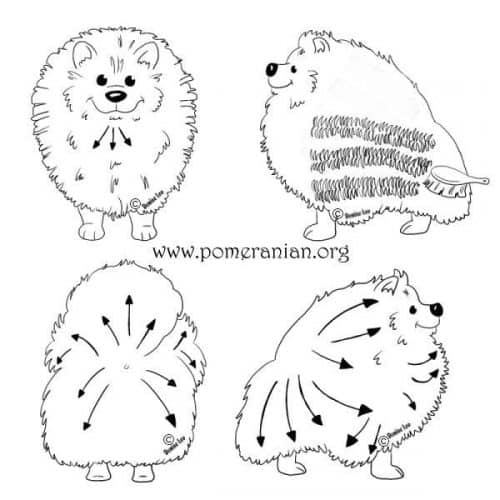
Step 4: Divide the Coat Into Lines
Use one hand to lift the coat and expose a narrow horizontal line of hair. You should be able to see the base of the coat and inspect the skin without scraping it with the brush.
Work through only a small section at a time. Brushing the entire outer surface may make the dog look tidy while leaving loose undercoat and tangles hidden underneath.
Step 5: Brush From Near the Skin Toward the Ends
Using a pin brush, brush the exposed section outward in the natural direction of the hair. Begin near the skin without pressing or scratching it, then continue gently toward the ends.
Repeat until the section is separated and free from loose hair. Lower another narrow layer of coat and continue in the same way.
Step 6: Work Through the Entire Coat
Follow a consistent order so no area is forgotten. You may brush:
- One side of the body
- The hindquarters and trousers
- The tail
- The other side
- The chest and neck
- The abdomen and groin
- The front and back legs
- Behind the ears
- The head and facial coat
Pay particular attention to friction areas beneath the collar or harness, behind the ears, under the front legs, and around the hindquarters.
Use very light pressure around the face, ears, abdomen, groin, and other sensitive areas.
Step 7: Use the Slicker Brush Where Needed
After line brushing with the pin brush, use a soft slicker gently on areas containing loose undercoat or small remaining tangles.
Brush in short, controlled strokes and regularly check the skin. Do not repeatedly scrape one spot, as this can cause irritation or slicker burn.
Step 8: Check the Coat With a Metal Comb
Finish by passing a wide-toothed metal comb through each section from near the skin toward the ends.
The comb should glide through smoothly. If it catches, do not pull. Stop, locate the remaining tangle with your fingers, and gently work through the area again.
Step 9: Reward Your Pomeranian
Praise your dog throughout the session and reward calm behavior with a small treat when grooming is finished.
Ending calmly and positively helps your Pomeranian associate brushing with comfort, attention, and rewards. This is especially important for puppies and dogs still learning to accept grooming.
How to Line-Brush a Pomeranian’s Double Coat
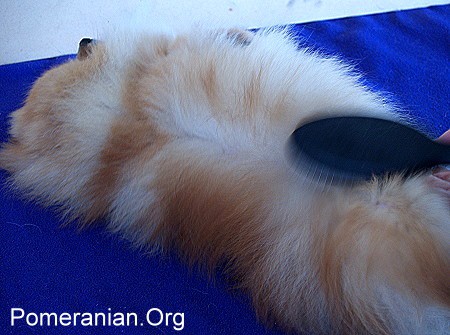
Line brushing is the most effective method for thoroughly brushing a Pomeranian. Instead of brushing only the visible outer coat, you divide the hair into narrow rows and work through one layer at a time.
This technique allows you to reach the dense undercoat, locate hidden tangles, and remove loose hair without repeatedly pulling through the entire coat.
Begin at the Lowest Section
Place your Pomeranian comfortably on its side. Begin near the lower part of the body, lift the coat above it with one hand, and expose a narrow line of hair.
Starting low and gradually working upward prevents finished sections from falling over the unbrushed coat.
Brush One Narrow Line at a Time
Lightly mist the exposed section with a dog-safe grooming spray. Hold the upper coat out of the way and brush the narrow line from near the skin toward the ends.
Use gentle, controlled strokes. The brush pins should pass through the coat without being driven into the skin.
Once the section is smooth, release another small layer of hair and repeat the process. Each completed line should blend naturally into the section below it.
Follow the Direction of Coat Growth
Brush outward in the natural direction of the hair. Do not repeatedly drag the coat backward or scrape the same area.
The purpose of line brushing is to separate the hair and release loose undercoat—not to strip out healthy coat.
Work Methodically Around the Body
Complete one side before turning your Pomeranian and brushing the other. Continue line brushing through:
- The sides of the body
- The shoulders
- The chest and neck
- The hindquarters and trousers
- The legs
- The abdomen
- Beneath and around the tail
Use smaller sections and lighter pressure on sensitive areas such as the abdomen, groin, armpits, ears, and face.
Line-Brush the Ruff
A Pomeranian’s neck ruff can be especially dense. Lift the coat in small sections and work gradually around the neck and chest.
Take care near the throat and do not place pressure on the trachea. Remove the collar before brushing so you can check the coat and skin underneath it.
Brush the Tail Carefully
The tail coat contains long hair that can be damaged by rough handling. Support the tail with one hand and divide the hair into small sections.
Begin at the ends of any tangles and gradually work inward. Avoid pulling or repeatedly brushing the same area.
Check carefully near the base and underneath the tail, where loose hair and small knots may be hidden.
Use the Comb Test
After completing each area, pass a wide-toothed metal comb gently through the coat. The comb should move from near the skin to the ends without catching.
If the comb stops, a small tangle or compacted undercoat remains. Return to that section and separate it gently rather than forcing the comb through.
When the comb glides easily through every section, the line-brushing session is complete.
How to Remove Pomeranian Tangles and Mats Safely
Small tangles are usually manageable when discovered early. Tight mats are more difficult because they pull continuously on the skin and may conceal redness, sores, parasites, or infection.
Never try to remove a mat by force. If your Pomeranian shows pain, becomes distressed, or has extensive matting close to the skin, stop and seek help from an experienced groomer or veterinarian.
Begin With Your Fingers
Place your fingers between the knot and the skin to reduce pulling. Gently separate the tangle into several smaller sections using your fingertips.
Work slowly from the outside edges rather than attempting to pull the entire knot apart at once.
Apply a Dog-Safe Detangling Spray
Lightly apply a detangling or conditioning spray formulated for dogs. Follow the product directions and allow it time to provide slip before continuing.
The coat should be lightly dampened rather than saturated. Avoid applying products to inflamed or broken skin unless directed by your veterinarian.
Work From the Ends Toward the Skin
Hold the hair firmly but gently between the mat and the skin. Begin loosening the ends of the tangle with your fingers, a soft slicker, or the wide end of a metal comb.
As the outer portion separates, gradually work closer to the skin. Trying to drag a brush from the skin through the entire knot will cause pain and may break or remove healthy hair.
Use Short, Gentle Brush Strokes
Use the corner of a soft slicker brush to work through one small area at a time. Apply minimal pressure and check the skin frequently.
Do not repeatedly scrape one spot. If the skin becomes pink, red, or tender, stop the session.
Check With a Metal Comb
Once the tangle appears to be removed, pass a wide-toothed metal comb gently through the section.
If the comb catches, do not force it. Locate the remaining strands with your fingers and continue separating them carefully. The area is complete only when the comb passes through smoothly.
Never Cut Beneath a Mat With Scissors
A tight mat can pull and fold the skin upward into the tangled hair. This makes it extremely easy to cut the skin accidentally, even when you believe the scissors are safely beneath the mat.
Do not slide scissors between a mat and your Pomeranian’s skin. Large, tight, or skin-level mats should be removed by a skilled professional using appropriate equipment.
When Professional Help Is Needed
Contact an experienced groomer or veterinarian if:
- Matting covers a large area
- Mats are extremely tight or close to the skin
- The skin appears red, moist, inflamed, or infected
- There is an unpleasant odor beneath the mat
- Your Pomeranian cries, snaps, or repeatedly tries to escape
- A foreign object is caught in the coat
- You cannot see or feel where the skin begins
- The dog is elderly, unwell, or unable to tolerate a long grooming session
Severely matted coat may occasionally need to be clipped for the dog’s welfare. This should be performed by a professional who can assess the skin and minimize the risk of injury.
Prevent Mats From Returning
After the tangle has been removed, check the area frequently. Regular line brushing, thorough drying, correctly fitted collars or harnesses, and prompt removal of debris will help prevent new mats from forming.
The safest approach is always prevention. Removing a small tangle during routine brushing is far easier and more comfortable than dealing with a tight mat later.
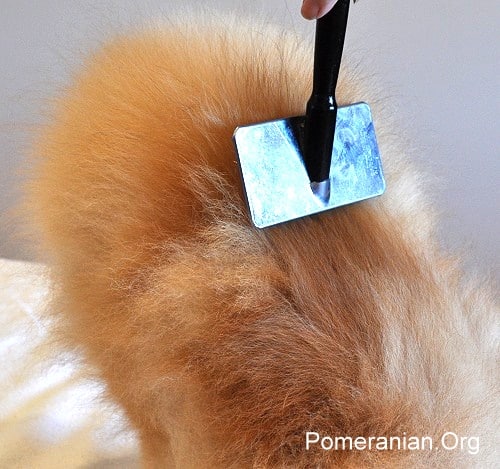
Brushing Pomeranian Puppies Through the Coat Change
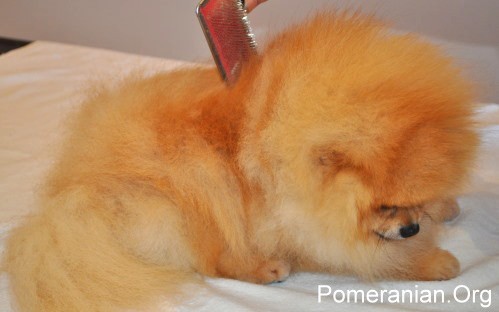
Pomeranian puppies should become accustomed to brushing long before their adult double coat begins to develop. Early sessions can be brief, but regular handling teaches the puppy to accept grooming calmly and makes the more demanding coat-change period much easier to manage.
The first adult coat usually begins developing as the soft puppy coat starts to shed. This transition is commonly known as the Pomeranian puppy uglies and often becomes noticeable from approximately four to six months of age. The timing and duration vary considerably between puppies.
Loose Puppy Fur Must Be Removed
As the adult coat begins to grow, the soft puppy fur loosens and sheds. Much of this hair does not immediately fall onto the floor. Instead, it can remain trapped within the developing coat.
This loose puppy fur needs to be removed gently and regularly. If it remains trapped, it can twist around the new adult hair, restrict airflow through the coat, and create tangles or mats close to the skin.
Brushing does not cause the adult coat to grow, but removing the loose puppy fur allows the new coat to emerge without being tangled in retained, dead hair.
How Often Should You Brush During the Coat Change?
Brush a puppy going through a coat change at least two or three times each week. Puppies shedding heavily or developing a particularly dense adult coat may require gentle daily attention.
The aim is not to complete a long, intensive grooming session every day. Frequent short sessions are often more comfortable and allow you to remove the loose coat gradually.
How to Brush a Changing Puppy Coat
Use a light grooming mist and work through the coat in small sections. Begin with your fingers or a pin brush to separate the soft hair, then use a small, soft slicker to collect loose puppy fur.
Finish with a metal comb to check for hidden tangles. Use especially gentle pressure because a puppy’s skin is delicate and the changing coat can be uneven.
Pay particular attention to:
- Behind the ears
- The armpits
- The chest and neck
- The thighs and trousers
- Beneath the tail
- Areas underneath a collar or harness
These locations often retain loose puppy coat and can mat rapidly.
Expect an Uneven Appearance
During coat change, a puppy may temporarily lose much of the fluffy baby coat. The legs may look long, the ears more prominent, the muzzle more noticeable, and the body coat thin or uneven.
This is usually a normal developmental stage. Some puppies change coat quickly, while others take considerably longer to develop a full adult coat.
During more than 50 years of breeding and exhibiting Pomeranians, I have watched many beautiful puppies pass through a stage when their coats looked thin, patchy, or completely unlike their eventual adult coats. Consistent gentle grooming helps keep the skin and developing coat in good condition throughout this transition.
Do Not Over-Brush Thin Areas
Although loose puppy coat should be removed, do not continue brushing an area after the dead hair has been released. Excessive brushing can irritate the skin and break the developing adult guard hairs.
Use the metal comb as your guide. When it passes smoothly through the section without collecting loose hair or catching on a tangle, move to the next area.
When Coat Loss May Not Be Normal
Normal puppy coat change should not cause inflamed skin, open sores, severe itching, a strong odor, or obvious discomfort. Contact your veterinarian if you notice these signs or if the hair loss appears extreme and the skin looks abnormal.
With regular, patient grooming, the loose puppy coat can be removed safely while the new adult double coat develops.
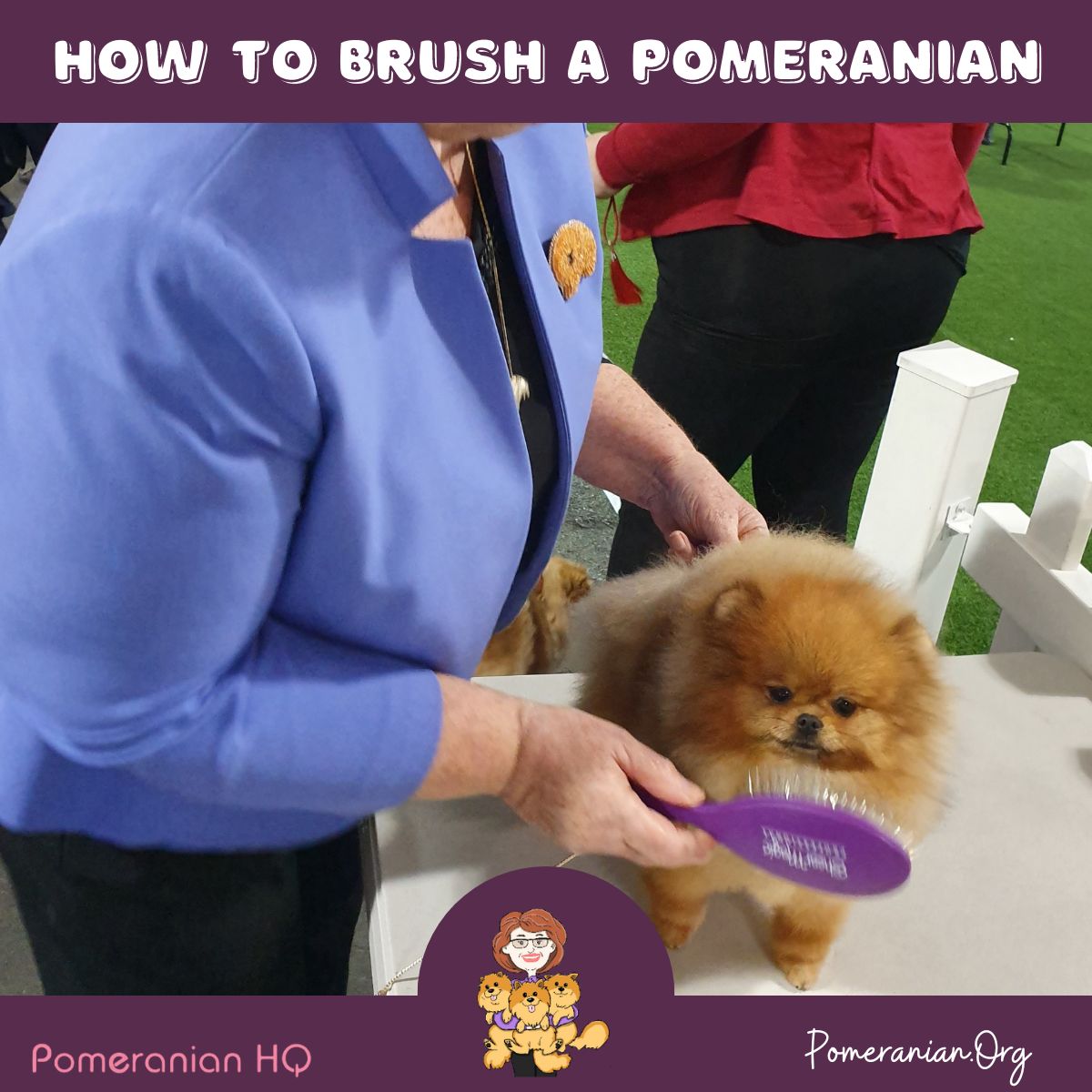
How Often Should You Brush an Adult Pomeranian?
Most adult pet Pomeranians benefit from a thorough line-brushing session two or three times each week. However, the ideal schedule depends on the individual dog’s coat density, activity level, grooming history, and whether the coat is currently shedding.
A Pomeranian with a very dense coat or one that tangles easily may need more frequent attention. Daily light brushing may be helpful during heavy shedding, after outdoor activities, or when the coat has been exposed to moisture.
Normal Weekly Brushing
During periods of normal coat growth, concentrate on completing a careful line brush rather than repeatedly brushing the outer surface.
A typical weekly routine may include:
- Two or three complete line-brushing sessions
- Quick daily checks behind the ears and under the front legs
- Immediate removal of grass, food, or other debris
- Additional brushing after the coat becomes damp
- A final metal-comb check after every thorough session
The aim is to prevent tangles before they tighten into mats.
Brushing During Seasonal Shedding
Adult Pomeranians may shed more heavily as their coats respond to seasonal and environmental changes. During a heavier shed, loose undercoat can remain trapped beneath the guard hairs and quickly become compacted.
Increase the frequency of brushing during these periods. Some Pomeranians may require gentle daily line brushing until most of the loose undercoat has been removed.
Work in small sections and remove only hair that is already loose. Brushing should never be used to strip healthy undercoat or pull out firmly attached coat.
Entire Females and Coat Changes
Entire female Pomeranians may experience noticeable coat changes associated with hormonal cycles, pregnancy, nursing, or the period after raising a litter. The amount and timing of coat loss vary between individuals.
A female dropping coat may require more frequent but gentle brushing to remove loose undercoat before it tangles. Her coat may temporarily look thinner or less even while new growth develops.
Contact your veterinarian if coat loss is accompanied by illness, skin irritation, extreme itching, behavioral changes, or other concerning symptoms.
Brushing After Bathing
Tangles and mats should be located and loosened before bathing because water can tighten existing knots. After the bath, the coat must be dried thoroughly and brushed carefully as it is dried.
Do not leave the dense undercoat damp close to the skin. Retained moisture can contribute to tangling, odor, and skin irritation.
Once the coat is completely dry, use a metal comb to check the armpits, chest, trousers, behind the ears, and underneath the tail.
Brushing Senior Pomeranians
Older Pomeranians may have thinner skin, reduced mobility, arthritis, or greater sensitivity to prolonged standing and handling. Shorter, more frequent sessions may be more comfortable than one long groom.
Allow the dog to lie in a supported position, avoid forcing stiff joints, and use very light pressure. Seek veterinary advice if your senior Pomeranian suddenly becomes reluctant to be touched or groomed.
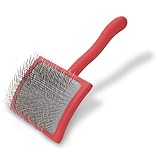
- ‘THE’ DOG BRUSH – you’ve found it! It’s THAT dog brush for shedding breeds. It’s THAT dog brush for detangling. It’s THAT brush groomers love and recommend. Chris Christensen Big G Slicker Brush is the original doodle brush for deshedding, detangling, and creating a finished look. Fluff, detangle, and style with one professional tool. Available in a coral color and three sizes to fit the requirements of a professional groomer and show exhibitor.
- DESHEDDING BRUSH – removes trapped undercoat with less strokes. The extra-long angled pins effectively reach down into the coat removing dead and loose undercoat. The hair remains trapped inside the brush until removed. Perfect for double-coated breeds, especially during the shedding season. Get maximum results, with less work when using the Big G Slicker. It is your workhorse.
- DETANGLING BRUSH – this slicker brush is ideal for removing fine knots from long-coated breeds and the tiny mats hidden in tight curly-coated breeds. With 30% more pins than other slickers, the Big G slicker works 30% harder for you. Brushing with this slicker brush is easier, faster and will make your job grooming painless.
- POODLE BRUSH – the long, dense pins are perfect for fluffing curly, cottony coats and fluffing and shaping heads, toplines, and legs. Ideal for Poodles, Bichons, Labradoodles, Goldendoodles, and other Doodle breeds.
- THOUGHT-OUT DESIGN – every pin is angled for gentle brushing and sits within a flexible cushioned pad allowing the pins to flex softly and glide through the coat. The unique handle design with a non-slip grip reduces hand and arm fatigue and the extreme curved back allows additional control, movement, and direction when brushing. Brushing multiple dogs has never been easier.

- DOG PIN BRUSH – meet the brush that started it all. Chris Christensen Original Series Pin Brushes offer quality and durability, all in an affordable, universal premium pin brush. Rounded pins glide through the coat easily and comfortably. Available in a variety of shapes and pin lengths, there is a Chris Christensen Original Pin Brush that is a perfect match for your dog’s coat.
- DURABLE OVAL BODY – the Original Oval Pin Brush is 8.5” in length, comfortable to hold, and made from a lightweight, durable Beechwood. The oval shaped head is effective at covering large areas of the body, making daily brushing a breeze. The firm, flexible cushion provides movement through the coat, even those with a dense or mixed coat type. This brush is suitable for all breeds and mixes that require regular brushing.
- ROUNDED POLISHED PINS – each pin in an Original Series brush is round ground and polished. The pins will not scratch or irritate skin, and they will not pull and tug at the coat making it the ideal brush for every dog, but especially for dogs with sensitivity issues or who hate being brushed. Choose the pin length based on your dog’s coat. For hair 1.5” or shorter, select 20mm pins; for hair 2” – 5” in length, select the 27mm; and for coats with longer hair, select the 35mm pins.
- LITTLE WONDER SIZE – for ringside touch-ups or face and feet, select the mini version of the Original Series Oval Pin Brush. Its smaller size – 5.75” in length with 20mm pins – has the exact features of the regular sized brush – round polished pins and a Beechwood body and handle. Ideal for travelling, on-the-go, and use at shows. Fits inside pockets and purses.
- HANDMADE IN GERMANY – Chris Christensen Original Series Brushes are handmade in Germany with unsurpassed quality and workmanship. Each brush is meticulously inspected from the stainless-steel pins to the ergonomic Beechwood handle. Each pin brush includes one air vent hole in the cushion for flexibility. It will withstand years of use, even with daily brushing, and is backed with a 6-month warranty against manufacturer defects.

- ‘THE’ DOG BRUSH – based on the Original Big G Slicker Brush used by professional groomers. Pet owners can benefit from the Chris Christensen difference without the professional price tag. Use the Chris Home Care Big G for deshedding, detangling, finishing, and fluffing your dog between groomer visits. Available in a limited-edition teal color and two sizes to fit your breed and size of dog. For at-home use.
- DESHEDDING BRUSH – removes trapped undercoat with less strokes. The extra-long angled pins effectively reach down into the coat removing dead and loose undercoat. The hair remains trapped inside the brush, until removed. Perfect for double-coated breeds, especially during the shedding season. Frequent brushing with the Big G keeps shedding hair around the home at a minimum. Spend less time cleaning and more time bonding with your pet.
- DETANGLING BRUSH – this slicker brush is ideal for removing fine knots from long-coated breeds and the tiny mats hidden in tight curly-coated breeds. With 30% more pins than other slickers, the Big G slicker works 30% harder for you. Brushing with this slicker brush is easier, faster and will make your trip to the groomers painless.
- DOODLE BRUSH – the long, dense pins are perfect for fluffing curly, cottony coats and fluffing and shaping heads, toplines, and legs. Ideal for Poodles, Bichons, Labradoodles, Goldendoodles, and other Doodle breeds.
- TRUSTED DESIGN – with the innovative design of the Original Big G, the teal version also has the unique ergonomic handle design but without the non-slip grip that professional groomers need. Every pin is angled for gentle brushing and sits within a flexible cushioned pad allowing the pins to flex softly and glide through the coat. The extra curved back allows additional control, movement, and direction when brushing. Brushing with the Big G is easy on the dog and you.

- ‘THE’ DOG BRUSH – based on the Original Big G Slicker Brush used by professional groomers. Pet owners can benefit from the Chris Christensen difference without the professional price tag. Use the Chris Home Care Big G for deshedding, detangling, finishing, and fluffing your dog between groomer visits. Available in a limited-edition teal color and two sizes to fit your breed and size of dog. For at-home use.
- DESHEDDING BRUSH – removes trapped undercoat with less strokes. The extra-long angled pins effectively reach down into the coat removing dead and loose undercoat. The hair remains trapped inside the brush until removed. Perfect for double-coated breeds, especially during the shedding season. Frequent brushing with the Big G keeps shedding hair around the home at a minimum. Spend less time cleaning and more time bonding with your pet.
- DETANGLING BRUSH – this slicker brush is ideal for removing fine knots from long-coated breeds and the tiny mats hidden in tight curly-coated breeds. With 30% more pins than other slickers, the Big G slicker works 30% harder for you. Brushing with this slicker brush is easier, faster and will make your trip to the groomers painless.
- DOODLE BRUSH – the long, dense pins are perfect for fluffing curly, cottony coats and fluffing and shaping heads, toplines, and legs. Ideal for Poodles, Bichons, Labradoodles, Goldendoodles, and other Doodle breeds.
- TRUSTED DESIGN – with the innovative design of the Original Big G, the teal version also has the unique ergonomic handle design but without the non-slip grip that professional groomers need. Every pin is angled for gentle brushing and sits within a flexible cushioned pad allowing the pins to flex softly and glide through the coat. The extra curved back allows additional control, movement, and direction when brushing. Brushing with the Big G is easy on the dog and you.

- CHRIS CHRISTENSEN SLICKER BRUSH – meet the Mark Series Slicker Brushes, featuring shorter pins, for shorter hair, and ergonomically designed to cut your grooming time in half. Made of lightweight natural Beechwood, the contoured handle allows for brushing in any direction. High-grade steel 12mm pins are fixed in an ultra-soft, highly flexible pad, cushioned with a 1/4″ foam base for a soft feel when grooming. Available in a variety of shapes, there is a Chris Christensen Mark Slicker Brush that is a perfect size for your dog or cat’s short-haired coat.
- MARK I SLICKER – the Mark I Slicker has a 6.5” body and an extra-small 2.75” head. It’s perfect for cats and kittens, even those who cannot tolerate brushing. Cats love the gentle brushing movement as it removes shedding fur and detangles small mats. Great for grooming toy dogs too, and use on larger breeds for behind the ears, on the muzzle, armpits, and paws.
- ALL COAT TYPES – for double coats, use pre-trim and, on the legs, head, and detail work. For scissored breeds, use it to detangle and smooth those cottony curly coats, leaving them soft and fluffy. For drop coats, use on the undercarriage, legs, feet, under the beard, and sanitary areas. For Setters and Spaniels, use it on the hocks and feet. For wire coats, use while stripping the jacket and separating hair when doing leg work. On smooth coats, it acts like a carding brush, removing shedding hair, and setting the chalk foundation and chalk between the hairs for show dogs.
- HANDMADE IN GERMANY – Chris Christensen Mark Series Brushes are handmade in Germany with unsurpassed quality and workmanship. Each brush is meticulously inspected from the stainless-steel pins to the ergonomic Beechwood handle. It will withstand years of use, even with daily brushing, and is backed with a 6-month warranty against manufacturer defects. The Mark I Slicker Brush is item # A5I in the Chris Christensen catalog.
- BEST IN SHOW RESULTS – steeped in dog show tradition, Chris Christensen has been crafting excellence and cultivating winners since 1996. Regarded highly in and out of the show ring, Chris Christensen dog grooming products have a reputation for performance and perfection. Groom like a professional and get best in show results.

- DOG DETANGLER BRUSH – Chris Christensen Ice Slip Pin Brush was created to glide through all coat textures with ease and is the perfect accompaniment to Chris Christensen’s Ice on Ice detangling products, to gently and effectively eliminate tangles and mats. For show dogs specifically, it will allow you to demat the coat while preserving as much coat as possible. It is also an excellent preventative and maintenance brush for daily use.
- PET APPROVED – our Ice Slip Dematting Brush is a great all-round brush, especially for dogs with sensitivities or who hate being brushed. The pins are rounded for comfort on your pets’ skin and coat making it gentle enough for everyday use. The pins will not scratch or irritate skin, and they will not pull and tug at the coat. For new pet parents, owners of younger, senior, rescue, or difficult dogs, this brush is for you.
- DESIGNED FOR EASE – the perfect shape of the brush lets you groom hard-to-reach or sensitive places. Easily remove mats from beneath armpits, behind the ears, furnishings, paws and more. It’s perfect for areas that mat frequently including bushy tails and long lush ears. The 20mm pin length, clever spacing and sturdy hold within a firm base, allows the brush to glide through these areas minimizing damage.
- HANDMADE IN GERMANY – Chris Christensen Ice Slip Pin Brush is handmade in Germany with unsurpassed quality and workmanship. Each brush is meticulously inspected from the stainless-steel pins to the ergonomic Beechwood handle. It will withstand years of use, even with daily grooming, and is backed with a 6-month warranty against manufacturer defects.
- BEST IN SHOW RESULTS – steeped in dog show tradition, Chris Christensen has been crafting excellence and cultivating winners since 1996. Regarded highly in and out of the show ring, Chris Christensen dog grooming products have a reputation for performance and perfection. Groom like a professional and get best in show results.

- DOG PIN BRUSH – meet the brush that started it all. Chris Christensen Original Series Pin Brushes offer quality and durability, all in an affordable, universal premium pin brush. Rounded pins glide through the coat easily and comfortably. Available in a variety of shapes and pin lengths, there is a Chris Christensen Original Pin Brush that is a perfect match for your dog’s coat.
- DURABLE OVAL BODY – the Original Oval Pin Brush is 8.5” in length, comfortable to hold, and made from a lightweight, durable Beechwood. The oval shaped head is effective at covering large areas of the body, making daily brushing a breeze. The firm, flexible cushion provides movement through the coat, even those with a dense or mixed coat type. This brush is suitable for all breeds and mixes that require regular brushing.
- ROUNDED POLISHED PINS – each pin in an Original Series brush is round ground and polished. The pins will not scratch or irritate skin, and they will not pull and tug at the coat making it the ideal brush for every dog, but especially for dogs with sensitivity issues or who hate being brushed. Choose the pin length based on your dog’s coat. For hair 1.5” or shorter, select 20mm pins, for hair 2” – 5” in length, select the 27mm; and for coats with longer hair select the 35mm pins.
- LITTLE WONDER SIZE – for ringside touch-ups or face and feet, select the mini version of the Original Series Oval Pin Brush. Its smaller size – 5.75” in length with 20mm pins – has the exact features of the regular sized brush – round polished pins and a Beechwood body and handle. Ideal for travelling, on-the-go, and use at shows. Fits inside pockets and purses.
- HANDMADE IN GERMANY – Chris Christensen Original Series Brushes are handmade in Germany with unsurpassed quality and workmanship. Each brush is meticulously inspected from the stainless-steel pins to the ergonomic Beechwood handle. Each pin brush includes one air vent hole in the cushion for flexibility. It will withstand years of use, even with daily brushing, and is backed with a 6-month warranty against manufacturer defects.

- CHRIS CHRISTENSEN SLICKER BRUSH – meet the Mark Series Slicker Brushes, featuring shorter pins, for shorter hair, and ergonomically designed to cut your grooming time in half. Made of lightweight natural Beechwood, the contoured handle allows for brushing in any direction. High-grade steel 12mm pins are fixed in an ultra-soft, highly flexible pad, cushioned with a 1/4″ foam base for a soft feel when grooming. Available in a variety of shapes, there is a Chris Christensen Mark Slicker Brush that is a perfect size for your dog or cat’s short-haired coat.
- MARK II SLICKER – the Mark II Slicker has a 6.25” body and a smaller 3.5” x 2″ head. It’s ideal for cats and smaller dogs. It’s great for puppy coats and all smaller cross-Poodle breeds, including Maltipoos, Cavapoos, Cockapoos, etc. It detangles and smooths cottony curly coats, leaving them soft and fluffy. The Mark II can also be used on larger dogs for grooming those smaller areas such as legs, feet, head and ears.
- ALL COAT TYPES – the Mark Series Brushes can be used on all coat types. For double coats, use pre-trim and, on the legs, head, and detail work on the ears. For drop-coated breeds, use on the undercarriage, legs, feet, under the beard, and sanitary areas. For Setters and Spaniels, use it on the hocks and feet. For wire coats, it is great to use while stripping the jacket, and the perfect length for separating hair when doing leg work. On smooth coats, it acts like a carding brush, removing shedding hair, and setting the chalk foundation and chalk between the hairs for show dogs.
- HANDMADE IN GERMANY – Chris Christensen Mark Series Brushes are handmade in Germany with unsurpassed quality and workmanship. Each brush is meticulously inspected from the stainless-steel pins to the ergonomic Beechwood handle. It will withstand years of use, even with daily brushing, and is backed with a 6-month warranty against manufacturer defects. The Mark II Slicker Brush is item # A5II in the Chris Christensen catalog.
- BEST IN SHOW RESULTS – steeped in dog show tradition, Chris Christensen has been crafting excellence and cultivating winners since 1996. Regarded highly in and out of the show ring, Chris Christensen dog grooming products have a reputation for performance and perfection. Groom like a professional and get best in show results.

- DOG DETANGLER SPRAY – Chris Christensen Ice on Ice Detangling and Finishing Spray is a 3-in-1 grooming spray that detangles, protects, and conditions the coat. Use for detangling and removing mats from the coat, providing protection against dirt and the elements, and as a finishing spray to eliminate static, tame flyaways, and achieve body and shine.
- REMOVES MATTED HAIR – make light work of mats by spraying Ice on Ice directly on the matted fur and loosening it with your fingers or the Chris Christensen Ice Slip Brush. Using Chris Christensen Ice on Ice Detangling and Finishing Spray will prevent new mats and tangles from forming.
- CONDITIONS AND PROTECTS – Ice on Ice Detangling and Finishing Spray creates a protective barrier to repel dirt, dust, urine and other pollutants and locks in moisture for overall coat health. It fortifies and protects the hair cuticle from the outside and adds elasticity and strength to the coat.
- ALL COAT TYPES – Chris Christensen Ice on Ice Detangling and Finishing Spray can be used on all coat types and breeds, including doodles. Choose from Ready to Use spray or Concentrated Formula – dilute 16:1 to make two gallons and apply with a mister. Concentrated Formula is water soluble and can be added to the final rinse for a truly beautiful coat. Made in the USA.
- BEST IN SHOW RESULTS – steeped in dog show tradition, Chris Christensen has been crafting excellence and cultivating winners since 1996. Regarded highly in and out of the show ring, Chris Christensen dog grooming products have a reputation for performance and perfection. Groom like a professional and get best in show results.

- GROOM LIKE A PROFESSIONAL – Dog boar brush distributes natural oils back into coat and stimulates skin follicles for a healthy coat.
- QUALITY MATERIALS – Made of durable, lightweight Beech wood, 100% natural boar hair bristles.
- BRISTLES – 8 rows of natural boar bristles redistribute natural oils making for a healthier, shinier coat.
- SIZE – 8.75 inches, body length
- WHY CHRIS CHRISTENSEN – It all started in 1996 when Chris Christensen developed the first true color correcting shampoo for canines and felines. White on White was a catalyst in the evolution of canine coat care. The momentum that followed has allowed Chris Christensen Systems to bring you the finest grooming products ever available in the dog show and pet care worlds.
Can You Brush a Pomeranian Too Often?
Gentle daily brushing can be appropriate, but excessive pressure, repeated slicker brushing, or continually working the same area can damage the coat and irritate the skin.
Judge grooming by the condition of the coat rather than following a rigid schedule. When the comb glides through easily, the skin looks healthy, and no loose undercoat remains trapped, the brushing session is complete.
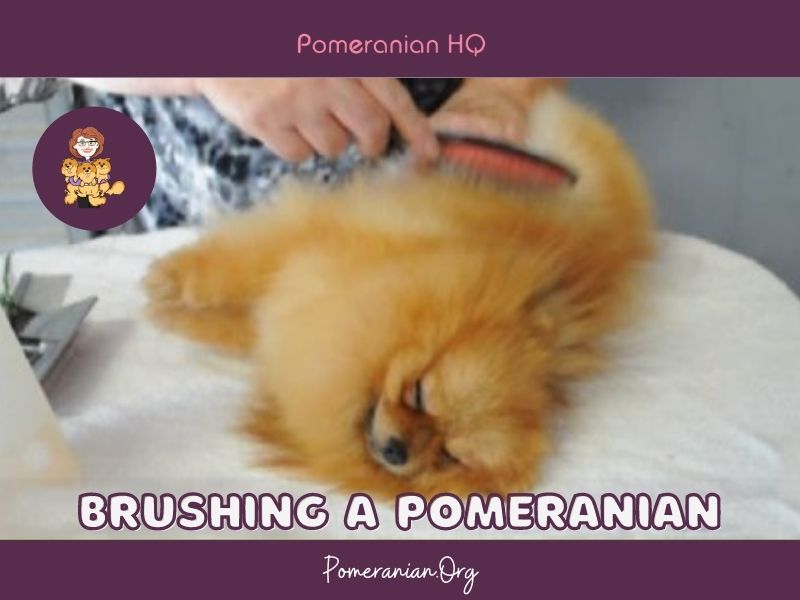
Teaching a Pomeranian Puppy to Enjoy Brushing
A Pomeranian’s grooming education should begin while the puppy is still with the breeder. I start gently handling and introducing my puppies to basic grooming from approximately three to four weeks of age. These early sessions are very short and help prepare puppies for a lifetime of brushing, bathing, nail care, and coat maintenance.
The new owner should continue the routine as soon as the puppy settles into its new home. Do not wait until the coat becomes tangled or the puppy begins its adult coat change.
Begin With Gentle Handling
Before introducing a brush, teach your puppy to accept being touched all over its body. Gently handle:
- The ears and face
- The paws and toes
- The chest and abdomen
- The legs and armpits
- The hindquarters
- The tail
- Around the mouth
Keep the experience calm and reward relaxed behavior. This handling will also make veterinary examinations, nail trimming, and other routine care much easier.
Keep the First Sessions Short
The first brushing sessions may last only one or two minutes. Allow the puppy to see and sniff the brush, then use a few gentle strokes on an easy area such as the back or sides.
Gradually introduce more sensitive areas as the puppy becomes comfortable. Finish before the puppy becomes tired, frustrated, or frightened.
Several short, successful sessions are more valuable than one long struggle.
Choose the Right Time
Brush your puppy when it is calm but awake. A quiet period after gentle play or toileting is often suitable.
Avoid beginning a grooming session when the puppy is highly excited, hungry, frightened, or desperate to sleep.
Use a Secure, Comfortable Position
Your puppy may stand on a non-slip surface, lie on its side, or sit securely on your lap. Support the body and make sure the puppy cannot fall.
Never leave a puppy unattended on a grooming table or other elevated surface.
Teach each position gradually. Do not force the puppy onto its back or hold it down while it struggles, as this can create fear and make future grooming more difficult.
Reward Calm Behavior
Use quiet praise and small treats to reward the puppy for standing still, allowing a paw to be handled, or remaining relaxed while a section is brushed.
Give the reward while the puppy is calm so it learns which behavior is being encouraged.
If the puppy mouths the brush or becomes playful, calmly pause and redirect its attention. Avoid turning grooming into a game of chasing or biting the equipment.
Do Not Ignore Signs of Distress
A puppy may need a brief pause if it repeatedly turns toward the brush, cries, pants, freezes, tries to escape, or becomes unusually restless.
Check that you are not pulling a tangle, scratching the skin, or placing the puppy in an uncomfortable position. Resume with an easier area and lighter pressure once the puppy is calm.
Build a Predictable Routine
Use the same safe location and a similar sequence each time. For example:
- Place the puppy on the grooming surface.
- Check the ears, feet, and body.
- Lightly brush one or two sections.
- Handle the paws briefly.
- Praise and reward calm behavior.
- Finish the session quietly.
As the puppy matures, gradually increase the length of the sessions and introduce complete line brushing.
With patience and consistency, most Pomeranians learn that brushing is a normal and enjoyable part of life. Early training is one of the best ways to prevent grooming difficulties when the full adult coat develops.
Common Pomeranian Brushing Mistakes
Correct brushing should maintain the coat without causing pain, skin irritation, or unnecessary hair breakage. Avoiding the following common mistakes will make grooming safer and more comfortable for your Pomeranian.
Brushing Only the Surface
Running a brush over the visible outer coat may make a Pomeranian look neat, but it does not reach loose undercoat or hidden tangles close to the skin.
Use the line-brushing method to divide the coat into narrow sections and brush each layer thoroughly.
Using Too Much Pressure
Pressing a slicker brush firmly against the skin can cause redness, scratches, and slicker burn. This is particularly easy to do around the armpits, groin, abdomen, and behind the ears.
Use short, light strokes and check the skin regularly throughout the grooming session.
Pulling a Brush Through Knots
Never force a brush or comb through a tangle. This pulls the skin, causes pain, and can make a Pomeranian frightened of grooming.
Hold the hair close to the skin and work from the outer ends of the knot inward. Separate the tangle into smaller sections with your fingers before using a brush or comb.
Using the Wrong Brush
A harsh slicker, damaged brush, or pin brush with plastic balls on the tips can pull and break the coat. Short-bristled brushes may pass over the surface without reaching the dense undercoat.
Choose high-quality tools suitable for a long, double-coated breed and regularly inspect them for bent pins, sharp edges, or other damage.
Forgetting the Metal Comb Check
A brushed coat can look smooth while still containing small tangles underneath. Finish every thorough grooming session with a metal comb.
If the comb catches, return to that section and continue gently separating the coat. Never force the comb through resistance.
Missing High-Risk Areas
Tangles commonly develop behind the ears, under the front legs, beneath the collar or harness, in the groin, around the trousers, and beneath the tail.
Check these areas during every complete brushing session, even when the rest of the coat appears tidy.
Brushing a Completely Dry, Static Coat Too Aggressively
Brushing a dry coat with repeated force can increase static and hair breakage. A very light mist of dog-safe grooming spray may provide slip and make the coat easier to separate.
The coat should be lightly misted rather than soaked.
Applying Too Much Grooming Spray
Excess product can leave the coat heavy, sticky, or more likely to collect dirt. It may also irritate sensitive skin.
Follow the manufacturer’s directions and use only enough product to produce a fine, even mist.
Cutting Mats With Scissors
Never slide scissors underneath a mat close to the skin. Tight mats can pull and fold skin into the tangled hair, making accidental cuts extremely likely.
Ask an experienced groomer or veterinarian to remove mats that cannot be separated safely.
Brushing for Too Long
A lengthy grooming session can be tiring for puppies, senior dogs, and Pomeranians unfamiliar with brushing. Fatigue can lead to restlessness, struggling, and negative associations with grooming.
Divide the coat into several short sessions if necessary.
Ignoring Signs of Pain or Skin Disease
Sudden resistance to brushing may indicate a tight mat, sore joint, wound, infection, parasite, or another painful condition.
Stop and investigate if your Pomeranian cries, snaps, flinches, or repeatedly guards one area. Seek veterinary advice when the cause is not obvious, or the skin appears abnormal.
Removing Too Much Undercoat
The purpose of brushing is to remove hair that has already loosened—not to strip healthy undercoat from the dog.
Stop brushing an area once the coat is separated, the skin looks comfortable, and the metal comb passes through smoothly. Continually brushing the same spot can damage the coat and irritate the skin.
What is the best brush for a Pomeranian?
A Pomeranian needs more than one grooming tool. A high-quality pin brush with smooth metal pins is useful for separating and maintaining the longer outer coat. A soft, flexible slicker brush helps remove loose undercoat and gently work through small tangles.
Finish with a metal comb. The comb should pass from near the skin through to the ends without catching.
How often should a Pomeranian be brushed?
Most adult pet Pomeranians benefit from thorough line brushing two or three times each week. Dogs with especially dense coats may require more frequent attention.
Brush more often during heavy shedding, puppy coat change, or whenever the coat becomes damp or collects debris.
Should I brush my Pomeranian before or after bathing?
Check the coat and loosen tangles before bathing because water can tighten existing knots. Do not bathe a heavily matted Pomeranian without first obtaining professional advice.
After bathing, dry the double coat thoroughly while gently separating it. Once completely dry, finish with a metal comb to check for hidden tangles.
Can I brush my Pomeranian every day?
Yes, gentle daily brushing can be helpful, especially during shedding or puppy coat change. However, a full intensive grooming session may not be necessary every day.
Avoid excessive pressure and repeated slicker brushing over the same area. Stop when the coat is separated, the skin looks comfortable, and the comb glides through easily.
How do I remove mats from a Pomeranian safely?
Hold the hair close to the skin, separate the knot into smaller pieces with your fingers, and work gradually from the ends toward the skin. A small amount of dog-safe detangling spray may provide helpful slip.
Never pull forcefully or slide scissors beneath a tight mat. Ask an experienced groomer or veterinarian to remove extensive or skin-level matting.
Should I use an undercoat rake on my Pomeranian?
An undercoat rake is generally unnecessary for routine Pomeranian grooming. Incorrect or aggressive use can remove healthy undercoat, damage guard hairs, and irritate the skin.
A pin brush, soft slicker, line-brushing technique, and metal comb are usually sufficient. Ask an experienced Pomeranian groomer before adding specialized shedding tools.
Why does my Pomeranian hate being brushed?
Your Pomeranian may associate brushing with pulled tangles, excessive pressure, uncomfortable restraint, or sessions that last too long. Sudden resistance may also indicate a mat, skin irritation, injury, or painful joint.
Use short, gentle sessions, reward calm behavior, and stop if your dog shows pain. Seek veterinary advice if sensitivity appears suddenly or you cannot identify the cause.
Why must loose puppy coat be removed?
During the puppy coat change, loose baby fur may remain trapped around the developing adult coat. If it is not removed, it can twist around the new hair and form tangles or mats close to the skin.
Gentle, frequent brushing removes the loosened puppy fur and allows the adult coat to emerge without becoming tangled in retained dead hair.
Brush thoroughly but gently—the goal is to separate and maintain the coat, not remove as much hair as possible.
Final Thoughts on Brushing a Pomeranian
During more than 50 years of breeding, exhibiting, and grooming Pomeranians, I have found that regular, gentle line brushing is the best way to maintain the breed’s beautiful double coat.
Brush your Pomeranian in small sections, pay special attention to areas that mat easily, and always finish with a metal comb. During puppy coat change, remove loose puppy fur regularly so it does not become tangled around the developing adult coat.
The aim is not to remove as much hair as possible. Correct brushing should separate the coat, prevent painful mats, and keep the skin and coat in good condition. With patience and a consistent routine, brushing can become an enjoyable part of caring for your Pomeranian.
Copyright Pomeranian.org. All Rights Reserved.
📚 References & Further Reading
- [1] AKC Pomeranian Breed Standard (2011)
- [2] English Kennel Club Breed Standard
- [3] The Pomeranian Handbook – Denise Leo
- [4] Denlinger, The Complete Pomeranian
- [5] Kimbering, 1891–1991
- [6] Taplin, The Sportsman’s Cabinet
- [7] Parker, The Popular Pomeranian
- [8] Ives, Show Pomeranians