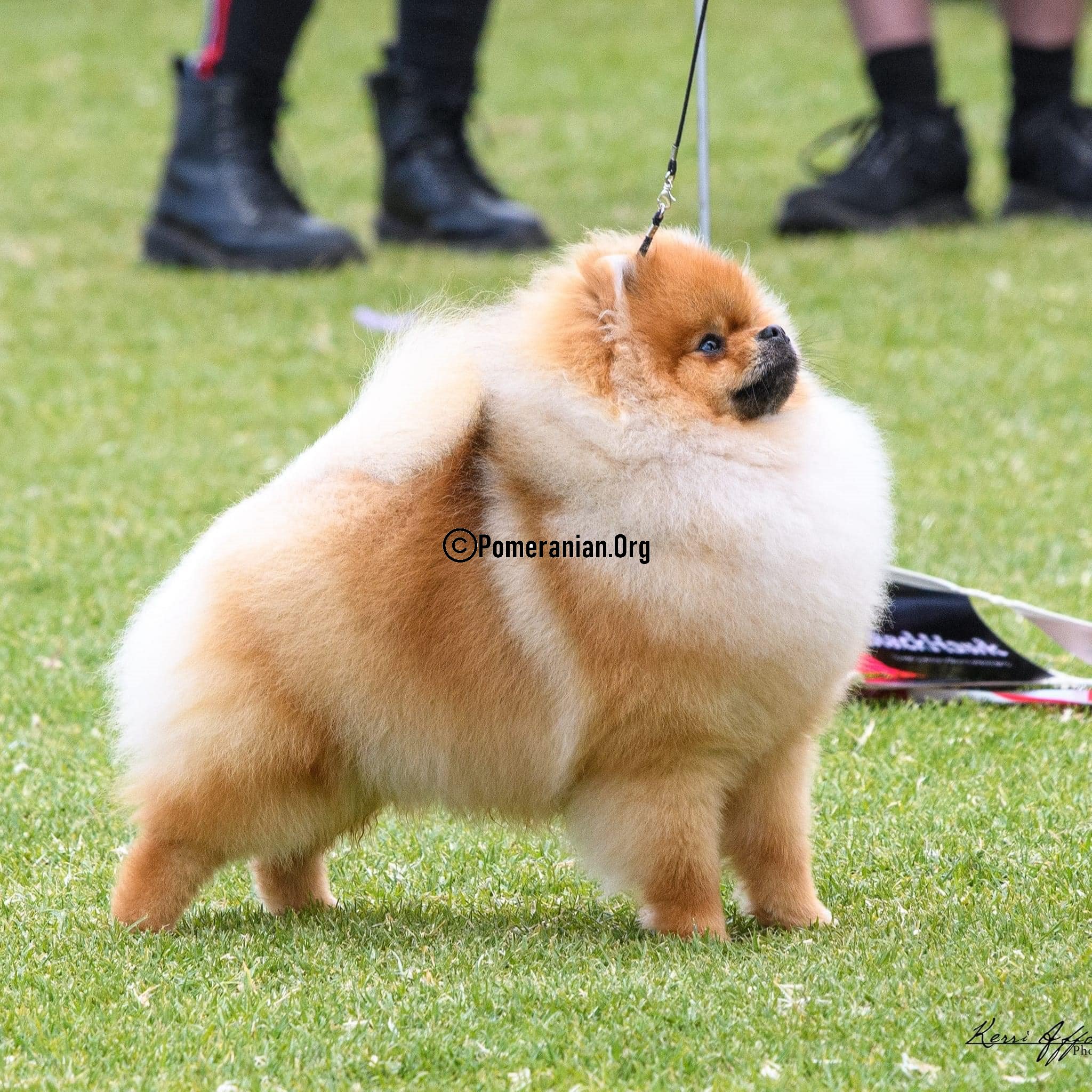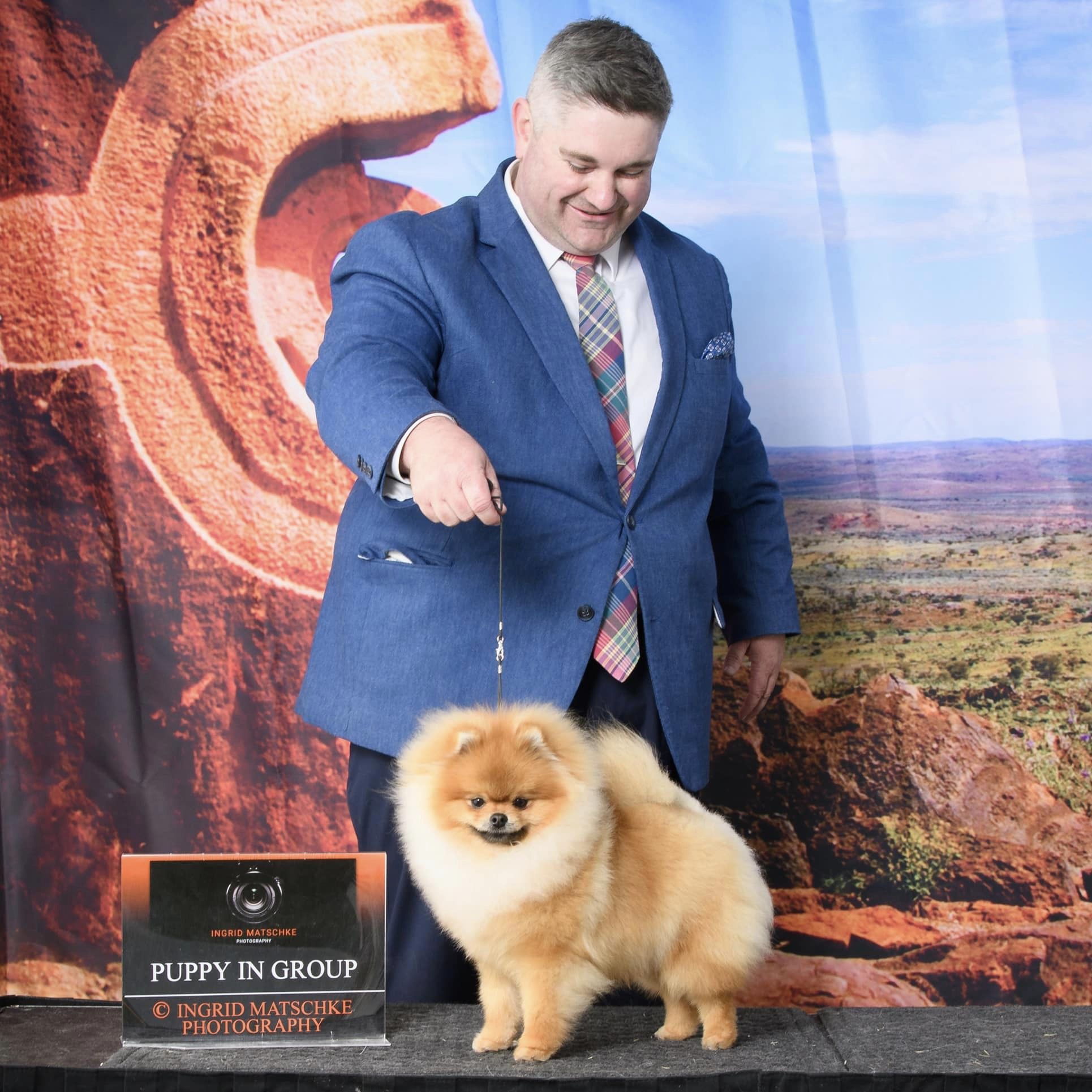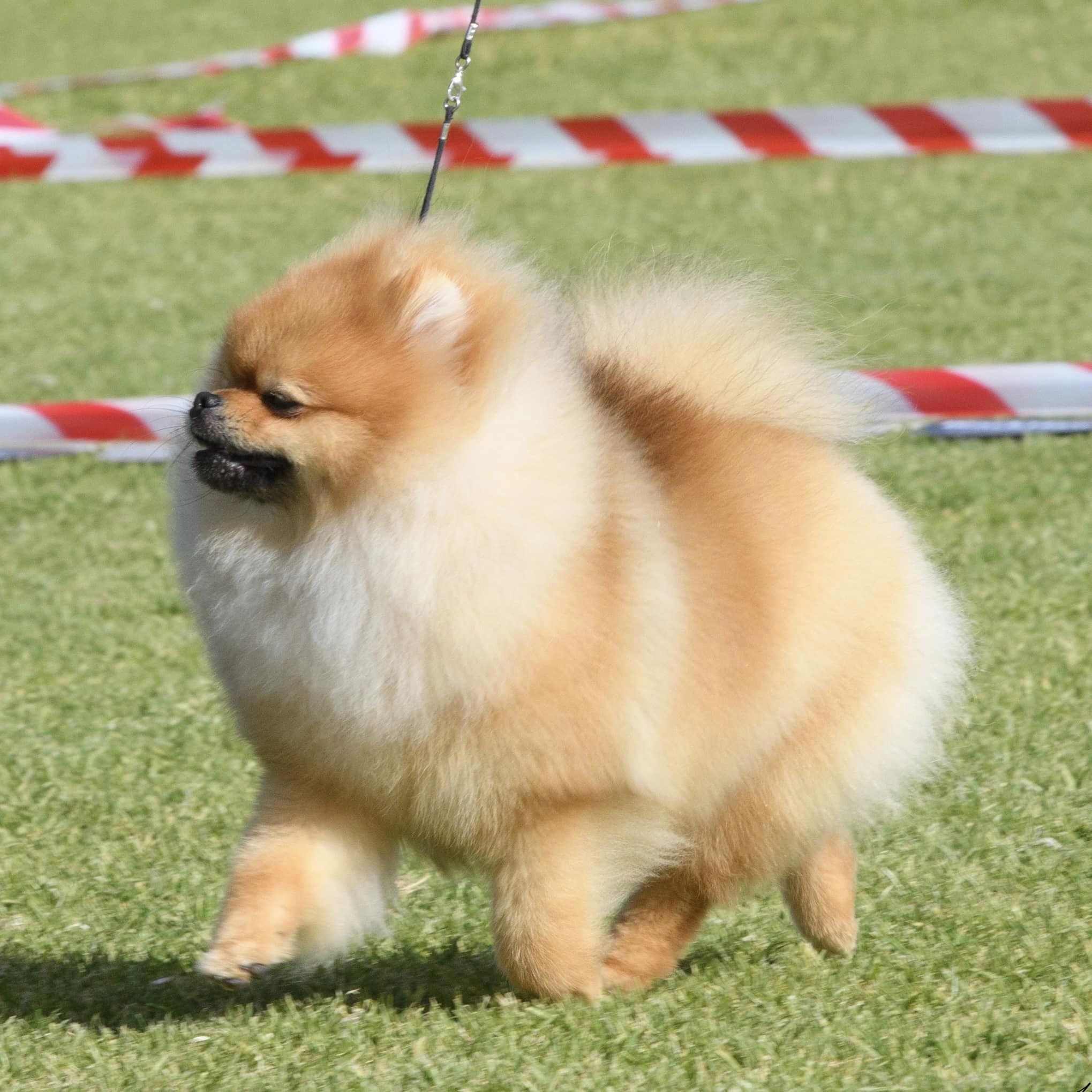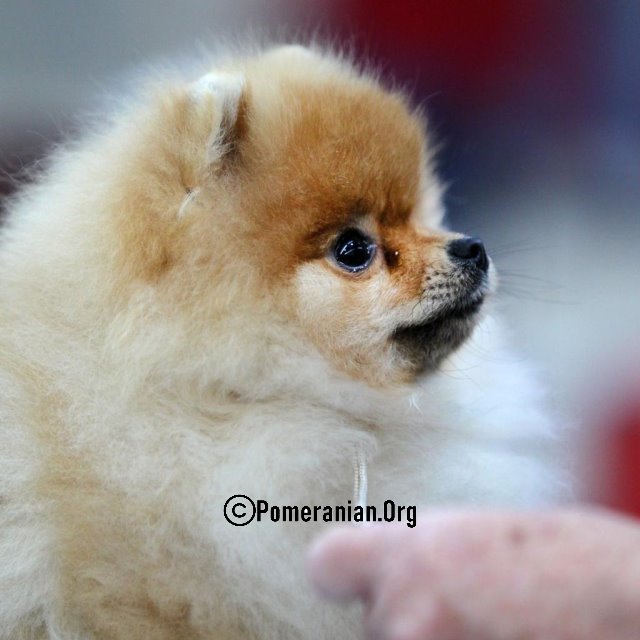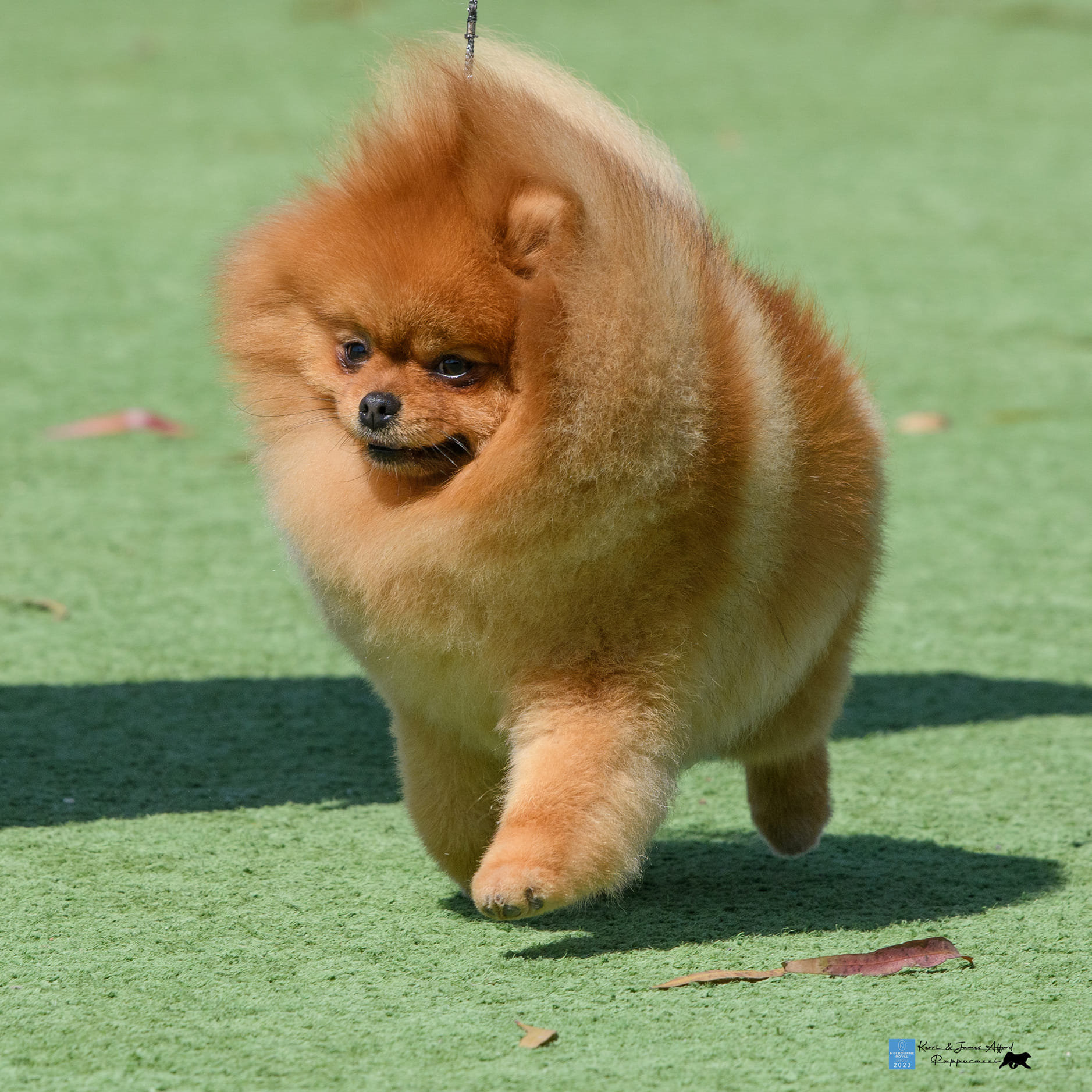

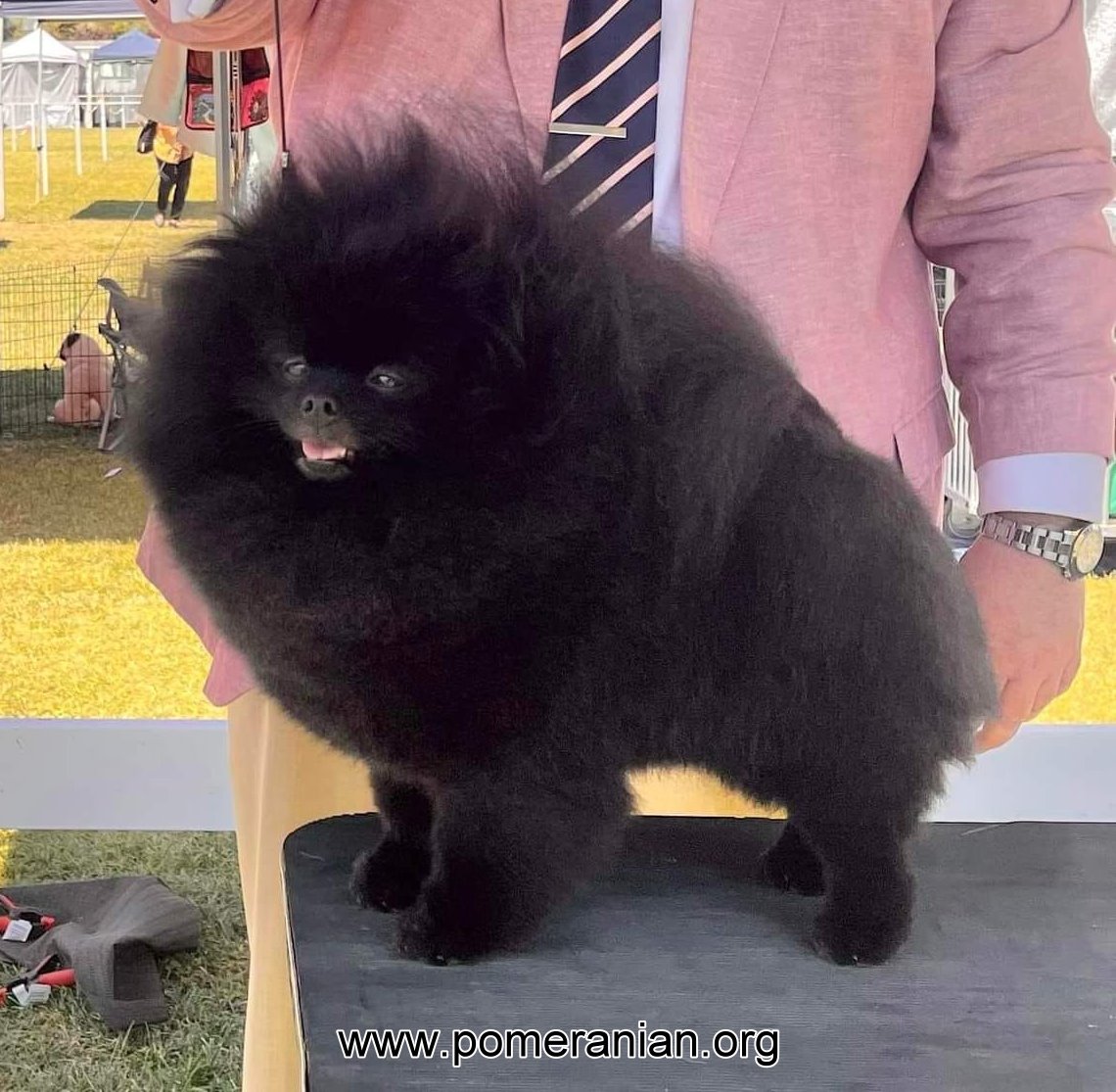
A true black Pomeranian has a rich, glossy black coat accompanied by black pigmentation on the nose, lips, eye rims and paw pads. Black is one of the Pomeranian’s historic colors and is recognized in breed standards worldwide. Although well-bred solid-black puppies can be difficult to find, the black Pomeranian is not a separate breed, special size or genuinely rare variety.
During more than 50 years of breeding, owning and exhibiting Pomeranians, I have bred and shown many beautiful black Poms, including champions. I am also a Pomeranian judge and the breeder behind Dochlaggie Pomeranians. This experience has given me a practical understanding of black coat development, grooming, breeding and show-ring presentation.
In this guide, I explain what a correctly coloured black Pomeranian should look like, whether black puppies remain black, why some coats develop reddish or greyish tones, and how black color is inherited. I also share advice drawn from my experience preparing and exhibiting black Pomeranians.
Black Pomeranian Facts at a Glance
Essential facts about the appearance, history, coat, and care of the solid-black Pomeranian.
A black Pomeranian is a coat-color variety—not a separate breed, temperament, or size.
Black Pomeranian Appearance
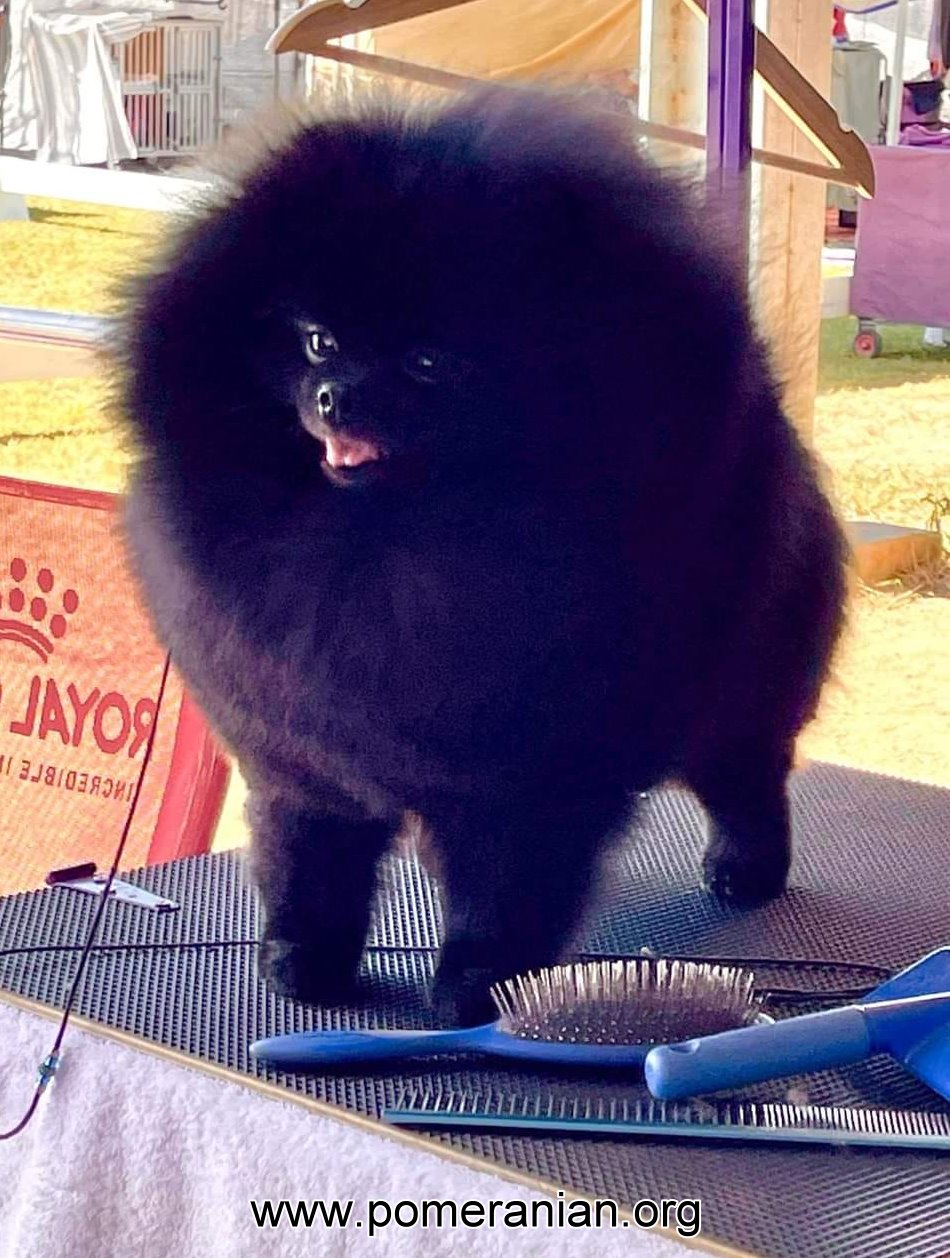
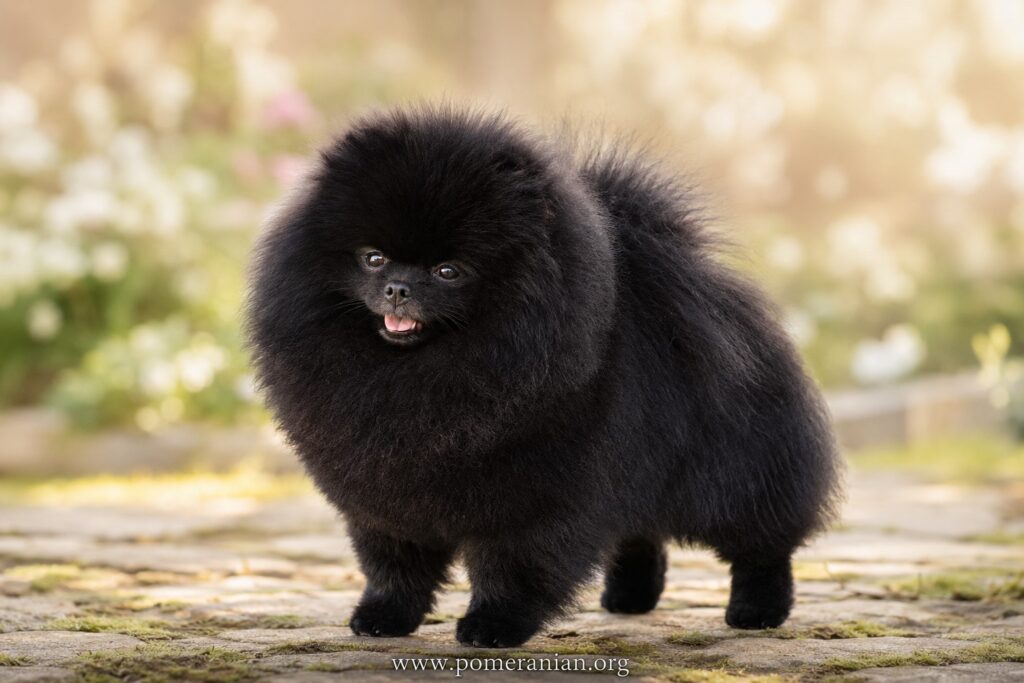
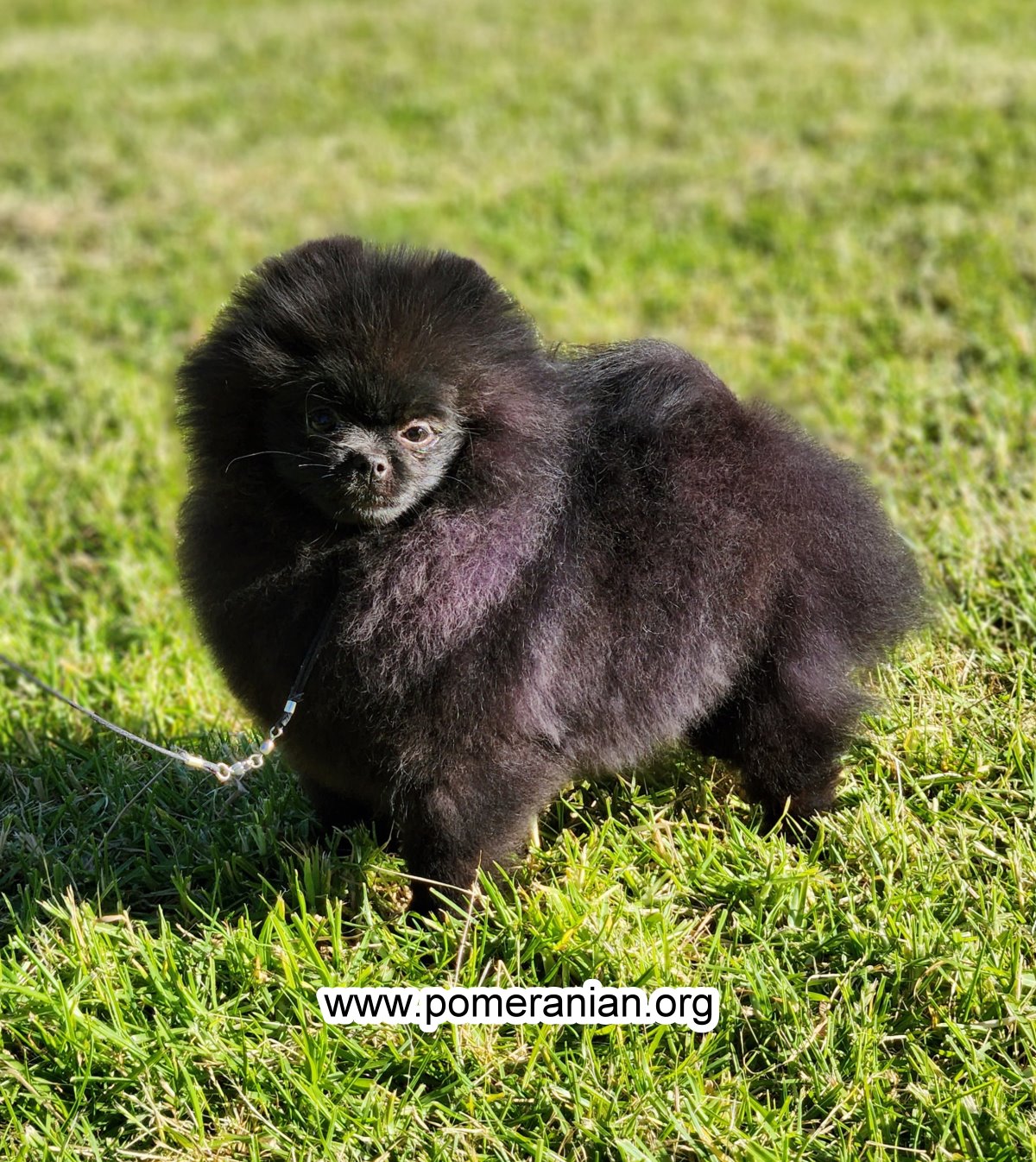
A true black Pomeranian has a rich, glossy, coal-black coat. The nose, lips, eye rims, and paw pads should also be black, creating the intense pigmentation that makes this color so striking.
Like every adult Pomeranian, a black Pom should have a double coat. The undercoat is short, soft, and dense, while the longer guard hairs form the abundant outer coat, profuse neck ruff, and heavily plumed tail characteristic of the breed.
The outer coat should appear black from the roots to the tips. The undercoat may look slightly softer or lighter, particularly when the dog is shedding, but it should not noticeably detract from the overall solid-black appearance.
Why Does a Black Pomeranian’s Coat Look Red or Brown?
Long periods in strong sunlight can fade the ends of a black coat, causing reddish or rusty-looking tips. This is commonly called sun bleaching. Normal outdoor activity should not be avoided, but prolonged exposure to intense sunlight may affect the deep black color, especially during the Australian summer.
Diet, coat condition, shedding, and the natural aging process can also influence how rich and glossy the coat appears. Some black Pomeranians develop scattered gray or white hairs around the muzzle as they grow older.
Solid Black, Mismarked, or Black and Tan?
Not every predominantly black Pomeranian is a solid black. These color patterns should be distinguished from one another:
- Solid black: The coat is entirely black without tan markings or significant white areas.
- Black and tan: The dog has clearly defined tan or rust markings, commonly above the eyes, on the muzzle, chest, legs, and beneath the tail.
- Black parti-color: The coat has a white base with clearly defined black patches.
- Black mismark: A predominantly black dog has a small amount of white, such as white hairs on the chest or white toes.
A few white hairs do not mean that most black Pomeranians are mismarked. Many correctly colored black Poms possess a completely solid coat.
How Big Do Black Pomeranians Get?
A black Pomeranian should be the same size as a Pomeranian of any other color. Coat color has no bearing on the breed’s correct size, weight, structure, or proportions.
Pomeranian size requirements differ among the Dogs Australia, American Kennel Club, and FCI breed standards. Dogs Australia and the AKC primarily use weight, while the FCI standard specifies height.
Pomeranian Size by Breed Standard
Each organization describes the correct size of the Pomeranian differently.
Dogs Australia
Dogs:
1.8–2 kg (4–4.5 lb)
Bitches:
2–2.5 kg (4.5–5.5 lb)
These are listed as the ideal weights.
American Kennel Club
Permitted weight:
3–7 lb (1.36–3.18 kg)
Ideal show weight:
4–6 lb (1.8–2.72 kg)
The AKC describes the Pomeranian as compact, sturdy, and square in proportion.
FCI Standard
Height at the withers:
21 cm ± 3 cm
Approximate range:
18–24 cm (7.1–9.4 in)
The FCI calls the breed the German Toy Spitz/Pomeranian. Weight should correspond to the dog’s size.
None of these standards establishes a different size for a black Pomeranian.
These differences do not mean that one standard is more correct than another. They reflect the requirements used by different canine organizations. A Pomeranian being exhibited should be assessed under the standard applying to that particular show.
Are There Teacup Black Pomeranians?
There is no officially recognized teacup, miniature, or micro Pomeranian variety.
These are marketing terms sometimes used to advertise exceptionally small puppies. A very tiny puppy is not automatically more valuable, healthier, or better bred.
When choosing a black Pomeranian puppy, health, soundness, temperament, breed type, responsible breeding, and appropriate size are considerably more important than finding the smallest possible dog.
Black Pomeranian Puppies
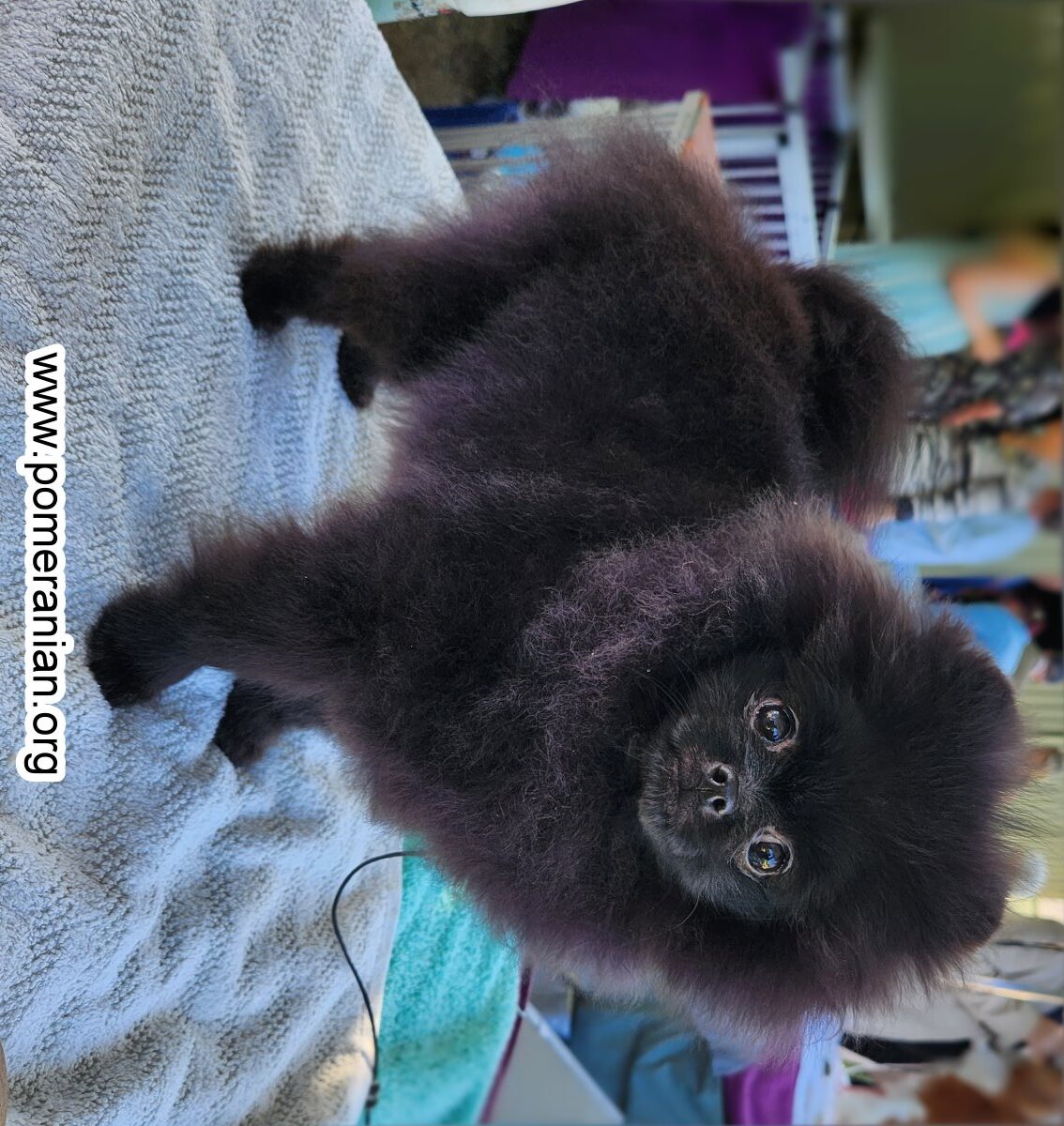
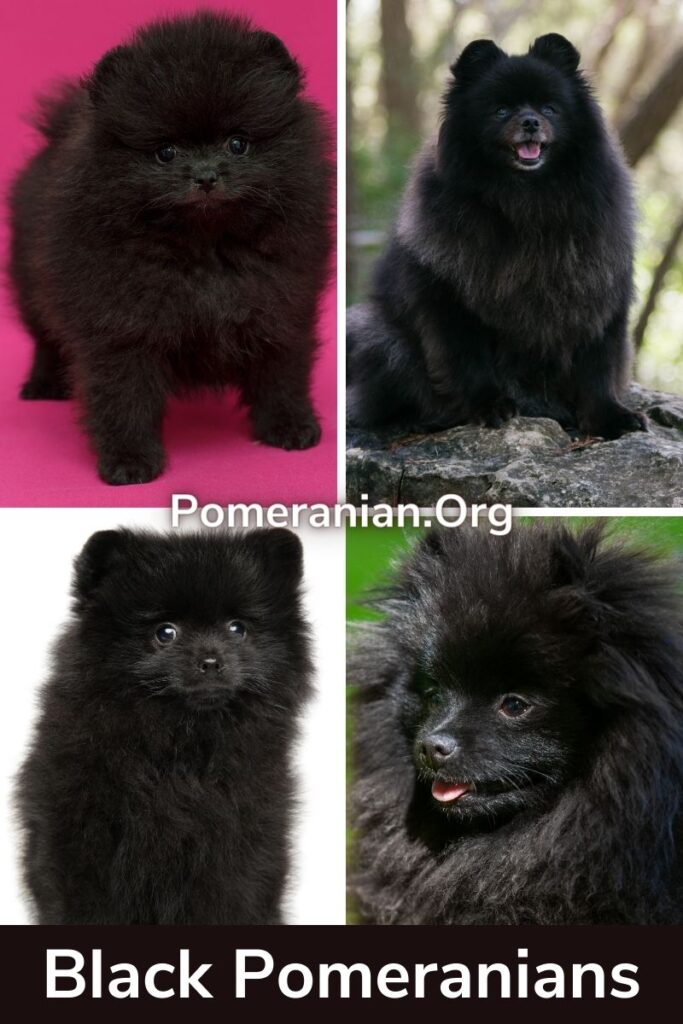
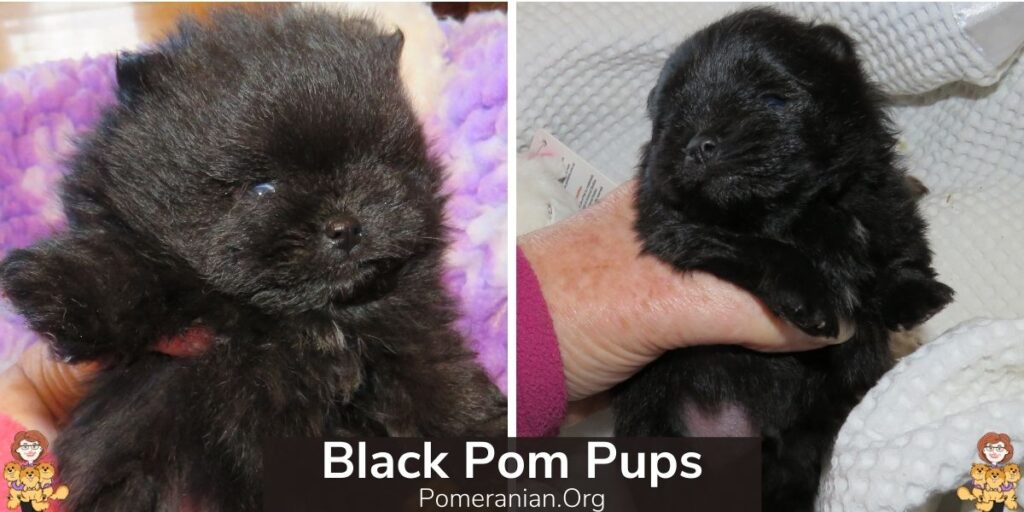
A true solid-black Pomeranian puppy is born black. The coat should be black without tan points, while the nose, lips, eye rims, and paw pads should also possess strong black pigmentation.
Black Pomeranian puppies go through the same stages of coat development as every other Pomeranian. Their fluffy baby coat gradually sheds and is replaced by the longer, fuller adult double coat. During this transition, a puppy may temporarily look less fluffy, unevenly coated, or slightly grayish.
Do Black Pomeranian Puppies Stay Black?
Most genuinely solid-black puppies remain black, although their coats may change in appearance as they mature.
How Can You Identify a True Black Puppy?
A very young puppy can appear almost entirely black while actually possessing another color or pattern. Check the coat and pigmentation carefully:
Solid Black
The coat is black without tan points or significant white markings. The nose, lips, eye rims, and paw pads should also be black.
Black and Tan
Tan points usually appear above the eyes and on the muzzle, chest, legs, and beneath the tail. These markings may become clearer as the puppy matures.
Blue
A very dark blue puppy may initially resemble black, but its coat and skin pigmentation are diluted rather than intensely black. The nose may appear slate-blue instead of black.
Mismarked Black
A predominantly black puppy may have a small white patch, white toes, or a few white hairs. More extensive white areas may indicate a parti-color pattern.
Denise Leo’s breeder experience
During more than 50 years of breeding Pomeranians, I have watched many black puppies pass through an untidy or grayish-looking coat stage. This temporary change is generally part of normal puppy development. A puppy’s pedigree, pigmentation, and the colors behind its parents provide more reliable guidance than judging the changing puppy coat alone.
Is a Black Pomeranian Puppy Suitable for Every Home?
Black Pomeranian puppies can adapt well to many households, including appropriately managed apartment homes. However, no puppy is automatically suited to every family simply because of its small size.
A Pomeranian requires companionship, early socialization, patient training, regular grooming, appropriate veterinary care, and protection from rough handling. Prospective owners should select a puppy for its health, temperament, soundness, and suitability for their lifestyle—not for coat color alone.
Are Black Pomeranians Rare?
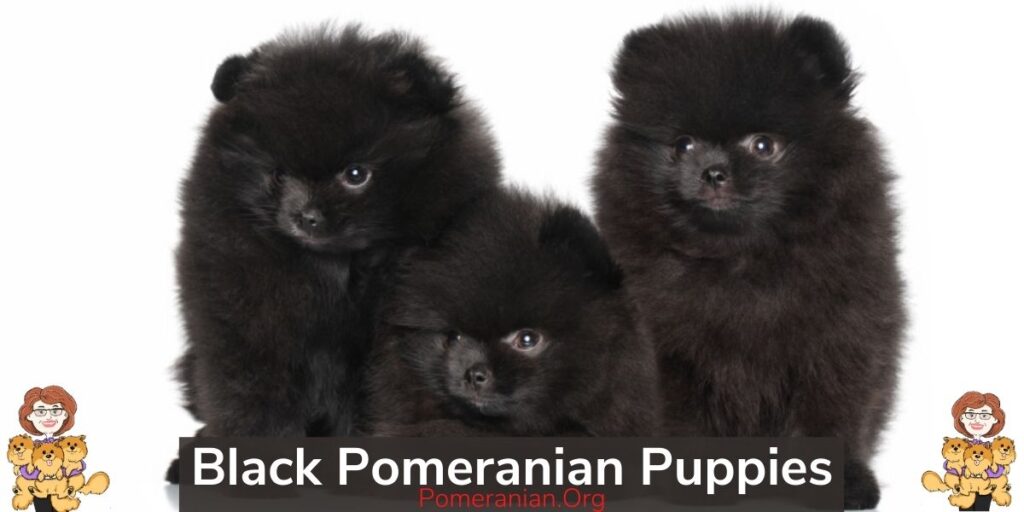
Black Pomeranians are not officially classified as rare. Black is an established Pomeranian coat colour with a long history within the breed.
However, a well-bred solid-black Pomeranian may be harder to find than an orange or orange sable puppy. Fewer breeders regularly produce solid blacks, so availability can vary considerably. Being less commonly available does not necessarily mean that the colour itself is rare.
Rare Colour or Limited Availability?
There is an important difference between a recognised colour being rare and a suitable puppy being difficult to find.
A black Pomeranian can be less commonly available without being an officially rare variety.
Be Careful of “Rare Black Pomeranian” Advertising
Prospective owners should be cautious when advertisements use words such as “rare,” “exclusive,” “exotic” or “teacup” to justify an inflated price. These marketing terms do not provide any assurance about the puppy’s health, temperament, pedigree or quality.
A responsible breeder should be willing to discuss the puppy’s parents, health history, expected adult size, temperament, socialisation and suitability for your household.
Denise Leo’s breeder advice
Choose the best-bred and most suitable puppy rather than purchasing solely because the puppy is black. A beautiful coat colour should accompany good health, sound construction, correct Pomeranian type and a confident temperament.
Finding and Buying a Black Pomeranian Puppy
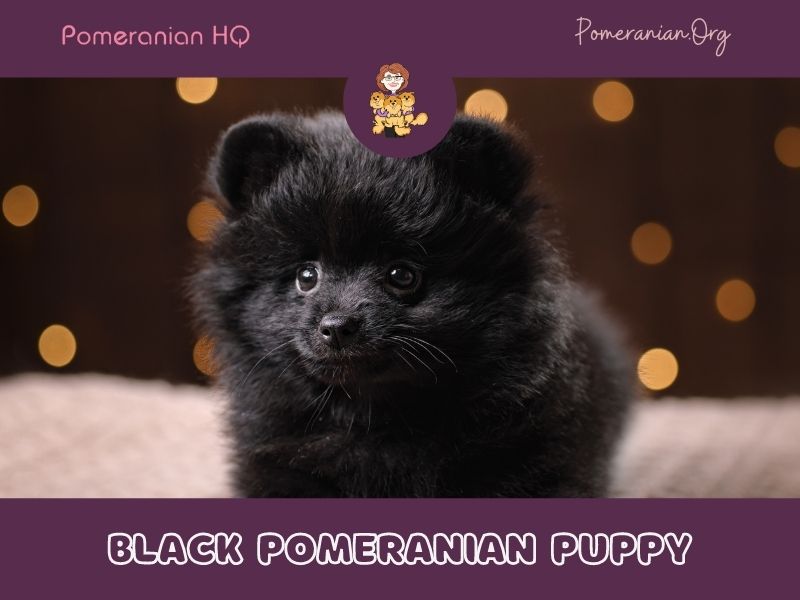
Finding a well-bred black Pomeranian puppy may require patience. Begin with recognised kennel organisations, Pomeranian breed clubs and experienced registered breeders who can provide reliable information about their dogs, breeding practices and puppy care.
Do not choose a puppy based on colour or price alone. Health, temperament, soundness, correct Pomeranian type and suitability for your household are much more important than finding the darkest coat or the cheapest puppy.
What Should You Look for in a Breeder?
A responsible breeder should be open about the puppy’s background, health, care and expected development.
Questions to Ask Before Paying a Deposit
- Is the puppy registered, and which canine organisation issued the registration?
- Can I see recent photographs or video of the puppy and its mother?
- What health testing has been completed on the parents?
- Has the puppy been examined by a veterinarian?
- What vaccinations, microchipping and parasite treatments will be completed?
- How has the puppy been raised and socialised?
- Is the puppy being sold as a companion or a potential show dog?
- Will I receive a written agreement, care information and continuing breeder support?
Warning Signs When Buying a Black Pomeranian
Be cautious when a seller has puppies permanently available, uses photographs that appear on multiple websites, refuses to show the puppy by live video or pressures you to make an immediate payment.
Other warning signs include claims of guaranteed “teacup” size, exaggerated descriptions such as “extremely rare,” no information about the parents and an unwillingness to discuss health, registration or veterinary care.
How Much Does a Black Pomeranian Cost?
The price of a responsibly bred Pomeranian varies considerably between countries and individual breeders. It may be influenced by the breeder’s experience, pedigree, registration, health practices, veterinary care, puppy raising costs and whether the puppy is sold as a companion or potential show prospect.
A black coat should not automatically make a puppy more expensive simply because it is advertised as “rare.” Buyers should consider what is included in the price and the quality of the breeding program rather than comparing puppies by price alone.
Denise Leo’s breeder advice
I price black Pomeranian puppies in the same manner as puppies of other recognised colours. Colour alone does not determine a puppy’s value. The quality of the breeding, health, temperament, pedigree, veterinary care and lifelong breeder support are far more important than whether the coat is black, orange, cream or another recognised colour.
Do Black Pomeranians Have Health Problems?
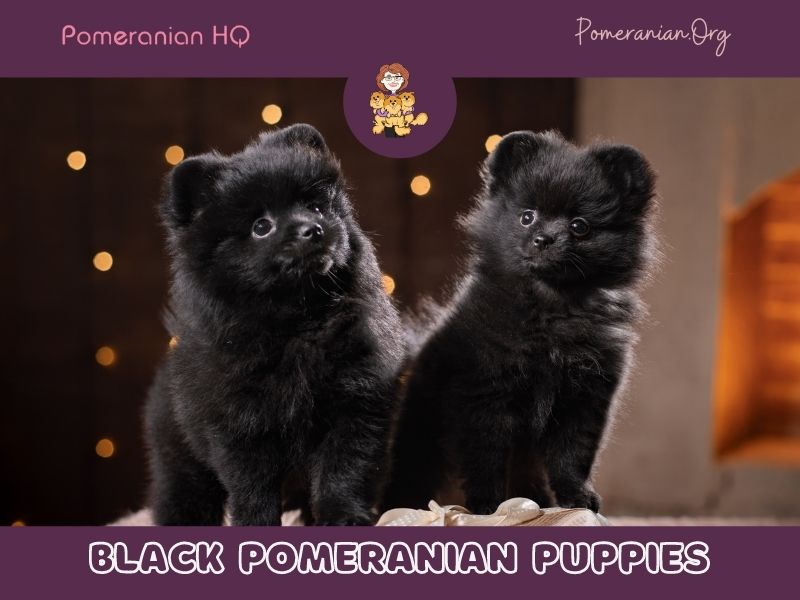
A solid-black Pomeranian is not automatically less healthy than a Pomeranian of another recognized color. Black Pomeranians can be affected by the same inherited, structural, and age-related conditions found throughout the breed.
Coat color alone cannot predict a puppy’s future health. Responsible breeding, appropriate health screening, veterinary care, nutrition, exercise, dental care, and maintaining a healthy body weight are all more important than whether a Pomeranian is black, orange, cream, or another color.
Health Concerns That Can Affect Pomeranians
These conditions are associated with the Pomeranian breed rather than specifically with the black coat color.
Does a Black Coat Cause Alopecia X?
No. Alopecia X is sometimes called Black Skin Disease because the exposed skin may become darker after hair loss. The name does not mean that the condition affects only black-coated dogs.
Pomeranians of many colors can develop coat loss. A veterinary examination is important because hormonal disorders, parasites, allergies, skin infections, and other medical problems can also cause thinning hair or bald patches.
Health Screening for Breeding Pomeranians
Health screening requirements and recommendations vary between countries and canine organizations. Depending on the program being followed, evaluations may include the patellas, heart, eyes, thyroid, hips, or Legg-Calvé-Perthes disease.
Testing cannot guarantee that every puppy will remain free from health problems. However, it provides breeders with valuable information and forms an important part of responsible breeding.
Questions to Ask the Breeder
- What health evaluations have been completed on the puppy’s parents?
- Have health concerns appeared in related dogs?
- Has the puppy received a veterinary examination?
- Will written veterinary and vaccination records be supplied?
- What health guarantee or written agreement accompanies the puppy?
- Will the breeder remain available if questions arise later?
Denise Leo’s breeder advice
During more than 50 years of breeding and exhibiting Pomeranians, I have never regarded a black coat as a health problem. I assess black Pomeranians in the same way as every other color—considering the dog’s health, soundness, temperament, pedigree, breed type, and family history rather than judging it by coat color alone.
Contact your veterinarian if your Pomeranian develops persistent coughing, breathing difficulty, lameness, eye discomfort, unexplained hair loss, irritated skin, or any other concerning change. Early assessment is always preferable to attempting to diagnose the problem at home.
History of the Black Pomeranian
Black is one of the historic colors of the Pomeranian. Early written descriptions show that black dogs existed alongside white, cream, and other colors long before the smaller orange Pomeranian became the familiar image of the breed.
The early Pomeranians were considerably larger than today’s dogs. As the breed developed and became smaller, fashions in coat color also changed. Black Pomeranians were highly valued during parts of the breed’s early history, but orange and orange sable eventually became more prominent in breeding programs and the show ring.
The Black Pomeranian Through History
Changes in size, color preferences, and show-ring fashion helped shape the modern Pomeranian.
An 1803 Description of the Pomeranian
William Taplin described the Pomeranian in The Sportsman’s Cabinet, published in 1803. His account is particularly valuable because it records the breed’s appearance, larger historical size, and known colors—including black.
“POMERANIAN; or, WOLF-DOG. The dog so called in this country is but little more than eighteen or twenty inches in height, and is distinguished by his long, thick, and rather upright coat, forming a most tremendous ruff about the neck, but short and smooth on the head and ears; they are mostly of a pale yellow, or cream-color, and lightest on the lower parts.
Some are white, some few black, and others but very rarely spotted; the head broad towards the neck, and narrowing to the muzzle; ears short, pointed, and erect; nose and eyes mostly black; the tail large and bushy invariably curled in a ring upon the back.
Instances of smooth, or short-coated ones are very rarely seen; in England he is much more familiarly known by the name of fox-dog, and this may originally have proceeded from his bearing much affinity to that animal about the head; but, by those who in their writings describe him as a native of Pomerania, he passes under the appellation of the Pomeranian-dog.”
Taplin’s observation that “some few” were black shows that the color was already established, even though it was apparently seen less often than cream or pale-colored dogs at that time. His description also illustrates how different the early Pomeranian was in size from the modern Toy breed.
How Color Fashion Changed the Breed
During the development of the modern Pomeranian, breeders began placing greater emphasis on orange, red, and sable coats. High-quality black females were sometimes bred to dogs of other colors as breeders worked toward their preferred color, type, and pigmentation.
This change in fashion meant that black and white Pomeranians were no longer always the dominant colors in breeding programs or the show ring. However, black Pomeranians continued to be bred, exhibited, and recognized as an important part of the breed.
Denise Leo’s historical perspective
The popularity of individual Pomeranian colors has changed many times, but black is not a modern novelty or an artificially created “rare” color. It belongs to the documented history of the breed and remains one of the most striking traditional Pomeranian colors.
Black Pomeranians in the Show Ring and Breeding Programs
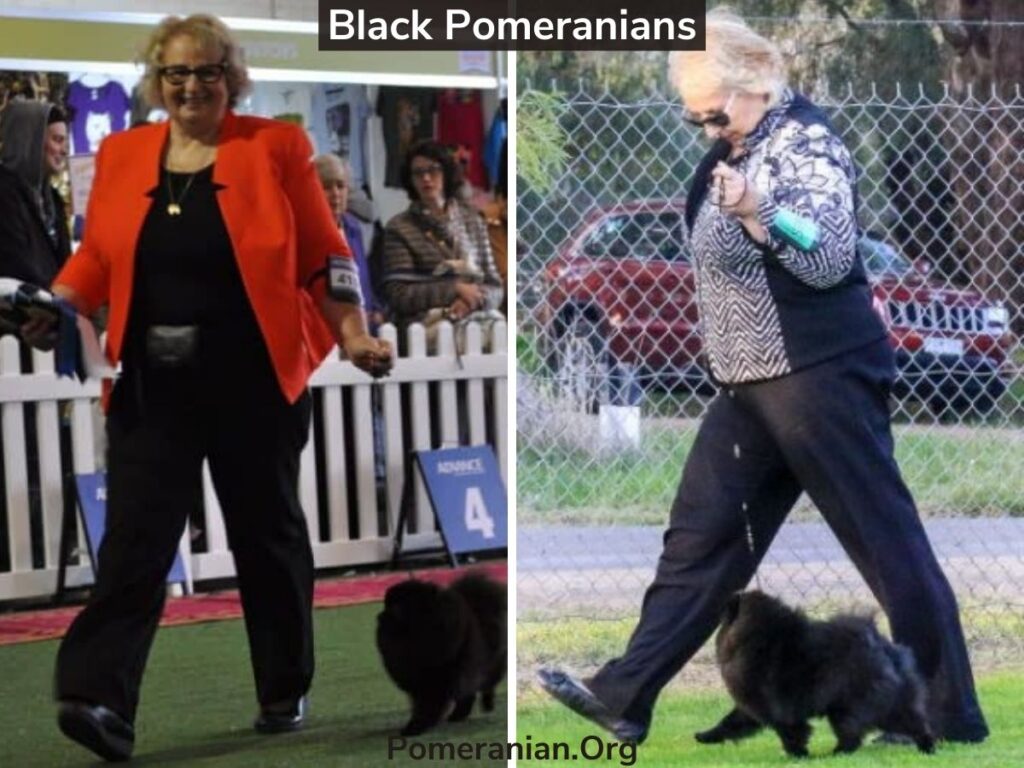
Black Pomeranians have been bred and exhibited for generations. Although orange and orange sable eventually became the colors most frequently seen in the show ring, outstanding black Pomeranians have earned major awards and made important contributions to the breed.
The intense pigmentation and dramatic outline of a well-presented black Pomeranian can be extremely impressive. However, the dark coat may conceal the dog’s expression, outline, and movement—particularly under poor lighting or when the handler wears dark clothing.
Historic Black Pomeranian Champions
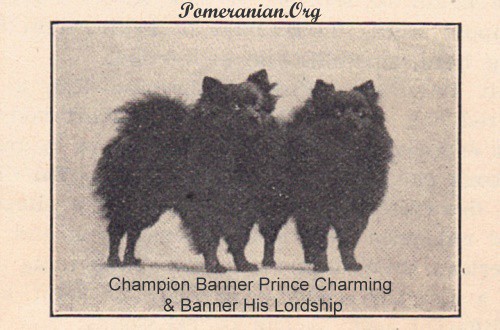
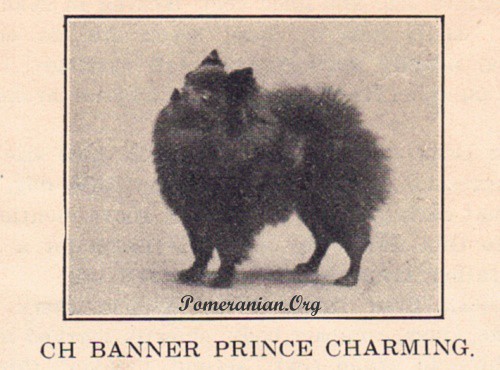
Champion Banner Prince Charming, owned by Mrs. Frank Smythe, holds an important place in American Pomeranian history. He was awarded Best in Show at the first American Pomeranian Club Championship Show.
Click the photograph to view it full size.
Click the photograph to view it full size.
Champion Finch’s He Walks on Water
One of the most influential modern black Pomeranians was Best in Show Champion Finch’s He Walks on Water, affectionately known as Travis. Bred by the late Dianne Finch, Travis became an exceptional show winner and a highly influential sire.
Travis was awarded 12 Best in Show wins and is recorded as having sired 67 champions. His achievements demonstrated that a beautiful black Pomeranian could compete successfully at the highest level while also contributing significantly to future generations.
Exhibiting a Black Pomeranian
Thoughtful presentation helps the judge clearly see the expression, shape, movement, and rich color of the dog.
“Presentation is everything when exhibiting a Black Pomeranian. Because dark coats can hide expression and outline under bright lights, careful trimming is essential to create a clean, balanced silhouette. Use products designed for dark coats to enhance depth and shine, and always show your Pom in contrasting colors so their stunning black coat truly stands out in the ring.”
Breeding Black Pomeranians
A black Pomeranian can be valuable within a carefully planned breeding program, particularly when the dog possesses strong pigmentation, correct coat texture, sound construction, good health, and desirable breed type. However, no dog should be selected for breeding because of color alone.
Black Pomeranians may be bred to blacks or to dogs of other compatible colors, depending on the breeder’s objectives and knowledge of the pedigrees involved. The visible colors of the parents do not reveal every color gene they may carry, so pedigree research and appropriate genetic testing can be useful when planning a litter.
Important Breeding Considerations
- Health, temperament, soundness, and correct breed type must come before coat color.
- Study both the pedigree and the colors produced by related dogs.
- Avoid dilution genes when the goal is to preserve intense black coat and skin pigmentation.
- Evaluate coat texture and density as carefully as color depth.
- Do not assume that mating two black dogs will automatically produce only black puppies.
- Use DNA color testing when the genetic background is uncertain or the result matters to the breeding plan.
Repeatedly breeding only for intense black color while overlooking coat quality, health, or overall type can weaken other desirable characteristics. Every planned mating should consider the complete dog and the strengths and weaknesses found throughout both pedigrees.
Denise Leo’s breeding perspective
A good black Pomeranian can make a valuable contribution to a breeding program, but the dog must offer far more than color. I look for correct Pomeranian type, soundness, health, temperament, coat quality, pedigree, and strong pigmentation before deciding whether any dog should be bred.
Black Pomeranian Genetics
A black Pomeranian is genetically capable of producing black pigment throughout the coat. However, several different genes can influence whether that pigment appears black, chocolate, blue, lavender, or is hidden by another coat color.
The most common genetic pathway to a solid-black coat is the dominant black allele at the K locus, written as KB. A Pomeranian needs only one copy of this allele for solid eumelanin pigmentation to be expressed, provided another gene does not modify or mask it.
Recessive black, represented as a/a at the A locus, has also been reported in Pomeranians. For recessive black to appear, the dog must inherit the required recessive A-locus genes and have a K-locus genotype that allows the A-locus pattern to be expressed.
Genes That Can Modify or Mask Black
A Pomeranian may be genetically capable of producing black pigment while other inherited genes change its visible color. This is why the color seen on the dog does not always reveal every color gene it carries.
- Chocolate (b/b): Two recessive brown alleles change black eumelanin to chocolate. The nose, eye rims, lips, and paw pads are also brown rather than black.
- Blue dilution (d/d): Two recessive dilution alleles lighten black pigment to blue or gray.
- Lavender or isabella (b/b d/d): When a dog inherits both chocolate and dilution, the black pigment is modified to a pale diluted brown commonly called lavender or isabella.
- Recessive orange (e/e): Two recessive alleles at the E locus prevent black pigment from being expressed in the coat. The dog appears orange, cream, or a related shade even though it may still carry dominant black or other black-producing genes.
Why DNA color testing can be useful
A dog’s appearance and pedigree can provide valuable clues, but they may not reveal every recessive color gene. DNA color testing can help identify genes for dominant black, recessive black, chocolate, dilution, and recessive orange when this information is relevant to a planned mating.
Black and White Pomeranian Dogs
A black and white Pomeranian has a striking coat that beautifully highlights the breed’s alert expression, compact outline, and abundant double coat. Depending on the placement and amount of white, the dog may be described as a black and white parti-color Pomeranian or a black mismark.
Although these descriptions are sometimes used interchangeably, they do not mean exactly the same thing. The main difference is whether white or black forms the predominant coat color.
Parti-Color or Mismark?
The amount and distribution of black and white help determine how the coat is described.
A parti-color Pomeranian has a predominantly white coat with clearly defined black patches. Ideally, the markings appear clean and well distributed, creating an attractive contrast across the head and body.
A black mismark is predominantly black but has one or more white markings. These may appear on the toes, feet, legs, chest, chin, neck, or as a small patch elsewhere on the coat.
Common Black and White Markings
Every black and white Pomeranian has an individual pattern. Some have large, balanced black patches over a white coat, while others are almost entirely black with only a small amount of white.
- White toes or feet
- One white leg
- A white chest marking
- A white collar or partial collar
- A white blaze on the face
- Large black patches on a predominantly white coat
The terms used to classify these dogs can vary slightly between countries and canine organizations. However, a simple distinction is that a parti-color is predominantly white with colored patches, while a mismark is predominantly one solid color with a smaller area of white.
Denise Leo’s breeder perspective
Black and white Pomeranians can be exceptionally attractive, particularly when the markings complement the dog’s expression and outline. However, color and markings should never be considered more important than health, soundness, temperament, correct coat, and overall Pomeranian breed type.
Are Black Pomeranians Hard to Keep Clean?
Black Pomeranians are generally no more difficult to keep clean than Pomeranians of other colors. Their dark coats can make minor tear staining and small marks around the eyes and muzzle less noticeable than they would be on white or cream dogs.
However, dust, dandruff, loose undercoat, and pale hairs can be more visible against a glossy black coat. Regular brushing helps remove loose hair, prevent mats, distribute the coat’s natural oils, and maintain a healthy shine.
Like every Pomeranian, a black Pom requires brushing several times a week, regular nail trimming, ear care, dental care, and bathing when necessary. The likelihood of mats and tangles depends more on the thickness and texture of the coat than on its color.
Preventing a Black Pomeranian’s Coat From Fading
Extended exposure to strong sunlight can cause a black coat to develop a faded, rusty, or reddish appearance. This may be particularly noticeable during the Australian summer. Your Pomeranian does not need to be kept indoors continually, but prolonged periods in harsh direct sunlight should be avoided.
Provide shade when your Pom is outside and choose cooler times of the day for walks and play. A gentle conditioner formulated for dogs can help keep the coat moisturized and healthy. Only use a sun-protection product if it is clearly labeled as safe for dogs, and follow the manufacturer’s directions.
Black Pomeranian grooming considerations
- Brush regularly to remove pale undercoat, dust, and loose hair.
- Avoid prolonged exposure to harsh direct sunlight.
- Use shampoos and conditioners specifically formulated for dogs.
- Avoid ordinary talcum powder, which can leave a noticeable residue on a black coat and may be inhaled during grooming.
- For show preparation, experienced exhibitors may use an appropriate black grooming chalk or color-enhancing product where permitted by show regulations.
White or Gray Hairs on a Black Pomeranian
Individual white or gray hairs may begin appearing around the muzzle as a black or dark sable Pomeranian matures. Because they contrast strongly with the dark coat, these hairs can be noticeable earlier than they would be on a lighter-colored dog. This is generally a normal cosmetic change associated with maturity rather than a cleanliness problem.
“Regular brushing is the best way to keep a Black Pomeranian’s coat clean, glossy, and free from loose undercoat. I also avoid leaving black Pomeranians in harsh sunlight for long periods, as excessive sun exposure can fade the coat and produce reddish tinges.”
Recommended Coat-Care Products for Black Pomeranians
The following grooming products may help with routine brushing, bathing, conditioning, and maintaining a healthy black coat. Always select products formulated specifically for dogs and follow the directions on the label.
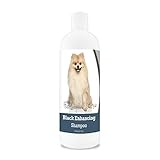
- A color-enhancing formula with pearlescent brighteners to intensify your dog’s coat
- Adds brilliance and base to the coat. Most effective on Black, Charcoal, Blue and other dark colors
- Contains Aloe and Vitamin E in a gentle coconut oil base
- MADE IN THE USA! Buy with confidence! All Healthy Breeds products are made in federally regulated manufacturing facilities. Excellent customer service and return policy. 100% satisfaction guaranteed
- Healthy Breeds offers an assortment of dog products including health care, grooming, dental care and treats for over 200 breeds! Make sure to search for your breed! Click the Healthy Breeds hyperlink above to see our Amazon storefront
Final Thoughts on Black Pomeranian Dogs
A true black Pomeranian is a striking example of this beautiful Toy breed. Its rich black double coat, dark pigmentation, alert expression, and profuse plume create an appearance that is both elegant and dramatic.
Black is an established historical Pomeranian color—not a separate breed, unusual size, or modern designer variety. Although well-bred solid-black puppies may be less commonly available than orange or orange sable puppies, they should not automatically be advertised as rare or sold for a higher price because of color alone.
What Matters Most
Coat color is only one part of choosing, raising, exhibiting, or breeding a Pomeranian.
Choosing a Black Pomeranian Puppy
Before purchasing a puppy, take time to research the breeder and ask about the parents, pedigree, health history, veterinary care, socialization, registration, and written purchase agreement. Avoid sellers who rely on exaggerated descriptions such as “micro,” “teacup,” or “extremely rare” instead of providing meaningful information about the puppy and their breeding practices.
A puppy should be selected because its health, temperament, size, breed type, and personality are suitable for the home—not simply because its coat is black.
Denise Leo’s final advice
During more than 50 years of breeding, owning, and exhibiting Pomeranians, I have found black Pomeranians to be every bit as beautiful, affectionate, intelligent, and rewarding as Pomeranians of other colors. A quality black Pomeranian should be appreciated as a complete dog—never judged by coat color alone.
Whether intended as a cherished companion, show dog, or part of a carefully planned breeding program, a well-bred black Pomeranian can be a wonderful representative of this historic and much-loved breed.
Continue Reading
Learn more about Pomeranian colors, Pomeranian grooming, and Pomeranian health and care.
Black Pomeranian Dogs and Puppies
Copyright Pomeranian.Org. All Rights Reserved.
📚 References & Further Reading
- [1] AKC Pomeranian Breed Standard (2011)
- [2] English Kennel Club Breed Standard
- [3] The Pomeranian Handbook – Denise Leo
- [4] Denlinger, The Complete Pomeranian
- [5] Kimbering, 1891–1991
- [6] Taplin, The Sportsman’s Cabinet
- [7] Parker, The Popular Pomeranian
- [8] Ives, Show Pomeranians