
Pomeranian haircuts may look adorable in photographs, but not every style is safe for this breed’s magnificent double coat. A Pomeranian does not normally need a short haircut to remain cool, comfortable, clean, or fashionable.
Safe Pomeranian grooming usually involves regular brushing, bathing, thoroughly drying the coat, and carefully trimming the feet, ear tips, sanitary area, and untidy outer hairs. The natural body coat should remain full and should not ordinarily be clipped short or shaved.
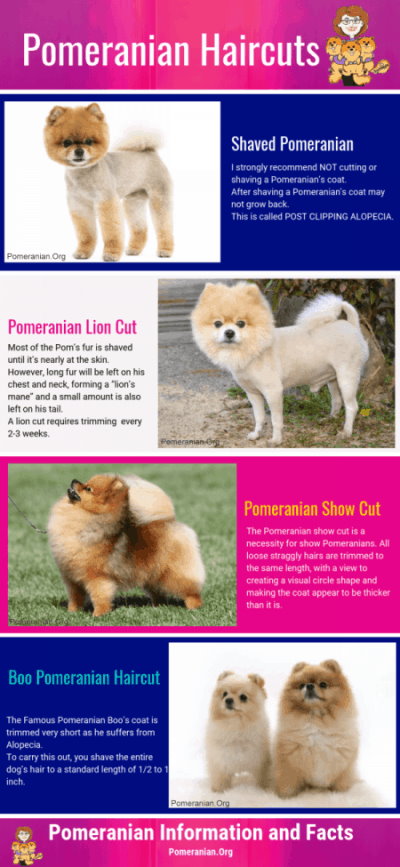
Popular styles such as the teddy bear cut, puppy cut, Boo haircut, and lion cut remove considerably more coat. Although these trims can look appealing, they may interfere with the natural coat-growth cycle and result in slow, uneven, altered, or occasionally incomplete regrowth.
In this guide, I explain which Pomeranian trims are generally safe, which haircuts should be avoided, what to tell your groomer, and what you can do if your Pom has already been shaved.
Advice From Denise Leo“During more than 50 years of breeding, exhibiting, and grooming Pomeranians, I have found that the safest approach is to preserve the natural double coat. A Pomeranian may be lightly scissor-trimmed to create a neat outline, but the body should not normally be clipped short or shaved for fashion, shedding control, or summer comfort.”
Can You Give a Pomeranian a Haircut?
The short answer: A Pomeranian can be lightly trimmed with scissors to neaten the natural outline. However, clipping the body short or shaving the double coat is not recommended unless it is medically necessary.
Understanding the Pomeranian Double Coat
Before choosing a Pomeranian haircut, it is important to understand how the breed’s coat grows. A Pomeranian has a thick double coat consisting of two distinct layers, each with an important purpose.
The soft, dense undercoat supports the longer outer coat and gives a Pomeranian its characteristic fluffy appearance. The outer coat is made up of longer, harsher guard hairs that help protect the skin and create the breed’s beautiful outline.
The Two Layers of a Pomeranian’s Coat
The undercoat and outer guard hairs work together to protect the skin and produce the correct Pomeranian coat.
The short, soft, densely packed undercoat provides insulation and supports the outer coat. It is also the layer from which much of the loose hair is removed during seasonal shedding.
The longer, straighter guard hairs protect the skin and give the adult Pomeranian coat its texture, color, shine, and distinctive stand-off appearance.
Why the Double Coat Should Be Preserved
A Pomeranian’s coat helps protect the skin from dirt, minor abrasions, and environmental exposure. It also assists with insulation. Although the coat does not make a dog immune to heat or cold, removing it is not a safe substitute for shade, fresh water, suitable indoor temperatures, and avoiding exercise during the hottest part of the day.
When the body coat is clipped very short, the undercoat and guard hairs may not grow back at the same rate. The resulting coat can initially appear soft and fluffy, but it may later become uneven, woolly, patchy, or difficult to groom.
What Can Happen After a Pomeranian Is Shaved?
- The undercoat may grow faster than the longer guard hairs.
- The coat may temporarily have a soft, woolly, or cotton-like texture.
- Regrowth may appear uneven or patchy.
- The color and texture of the new coat may look different.
- The exposed skin may have less protection from sunlight and minor injury.
- Complete coat recovery can take many months and occasionally much longer.
Not every shaved Pomeranian develops permanent coat problems. Some coats recover well, while others take considerably longer or fail to return completely to their previous condition. Age, genetics, health, coat quality, the length of the remaining hair, and the individual growth cycle can all affect regrowth.
Important: If your Pomeranian has already been shaved, do not panic. Allow time for the coat to recover and maintain it with gentle brushing and appropriate bathing. Consult your veterinarian if the skin is inflamed, itchy, discolored, or if there is very little regrowth over an extended period.
Safe Pomeranian Haircuts and Trims
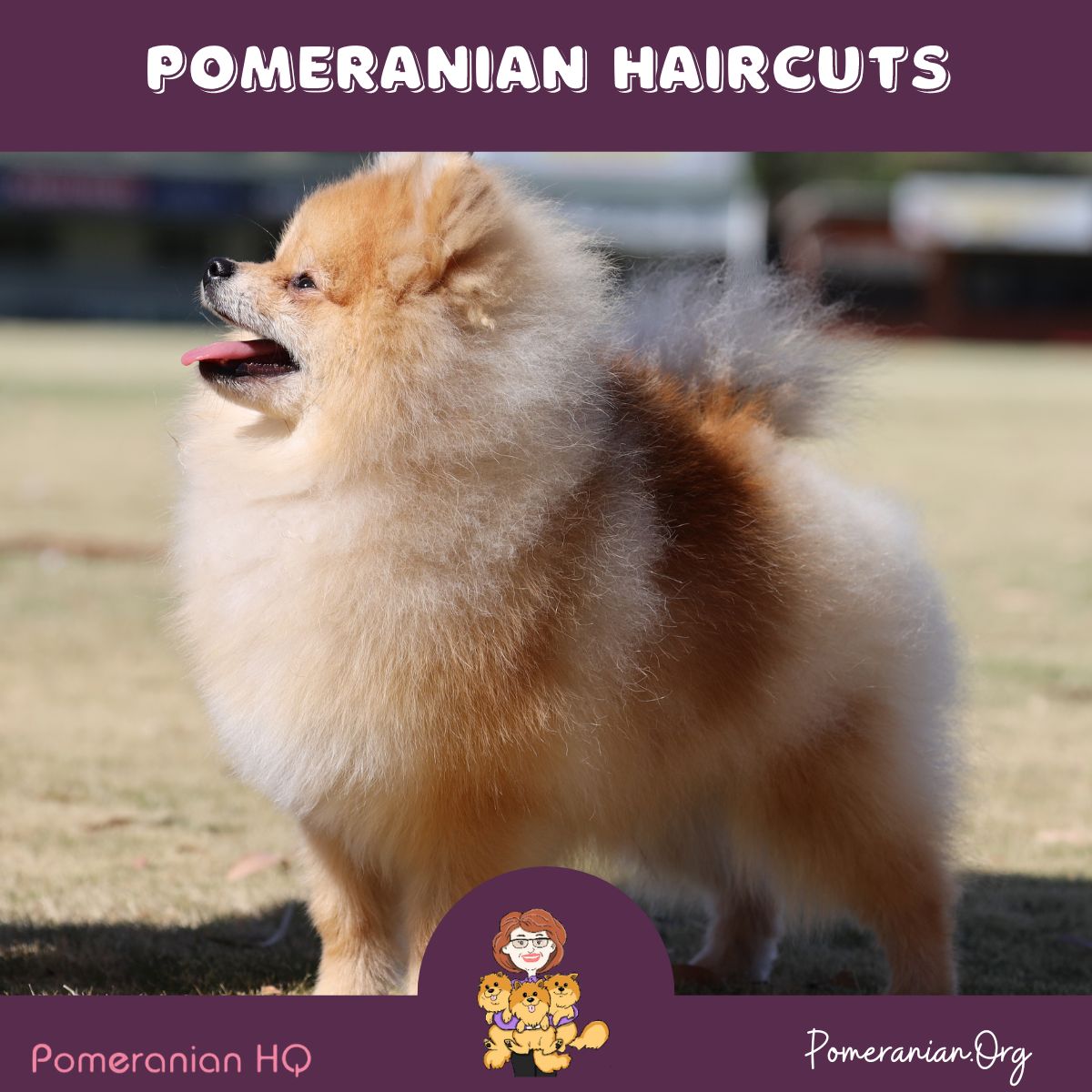
The safest Pomeranian haircut is not really a haircut at all. It is a light tidy trim that preserves the full double coat while creating a clean, balanced outline.
Using scissors, an experienced groomer can carefully neaten the feet, ears, sanitary area, and long stray hairs. The aim is to improve the Pomeranian’s natural appearance without shortening the body coat or cutting deeply into the undercoat.
Areas That May Be Lightly Trimmed
Careful trimming can keep a Pomeranian neat and comfortable without removing the natural body coat.
Trim excess hair beneath the paw pads to improve grip, then carefully shape the hair around each foot to create a tidy, compact appearance.
Long hairs around the ear edges may be lightly trimmed to reveal the small, neat ears and improve the Pomeranian’s alert expression.
A small amount of hair around the sanitary area may be shortened when necessary to help keep the dog clean. This should be done carefully without creating a large, closely clipped patch.
Occasional long or uneven hairs may be carefully neatened to create a balanced outline while retaining the coat’s natural length, texture, and fullness.
What Does a Natural Pomeranian Trim Look Like?
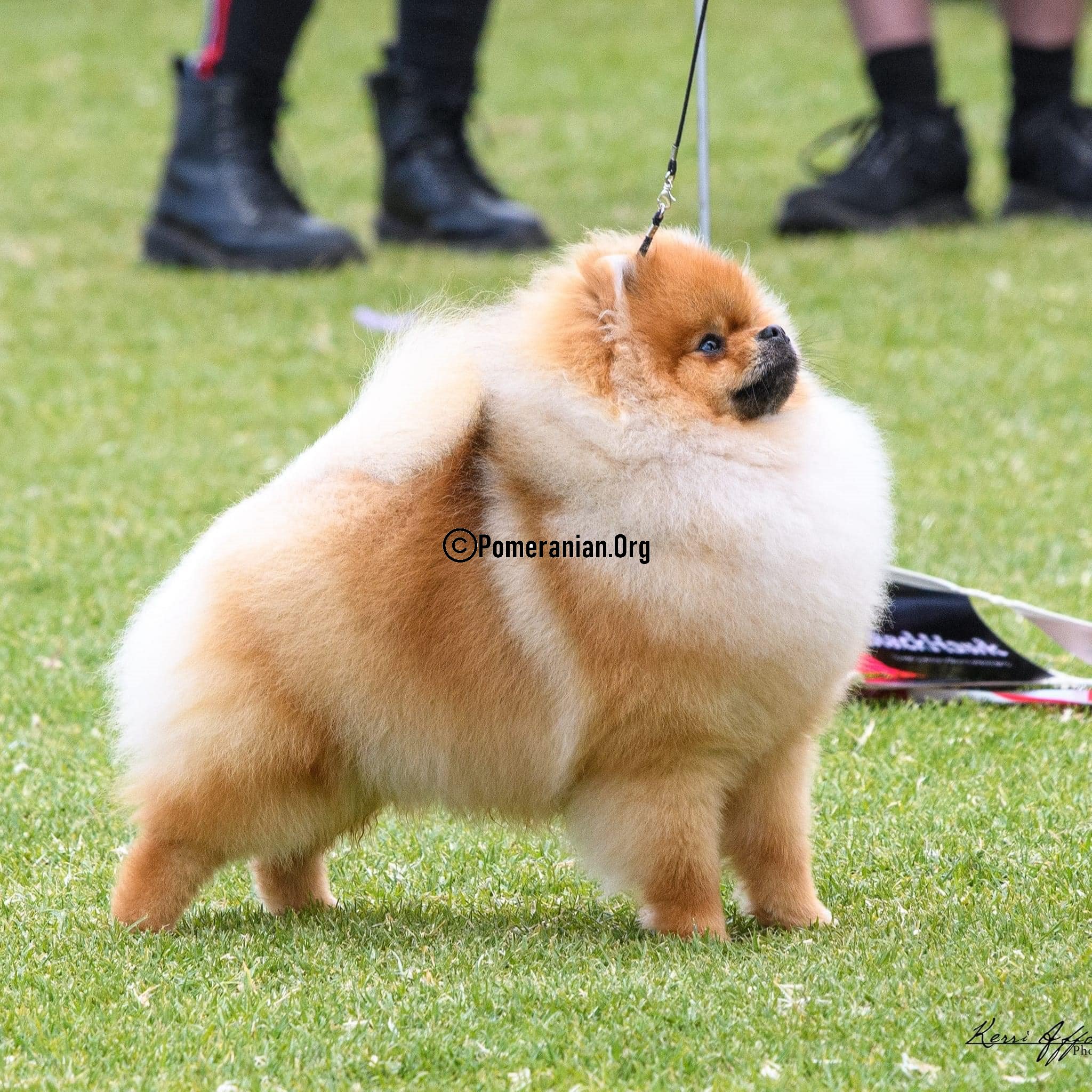
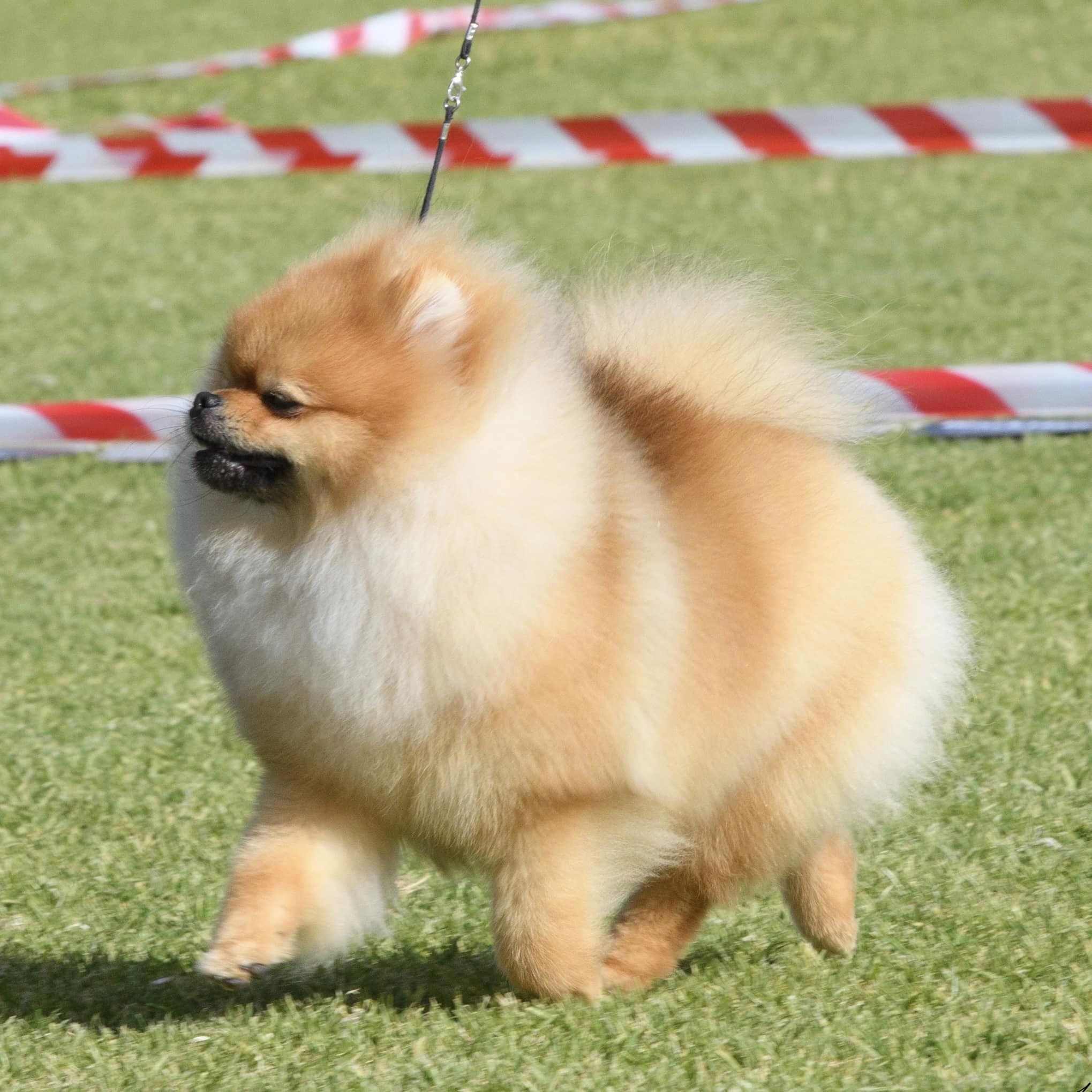
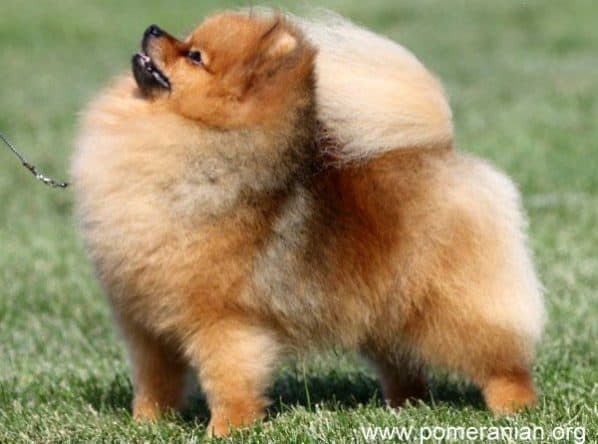
A correctly trimmed Pomeranian should still look like a naturally full-coated Pomeranian. The coat should frame the face, form a profuse ruff around the neck and shoulders, cover the body abundantly, and support the heavily plumed tail carried over the back.
The finished appearance should be neat and balanced without looking sculpted, clipped, or artificially rounded. A good trim enhances the dog’s natural shape rather than creating an entirely different silhouette.
A Safe Trim Should Preserve
- The full length of the body coat
- The protective outer guard hairs
- The profuse neck ruff and shoulder frill
- The natural furnishings on the legs
- The heavily plumed tail
- The characteristic Pomeranian outline
What to Tell Your Groomer
Before leaving your Pomeranian with a groomer, clearly explain that you want only a light scissor trim. Do not rely on phrases such as “just tidy him up,” because different groomers may interpret these words differently.
You can give your groomer these instructions:
“Please preserve the full double coat. Do not use clippers on the body and do not give my Pomeranian a teddy bear, puppy, Boo, or lion cut. Please only neaten the feet, paw pads, ear tips, sanitary area, and obvious stray hairs with scissors.”
If possible, choose a groomer who has experience with Pomeranians and other double-coated breeds. Show the groomer photographs of the natural finish you want and confirm the instructions again when you collect your dog.
Pomeranian Haircut Styles Compared
Pomeranian haircut names are not always used consistently. One groomer’s “puppy cut” may be another groomer’s “teddy bear cut,” so it is important to discuss the exact length and shape before grooming begins.
The following comparison explains what each popular Pomeranian hairstyle generally involves and whether it preserves the breed’s natural double coat.
| Haircut or Trim | What It Involves | Coat Impact | Recommendation |
|---|---|---|---|
| Natural Tidy Trim | Light trimming of the feet, paw pads, ear tips, sanitary area, and stray outer hairs. | Preserves the full body coat and natural outline. | ✓ Recommended |
| Pomeranian Show Trim | Careful shaping to enhance the dog’s natural outline while retaining the correct coat. | Preserves the double coat when performed correctly. | ✓ Recommended |
| Teddy Bear Cut | The body and furnishings are shortened, with the head shaped into a rounded appearance. | Removes substantial coat and may affect its texture and regrowth. | ✗ Not recommended |
| Puppy Cut | The body coat is shortened to a relatively even length to create a puppy-like appearance. | Cuts into the double coat and can result in slow or uneven regrowth. | ✗ Not recommended |
| Boo Haircut | A very short body combined with a heavily rounded head and face. | Removes much of the protective coat and dramatically changes the natural outline. | ✗ Strongly discouraged |
| Lion Cut | Most of the body is clipped or shaved while hair is retained around the head, chest, and tail tip. | Exposes the body and may cause significant problems with coat texture and regrowth. | ✗ Strongly discouraged |
The Safest Choice
A natural tidy trim or correctly performed show trim is the safest cosmetic option for a Pomeranian. Both preserve the protective double coat while improving the dog’s neatness and natural outline.
Why Short Pomeranian Haircuts Are Popular
Teddy bear, puppy, Boo, and lion cuts have become popular through photographs and videos shared online. Owners may also believe that a short coat will be easier to maintain, reduce shedding, or help their Pomeranian remain cool in summer.
Unfortunately, shortening the coat does not stop shedding. Loose undercoat will continue to develop and may become more difficult to remove if it is trapped beneath a clipped outer layer. A short haircut also does not replace appropriate heat management, including shade, drinking water, air conditioning, and avoiding exercise in hot weather.
Before approving a haircut, ask the groomer:
- Will clippers be used anywhere on the body?
- How much coat will be removed?
- Will the scissors cut deeply into the undercoat?
- Can the natural ruff, furnishings, and tail plume be retained?
- Does the groomer have experience with Pomeranian double coats?
If a groomer recommends a particular style, ask them to show you exactly how short the finished coat will be. Photographs are more reliable than haircut names, which can mean different things to different groomers.
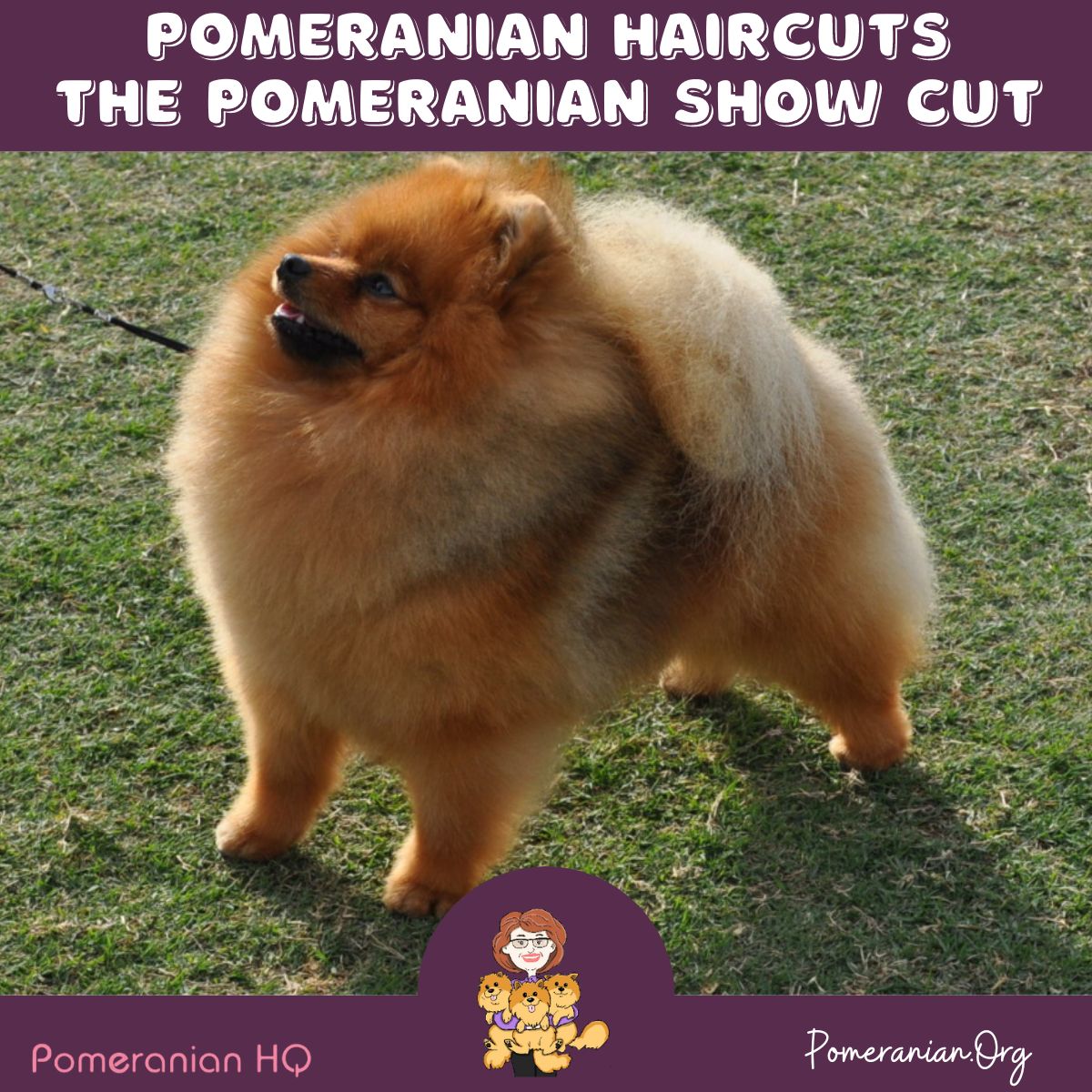
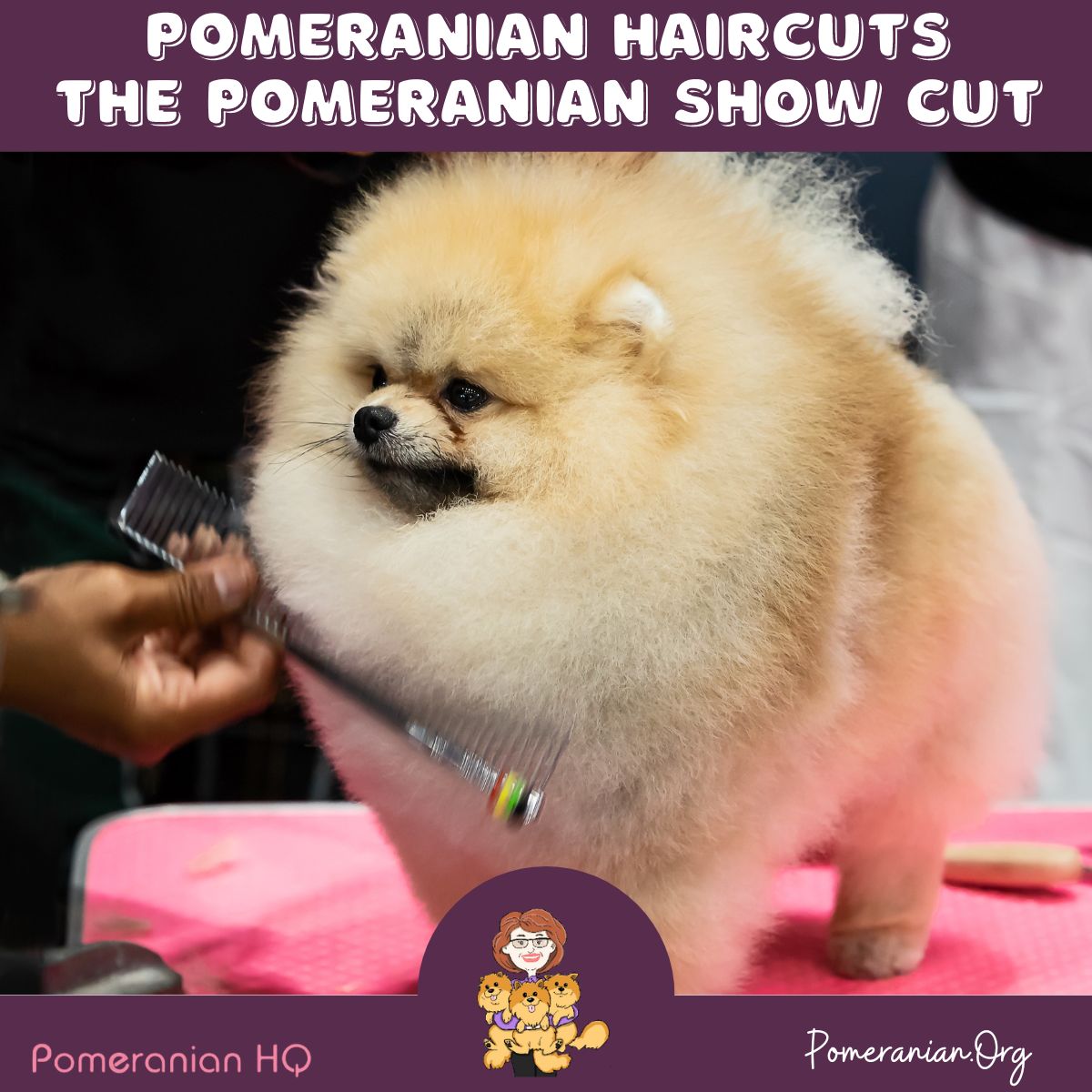
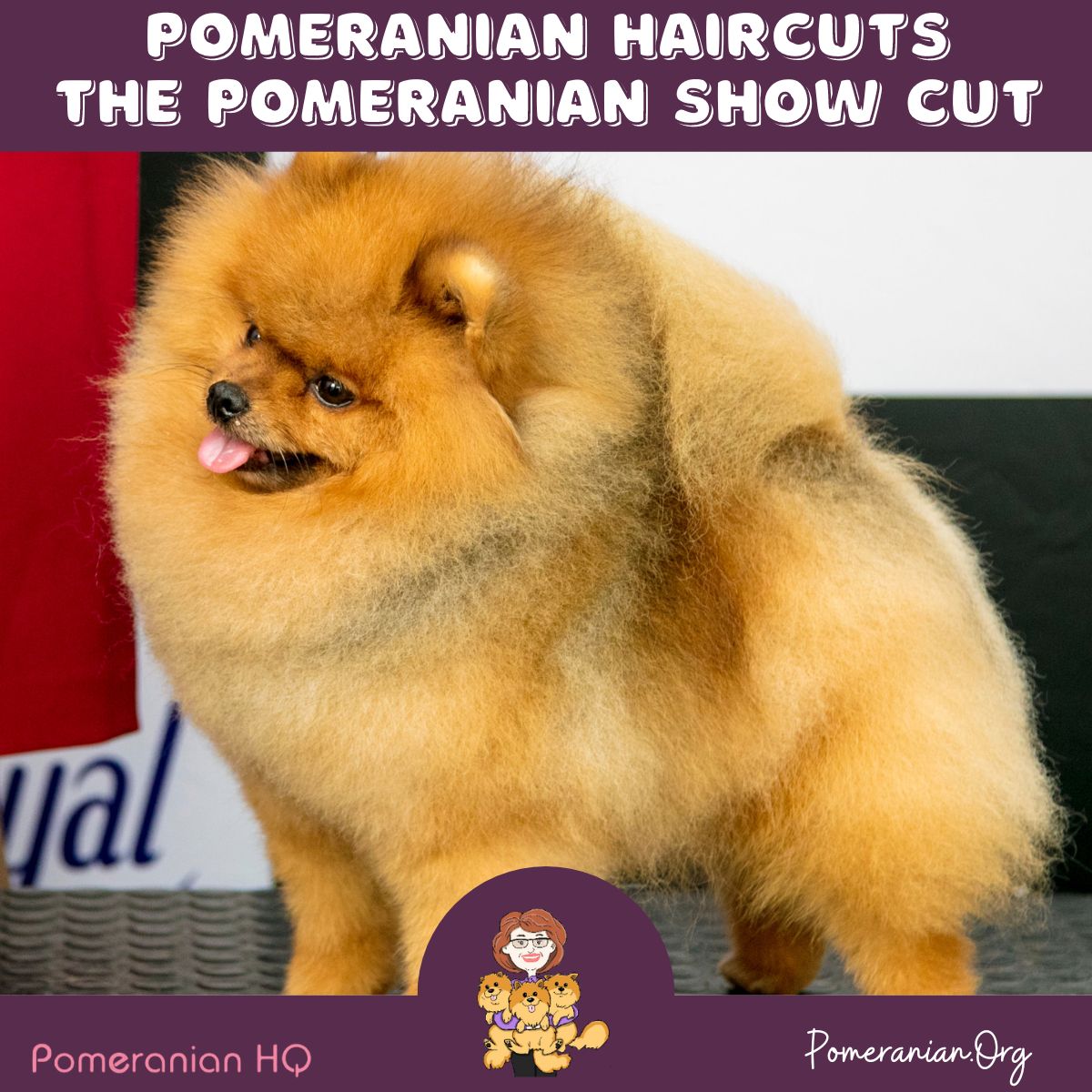
The Pomeranian Show Trim
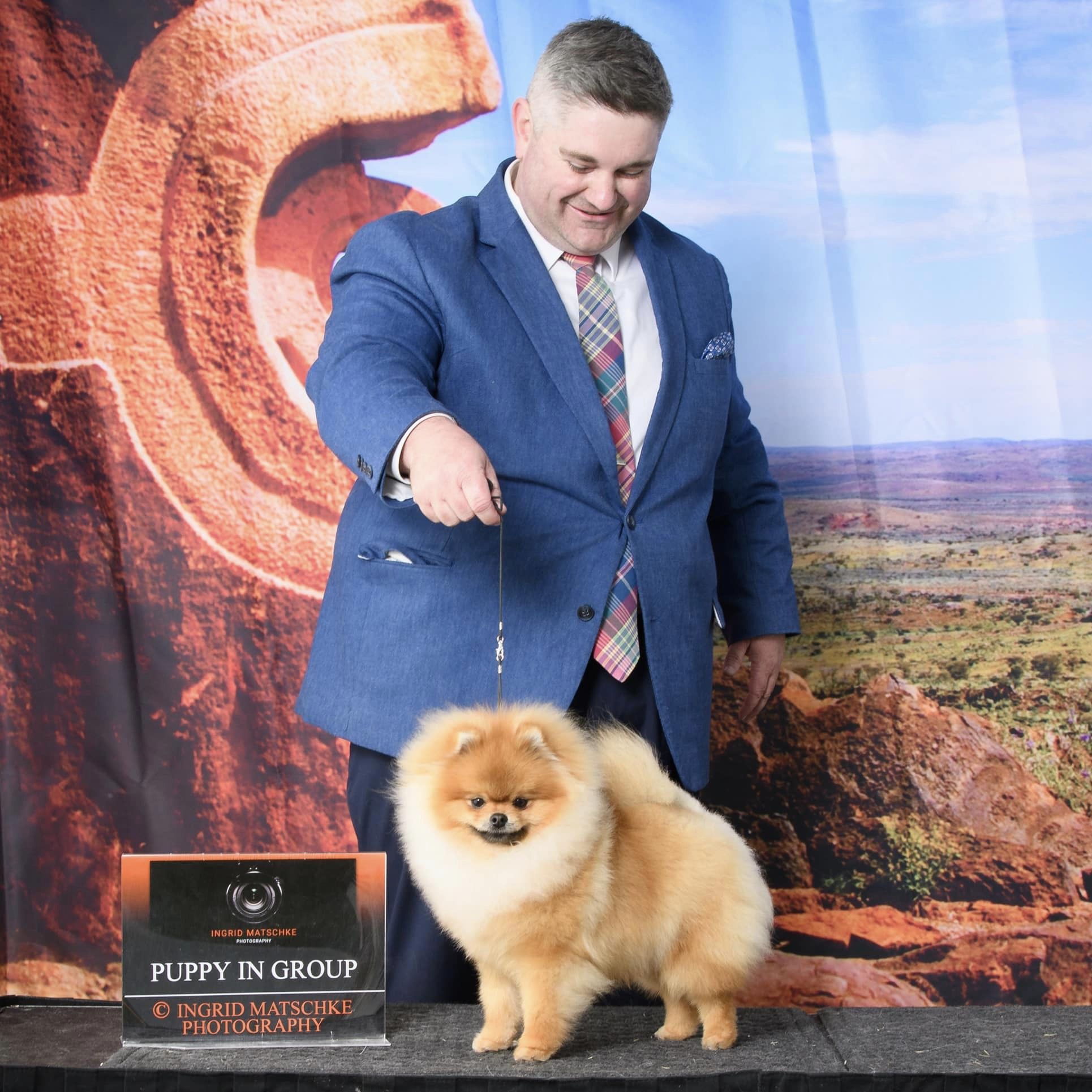
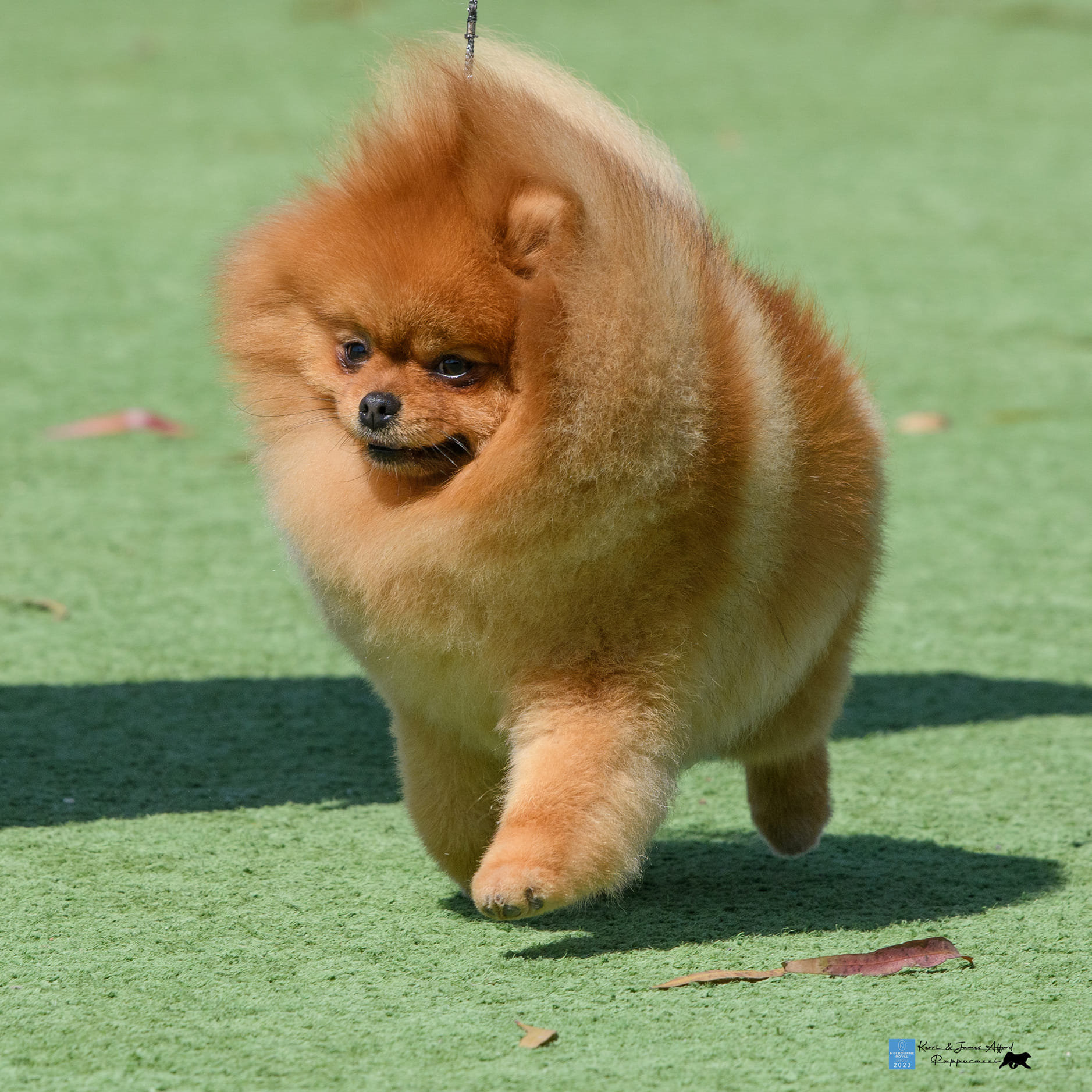
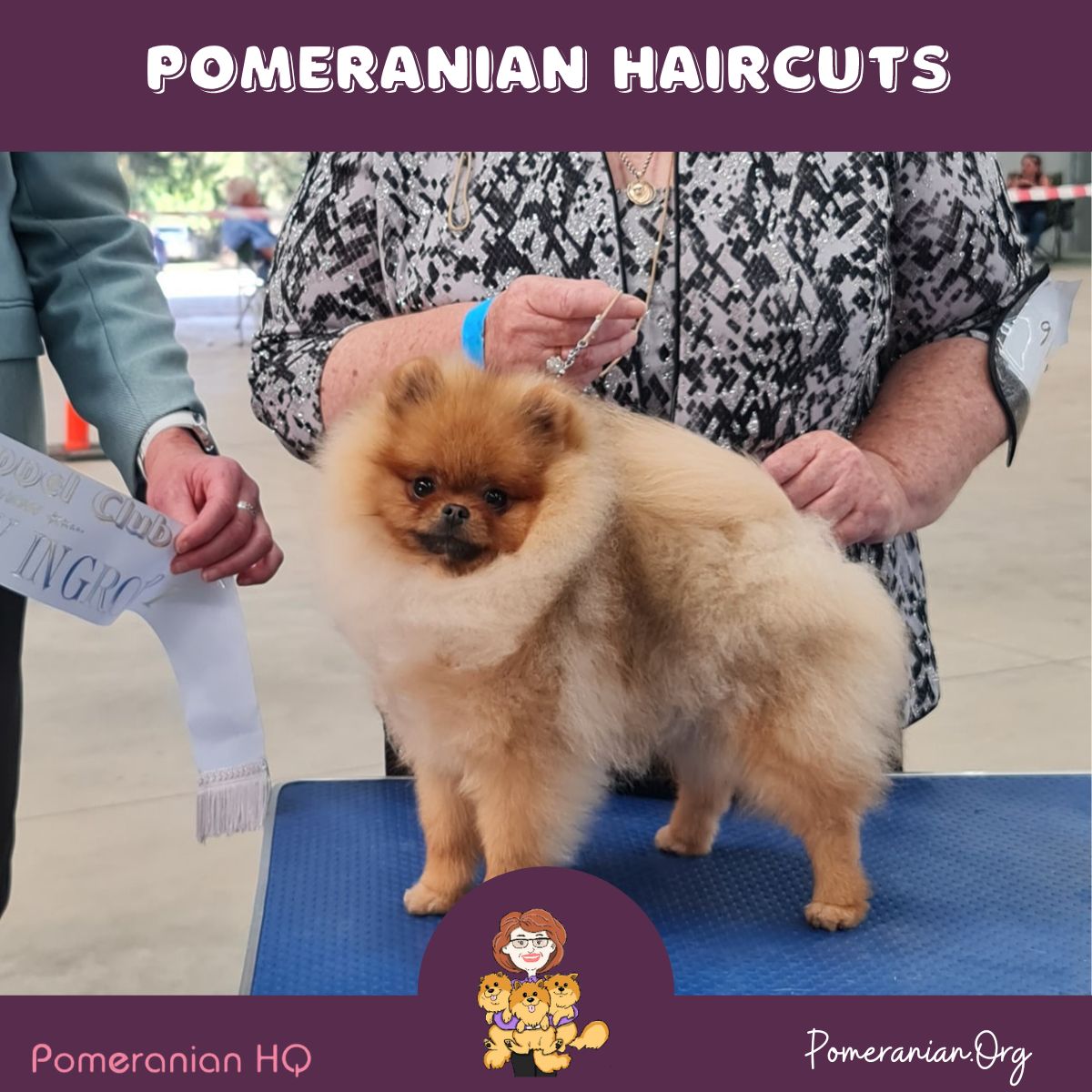
A Pomeranian show trim is very different from a teddy bear, puppy, or Boo haircut. The objective is not to shorten the body coat or transform the dog into an artificially rounded shape. A correct show trim tidies and balances the natural outline while preserving the breed’s profuse double coat.
Most of the Pomeranian’s show-ring appearance is achieved through excellent coat condition, careful brushing, thorough bathing, correct drying, and skilled presentation. Scissors are used sparingly to neaten particular areas rather than remove substantial amounts of coat.
The Purpose of a Show Trim
A carefully performed show trim enhances the natural Pomeranian outline without disguising the dog’s true structure or coat.
Excess hair beneath the pads is removed, and the coat around each foot is carefully shaped to create a small, tidy appearance.
Stray hairs around the ear edges are lightly trimmed so the small ears remain visible and contribute to the Pomeranian’s alert expression.
Long, uneven hairs may be lightly neatened to produce a balanced silhouette while retaining the natural length and texture of the coat.
The finished trim should complement the Pomeranian’s compact proportions, profuse ruff, leg furnishings, high-set tail, and characteristic breed outline.
How Is a Show Pomeranian Trimmed?
Before trimming begins, the coat should be clean, completely dry, free from mats, and carefully brushed. The undercoat is lifted and supported during drying so the outer coat stands away from the body as it should.
The groomer or exhibitor may then tidy the feet, lightly define the ear tips, neaten the sanitary area, and remove obvious hairs that interrupt the outline. Any shaping around the body, ruff, trousers, and tail should be conservative and performed with great care.
A Correct Show Trim Should
- Preserve the natural double coat and protective guard hairs.
- Retain the full neck ruff, shoulder frill, and leg furnishings.
- Keep the tail plume long, full, and naturally carried over the back.
- Create neat feet and clearly visible ear tips.
- Improve balance without concealing the dog’s natural structure.
- Leave the Pomeranian looking natural rather than heavily sculpted.
Show Trim Versus Teddy Bear Cut
A show trim preserves the Pomeranian’s full coat and enhances the breed’s natural outline. A teddy bear cut shortens the body coat and usually rounds the head and face to create a deliberately different appearance.
| Feature | Show Trim | Teddy Bear Cut |
|---|---|---|
| Body coat | Retained at its natural length | Shortened considerably |
| Head shape | Natural expression preserved | Rounded to resemble a soft toy |
| Double coat | Preserved when trimmed correctly | Cut into and substantially reduced |
| Overall purpose | Enhances correct Pomeranian type | Creates a fashionable pet hairstyle |
“A beautifully prepared show Pomeranian should still look natural. The trim should enhance the dog’s correct outline, not remove the magnificent double coat or create an exaggerated, sculpted shape.”
Owners who want a show-style finish should choose a groomer with proven experience preparing Pomeranians. This specialised trim requires a sound understanding of the breed’s coat, structure, and correct outline.
Pomeranian Teddy Bear Cut
The Pomeranian teddy bear cut is a fashionable hairstyle designed to give the dog a soft, rounded appearance resembling a stuffed toy. The hair around the face and ears is shaped into a circle, while the body coat, chest, legs, and furnishings are shortened to create an even, compact outline.
Although the finished style may look adorable, achieving this appearance requires considerably more coat removal than a natural tidy trim. The scissors or clippers cut into the double coat, potentially affecting its texture, growth cycle, and future appearance.
What Does a Teddy Bear Cut Look Like?
The exact length varies between groomers, but the style usually includes these features.
The hair around the face, cheeks, and ears is shaped into a rounded outline intended to resemble a teddy bear.
The body coat is cut to a shorter, more even length, removing much of the natural fullness and stand-off appearance.
The leg furnishings are shortened and blended into rounded feet, creating a compact and uniform shape.
The remaining undercoat can initially make the dog look soft and plush, but this texture may become woolly or uneven as the coat grows.
Why Is the Pomeranian Teddy Bear Cut So Popular?
The teddy bear haircut has become extremely popular because of photographs and videos shared on social media. Its rounded face and plush appearance can make an adult Pomeranian resemble a puppy or soft toy.
Some owners also request this cut because they believe a shorter coat will be cooler, shed less, or require no brushing. Unfortunately, shortening the coat does not stop the undercoat from shedding, and the dog will still require regular grooming to prevent loose hair, tangles, and mats.
Possible Problems With a Teddy Bear Cut
- The protective guard hairs and soft undercoat may regrow at different rates.
- The new coat may initially feel woolly, cotton-like, or unusually soft.
- Regrowth can appear patchy or uneven.
- The coat may lose some of its natural texture, colour, or stand-off appearance.
- The full neck ruff, leg furnishings, and tail plume may take many months to recover.
- Some Pomeranians may not regain their original coat completely.
- Exposed skin may have less protection from sunlight and minor abrasions.
Is a Long Teddy Bear Trim Safe?
Some groomers use the term “teddy bear trim” for a much longer style created almost entirely with scissors. If only the longest stray hairs are lightly neatened and the full body coat remains intact, the risk is lower than with a short teddy bear cut.
However, the name alone does not tell you how much coat will be removed. Always show the groomer photographs of the finish you want and ask exactly how short the body, chest, trousers, and tail will be before agreeing to the trim.
If you want a softly rounded appearance:
Ask for a very light scissor trim that preserves the natural body length. The groomer can gently neaten the face, ear tips, feet, and obvious stray hairs without clipping the coat short or cutting deeply into the undercoat.
“A teddy bear cut may look appealing when it is first completed, but owners should understand that achieving this style usually means cutting into the Pomeranian’s double coat. I recommend preserving the natural body coat and using only a light scissor trim to create a neat appearance.”
What if My Pomeranian Already Has a Teddy Bear Cut?
Do not panic if your Pomeranian has already received a teddy bear haircut. Many coats gradually recover, although returning to full length and condition may take many months. Continue gentle brushing, use suitable dog-grooming products, provide a balanced diet, and allow the coat time to complete its natural growth cycle.
Consult your veterinarian if the skin becomes itchy, inflamed, discoloured, or unusually thin, or if very little coat regrowth is visible over an extended period. Poor regrowth can sometimes be associated with an underlying skin, hormonal, or coat-cycle condition rather than the haircut alone.
Pomeranian Puppy Cut
A Pomeranian puppy cut usually involves shortening the body coat, chest, legs, and furnishings to a fairly even length. The intention is to give an adult Pomeranian a neat, youthful appearance similar to that of a young puppy.
Despite its name, this is not a special trim required by Pomeranian puppies. A healthy puppy’s coat should normally be allowed to develop naturally, with regular brushing, bathing, drying, nail care, and only minimal trimming around the feet and sanitary area when necessary.
What Does a Pomeranian Puppy Cut Involve?
There is no standard length, so the finished result can vary considerably between groomers.
The body coat is shortened to a relatively uniform length, removing much of its natural fullness and stand-off appearance.
The chest, stomach, trousers, and leg furnishings may be shortened and blended into the body coat.
The shorter coat is intended to make an adult Pomeranian appear younger, smaller, and less heavily coated.
The exposed undercoat may initially look plush, but it can become woolly, uneven, or difficult to maintain as it regrows.
Puppy Cut Versus Teddy Bear Cut
The terms “puppy cut” and “teddy bear cut” are frequently used interchangeably. Both usually involve shortening the body coat, but a teddy bear cut places greater emphasis on creating a distinctly round head and face.
| Feature | Puppy Cut | Teddy Bear Cut |
|---|---|---|
| Body coat | Shortened to a fairly even length | Shortened and shaped for a plush finish |
| Head and face | May be lightly rounded or left more natural | Deliberately shaped into a pronounced circle |
| Intended appearance | Young and evenly coated | Rounded like a stuffed toy |
| Coat risk | May affect texture and regrowth | May affect texture and regrowth |
Is a Puppy Cut Easier to Maintain?
A puppy cut may appear easier to manage because the coat is shorter, but it does not remove the need for regular grooming. The undercoat continues to shed and can still become tangled or matted beneath the shortened outer hairs.
Repeated clipping may also produce a soft, dense, woolly coat that becomes more difficult to brush. Regular bathing, thorough drying, line brushing, nail trimming, and attention to the ears, teeth, and paw pads remain necessary.
Possible Effects of a Short Puppy Cut
- The undercoat and guard hairs may regrow at different rates.
- The coat may become soft, woolly, cotton-like, or uneven.
- Natural colour, texture, and stand-off appearance may be altered.
- The neck ruff, trousers, and other furnishings may take many months to return.
- The skin may have less protection from sunlight and minor injury.
- Some Pomeranians may not regain their original coat completely.
A Puppy Cut Is Not the “Puppy Uglies”
The Pomeranian puppy uglies are a normal stage of coat development and are not a haircut. During this transition, the soft baby coat is shed as the mature double coat begins to develop. A puppy may temporarily look thin-coated, uneven, or less fluffy.
Clipping a puppy during this stage will not make the adult coat grow faster or thicker. The coat should be allowed to develop naturally while the puppy receives gentle, regular grooming.
Safer alternative to a puppy cut:
Keep the body coat at its natural length and ask for a light scissor trim around the feet, paw pads, ear tips, sanitary area, and obvious stray hairs. This creates a neater appearance without removing the protective double coat.
“A Pomeranian does not need its coat cut short to look neat or youthful. Regular grooming and a conservative scissor trim will preserve the natural double coat while keeping the dog beautifully presented.”
What if My Pomeranian Already Has a Puppy Cut?
Do not panic. Many Pomeranian coats gradually recover after a puppy cut, although full regrowth can take many months and occasionally much longer. Allow the coat to grow without further clipping and maintain it with gentle brushing, suitable grooming products, and a balanced diet.
Contact your veterinarian if the skin appears itchy, inflamed, discoloured, or unusually thin, or if coat regrowth remains very poor. Slow regrowth may sometimes have an underlying skin, hormonal, or coat-cycle cause.
The Boo Pomeranian Haircut
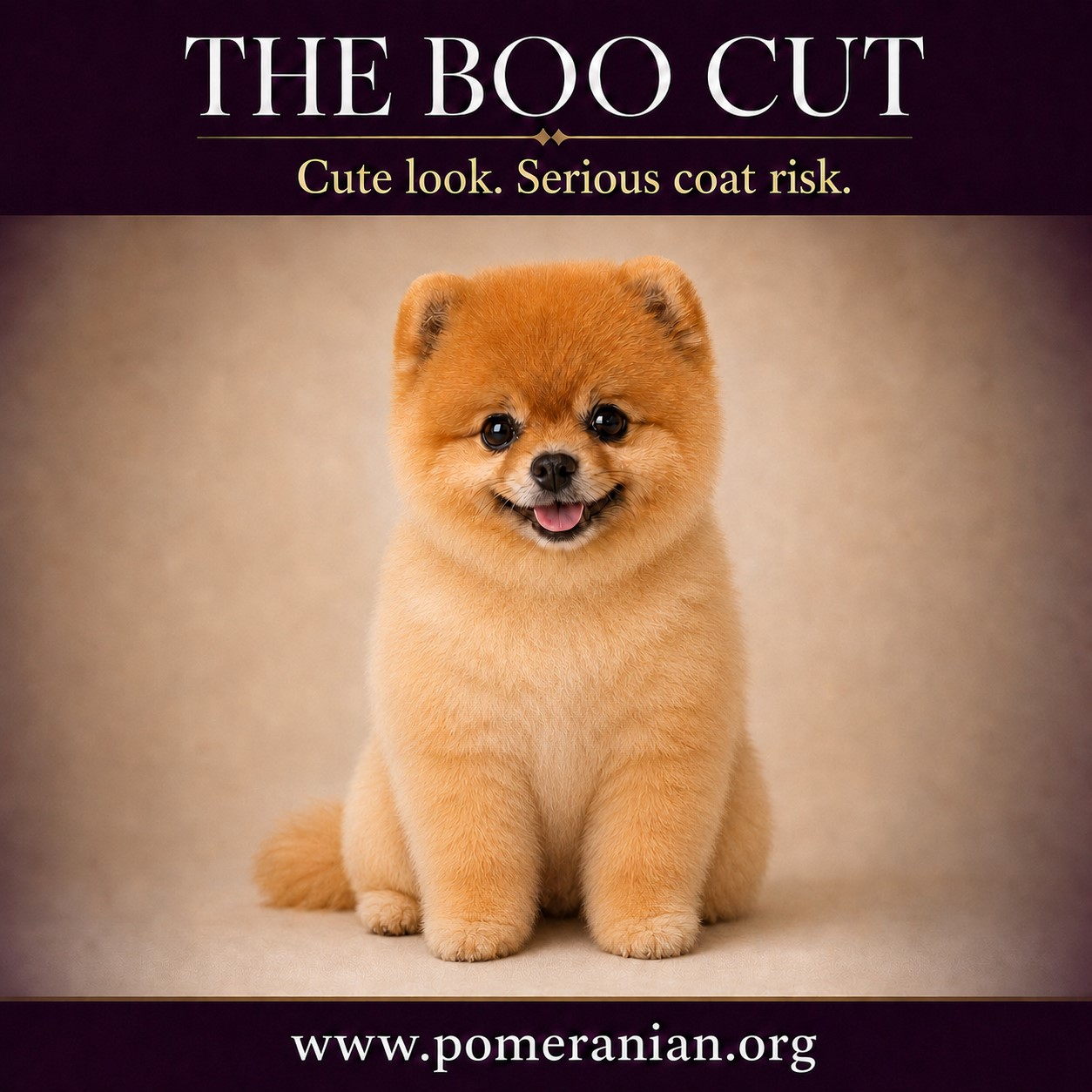
The Boo haircut is an extremely short Pomeranian hairstyle made famous by Boo, a social-media celebrity often described as the “world’s cutest dog.” His rounded head, tiny visible ears, and closely clipped body created an appearance resembling a plush toy.
Many owners began asking groomers to recreate this distinctive look. However, Boo’s haircut was reportedly associated with coat problems and matting rather than being an ideal cosmetic style for every Pomeranian. Achieving the same appearance usually requires removing a substantial amount of the breed’s protective double coat.
What Does a Boo Haircut Look Like?
This dramatic haircut changes the Pomeranian’s natural appearance from a profusely coated dog into a short, rounded character.
The hair surrounding the face is sculpted into a pronounced circle, with the ears trimmed so they appear particularly small.
The body coat is clipped extremely short, removing the natural ruff, outer coat, and much of the breed’s characteristic fullness.
The leg furnishings, chest coat, and trousers are shortened and blended to create a compact, uniform silhouette.
The combination of a round head and very short body is intended to make the Pomeranian resemble a teddy bear or soft toy.
Why Is the Boo Cut Strongly Discouraged?
The Boo cut is more extreme than most puppy or teddy bear cuts. It removes a large proportion of the protective outer coat and cuts deeply into the soft undercoat. Once the coat has been clipped this short, there is no reliable way to predict how quickly or evenly it will return.
Some Pomeranians gradually regain a satisfactory coat, while others develop patchy, slow, woolly, or uneven regrowth. Repeated clipping may further disrupt the coat’s natural appearance and make it increasingly difficult to restore.
Possible Consequences of a Boo Cut
- Slow, patchy, or uneven coat regrowth
- A soft, woolly, cotton-like, or matted texture
- Loss of the correct harsh-textured protective guard hairs
- Changes to the coat’s colour and natural stand-off appearance
- Loss of the full neck ruff, trousers, and leg furnishings
- Reduced protection from sunlight, insects, and minor abrasions
- Greater difficulty restoring the natural coat after repeated clipping
- A possibility that the original coat may never completely return
Will a Boo Haircut Keep a Pomeranian Cool?
A very short haircut is not a safe substitute for sensible summer care. Removing the coat does not prevent a Pomeranian from overheating and may leave the skin with less protection from direct sunlight.
During hot weather, keep your Pomeranian indoors in a cool or air-conditioned area, provide constant access to fresh water and shade, avoid hot surfaces, and restrict exercise to the cooler parts of the day. Never leave a dog unattended in a vehicle.
Boo Cut Versus Natural Pomeranian Coat
| Feature | Natural Coat | Boo Cut |
|---|---|---|
| Body coat | Long, profuse, and standing away from the body | Clipped extremely short |
| Neck ruff | Full and abundant | Mostly removed |
| Head shape | Natural expression and visible ears | Heavily rounded and sculpted |
| Coat protection | Double coat remains intact | Protective coat is substantially reduced |
A safer way to achieve a cute, rounded appearance
Ask for a conservative scissor trim that lightly neatens the feet, ear tips, sanitary area, and obvious stray hairs. The face may be gently shaped without clipping the body short or removing the full neck ruff, furnishings, and tail plume.
“The famous Boo appearance was created by removing most of the magnificent coat that defines a Pomeranian. Owners should understand that their dog may look very different while the coat grows back—and there is no guarantee it will return exactly as it was.”
What if My Pomeranian Already Has a Boo Cut?
Do not panic, and do not repeatedly clip the coat in an attempt to make uneven regrowth look tidier. Allow the hair to grow, brush gently and regularly, prevent mats, and use appropriate dog-grooming products. Returning to a full coat may take many months and occasionally much longer.
Seek veterinary advice if the skin is itchy, inflamed, discoloured, unusually thin, or exposed to sunburn. A veterinary examination is also advisable if very little regrowth occurs over an extended period, as an underlying skin, hormonal, or coat-cycle condition may be involved.
The Pomeranian Lion Cut
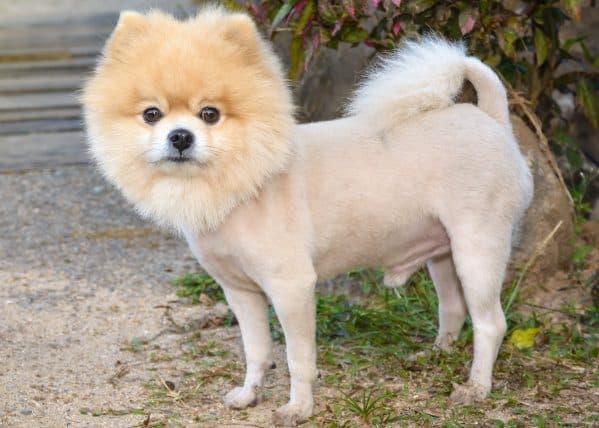
The Pomeranian lion cut is a dramatic hairstyle in which the coat covering most of the body is clipped or shaved very short. Longer hair is retained around the head, neck, and chest to resemble a lion’s mane, while a tuft may be left on the end of the tail.
This cut completely changes the natural appearance of a Pomeranian and removes much of the coat that protects the body. Because it requires shaving deeply into the double coat, the lion cut is strongly discouraged except when clipping is medically necessary or severe matting leaves no safe alternative.
What Does a Pomeranian Lion Cut Look Like?
The style attempts to imitate a lion by combining a long mane with a closely clipped body.
Hair is retained around the head, neck, shoulders, and sometimes the chest to create the appearance of a lion’s mane.
The body coat is clipped extremely short, removing both protective guard hairs and much of the insulating undercoat.
The natural trousers and rear furnishings are removed, leaving the hindquarters and legs closely clipped or shaped.
Most of the tail may be shortened, with a small tuft of longer hair left at the tip to complete the lion-like appearance.
Why Is the Lion Cut Unsuitable for a Pomeranian?
A Pomeranian’s coat consists of a dense, soft undercoat supporting longer protective guard hairs. Shaving the body removes the natural barrier provided by these two layers and may disrupt the way they grow back.
The undercoat often grows more quickly than the outer guard hairs. During regrowth, the coat may appear patchy, woolly, dull, or uneven. It may also mat more easily because the soft undercoat is no longer properly separated and protected by the longer outer hairs.
Possible Risks of a Pomeranian Lion Cut
- Slow, patchy, or uneven coat regrowth
- A woolly, cotton-like, or unusually soft coat texture
- Loss or delayed return of the protective guard hairs
- Permanent changes to the coat’s colour, texture, or appearance
- Greater risk of tangles and matting during regrowth
- Reduced protection from sunlight, insects, and minor abrasions
- Clipper irritation, razor burn, or small cuts
- A possibility that the original coat may never completely return
Protecting Exposed Skin After a Lion Cut
Once the body has been shaved, the skin is more exposed to direct sunlight, cold conditions, insects, rough vegetation, and accidental scratches. Light-coloured Pomeranians and dogs with pale skin may be particularly vulnerable to sunburn.
Keep a recently shaved Pomeranian out of strong sunlight and avoid prolonged outdoor activity during the hottest part of the day. Ask your veterinarian about a suitable canine sunscreen if sun exposure cannot be avoided. Human sunscreen should not be used unless your veterinarian confirms that its ingredients are safe for dogs.
| Feature | Natural Coat | Lion Cut |
|---|---|---|
| Body | Covered by the complete double coat | Clipped or shaved very short |
| Neck and chest | Naturally profuse ruff | Left long to imitate a mane |
| Tail | Long, profuse plume carried over the back | Often shortened with a tuft at the tip |
| Skin protection | Natural protection remains intact | Much of the body is left exposed |
When Might Shaving Be Necessary?
There are occasions when shaving part or all of a Pomeranian’s coat may be necessary for medical treatment, surgery, wound care, diagnostic testing, or the removal of severe mats that cannot be safely brushed out.
In these situations, the dog’s health and comfort must come before appearance. Clipping should be limited to the smallest area necessary whenever possible and performed by a veterinarian or experienced professional.
A safer cosmetic alternative
Retain the full body coat and request a natural tidy trim. The groomer can neaten the feet, ear tips, sanitary area, and stray hairs without shaving the body, removing the trousers, or shortening the tail plume.
“The Pomeranian’s magnificent double coat is an essential feature of the breed. A lion cut removes this natural protection and creates an unnecessary risk of poor regrowth. Unless shaving is required for health or welfare reasons, I strongly recommend preserving the full coat.”
What if My Pomeranian Already Has a Lion Cut?
Do not panic. Protect the exposed skin and allow the coat to grow without further cosmetic clipping. Brush gently as new hair develops, as the uneven mixture of undercoat and guard hairs may tangle easily. Full recovery can take many months and, in some dogs, considerably longer.
Consult your veterinarian if the skin becomes red, itchy, inflamed, discoloured, or sunburnt. Veterinary advice is also recommended if coat growth remains extremely poor, as an underlying skin, hormonal, or coat-cycle condition may be contributing to the problem.
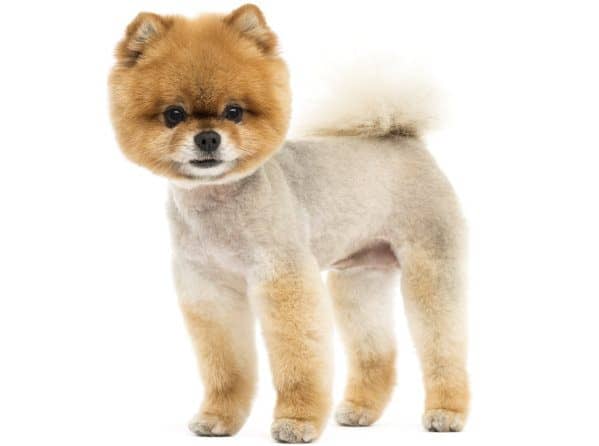
Clipping, Shaving and Scissor Trimming a Pomeranian
The words clipping, shaving, and trimming are sometimes used as though they mean the same thing. However, each grooming method removes a different amount of coat and carries a different level of risk.
Understanding these terms will help you give clear instructions to your groomer and avoid an unexpectedly short haircut.
| Method | What It Means | Is It Suitable? |
|---|---|---|
| Light scissor trimming | Neatening selected areas without significantly shortening the body coat. | Generally suitable when performed conservatively. |
| Clipping | Using electric clippers with a blade or attachment comb to shorten the coat. | Suitable for limited hygienic areas, but not recommended across the body for cosmetic purposes. |
| Shaving | Cutting the coat extremely close to the skin with a short clipper blade. | Reserved for genuine veterinary, welfare, or severe matting situations. |
Which Parts of a Pomeranian Can Be Safely Trimmed?
A properly groomed pet Pomeranian can be kept clean and tidy without shortening the main body coat. Only small amounts of hair should be removed, following the dog’s natural outline.
Trim around each foot to create a neat, compact outline. Remove only the untidy hair extending beyond the toes.
Hair growing beneath and between the paw pads may be carefully shortened to improve cleanliness and grip.
The fine hair extending beyond the tips may be lightly neatened to show the ears’ natural shape.
A small hygienic trim may be performed around the genital area and anus without removing the surrounding furnishings.
A few noticeably long or uneven hairs may be carefully blended while preserving the full natural outline.
The hair below the hock joint may be lightly tidied for a clean finish without cutting into the rear trousers.
Areas That Should Retain Their Natural Length
The body, neck ruff, chest, shoulders, trousers, leg furnishings, and tail plume should normally remain full. These areas create the characteristic Pomeranian outline and should not be routinely shortened simply to make grooming quicker.
Instructions to Avoid
Do not simply ask a groomer to “make my Pomeranian shorter” or “take half off.” These instructions are open to interpretation and may result in far more coat being removed than expected.
Avoid requesting a number such as a “number four” or “number seven” unless you fully understand the blade or attachment being discussed and the exact finished length.
What to Tell Your Pomeranian Groomer
Give your groomer precise instructions before leaving your dog:
- Do not clip or shorten the body coat.
- Do not remove the neck ruff, trousers, or tail plume.
- Neaten the feet and trim beneath the paw pads.
- Lightly shape the ear tips if necessary.
- Perform only a small sanitary trim.
- Use scissors only for obvious stray hairs.
- Contact me before removing any additional coat.
Denise’s grooming advice
Take photographs showing the natural finish you want and ask the groomer to repeat the instructions back to you. Clear communication is particularly important because terms such as “tidy trim” can mean different things to different groomers.
“A skilled Pomeranian groomer enhances the dog’s natural outline rather than creating an entirely different shape. When trimming is finished, the dog should still look unmistakably like a naturally coated Pomeranian.”
Final Thoughts on Pomeranian Haircuts
Pomeranians rarely need a dramatic haircut. A careful tidy of the feet, ear tips and sanitary area can keep the dog looking neat while preserving the natural double coat.
If clipping is medically necessary, follow your veterinarian’s advice. Otherwise, the safest approach is simple: groom the coat regularly, trim conservatively and allow your Pomeranian to look like a Pomeranian.
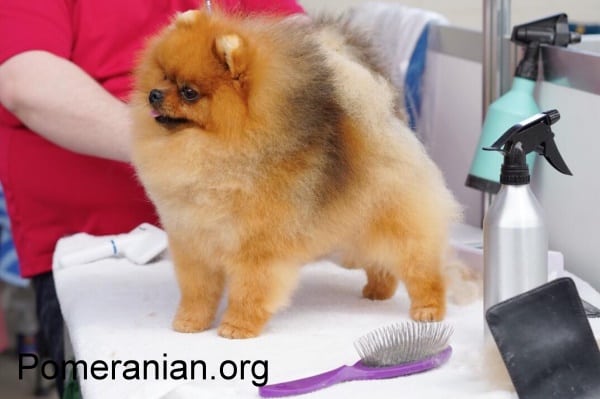
For more information, refer to the Pomeranian Grooming Book.
Copyright Pomeranian.Org. All Rights Reserved.
References and Further Reading:
[1] Denise Leo, “The Pomeranian Grooming Guide.”