
Thinking about getting a Pomeranian? Take our “Should I Get a Pomeranian?” quiz and discover if this lively, fluffy companion is the right breed for you. Learn the real pros and cons of owning a Pomeranian puppy and get expert insights from Denise Leo on what to expect when bringing one home.
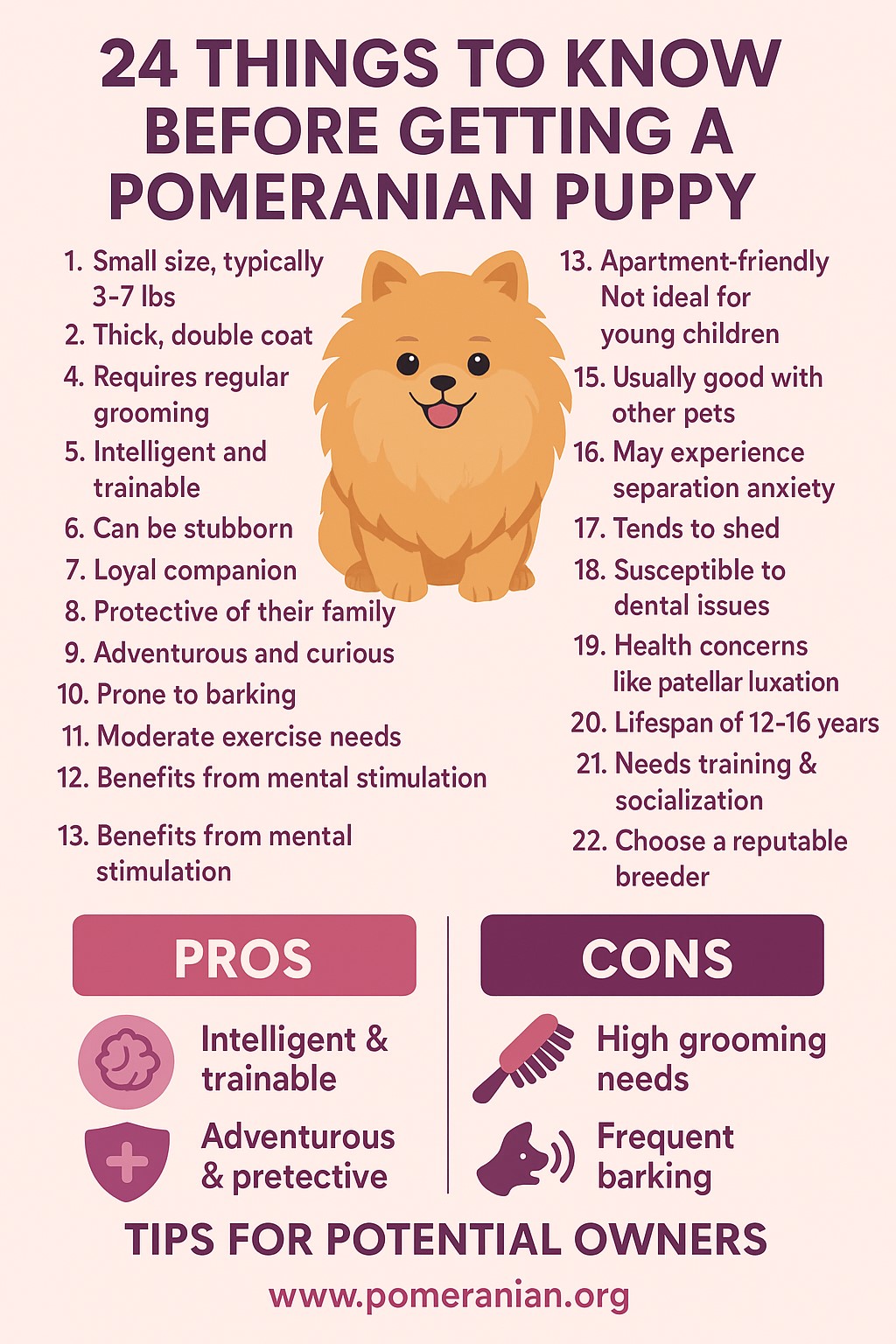
Explore the 24 pros and cons of owning a Pomeranian—from their lively personalities and affectionate nature to grooming needs and health considerations—before welcoming one into your home.
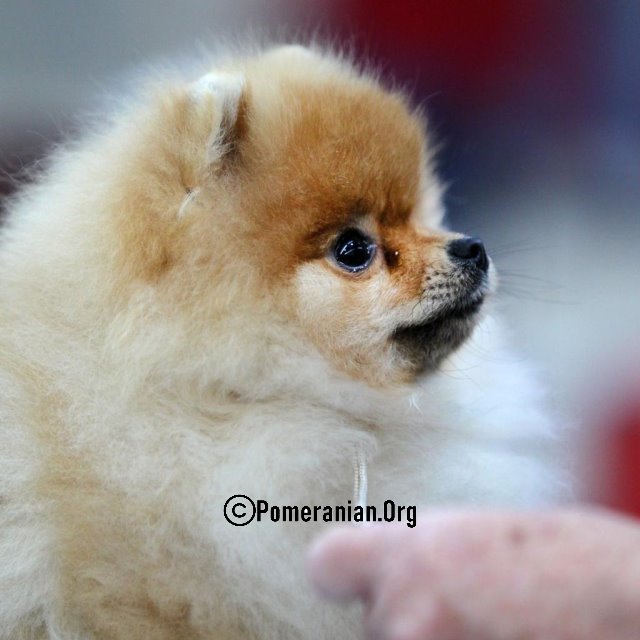
With their distinctive fox-like faces and luxuriously thick coats, Pomeranians embody the allure and complexities of sharing your life with a small dog breed. As one of the most sought-after toy breeds, these pint-sized canines are renowned for their lively temperament and endearing appearance, making them a beloved choice for dog enthusiasts, even in compact living spaces. Despite their diminutive stature, Pomeranians are a bundle of energy requiring meticulous care to flourish.
For those considering adopting a Pomeranian, whether a puppy or an older dog, male or female, it’s essential to understand both the joys and the commitments associated with these fluffy companions. There’s much to consider, from their status as a top breed registered with the American Kennel Club to their specific needs, such as regular exercise and grooming.
Pomeranians can be a good choice for novice dog owners and experienced dog lovers alike, provided they are prepared to meet their exercise needs, grooming requirements, and heat cycles, particularly for female Pomeranians. Understanding and being prepared for these responsibilities is key to successful Pomeranian ownership.
This guide explores the advantages and challenges of owning a Pomeranian, offering insights into what it truly means to live with these energetic, long-coated companions. Whether you’re looking to rescue a Pomeranian from an animal shelter or purchase one from a reputable breeder, understanding these details will help you and your tiny companion enjoy a happy, healthy life together and make you a confident and knowledgeable Pomeranian owner.
A Pomeranian is naturally man’s best friend, but he’s also fiercely loyal, smart, cuddly, and incredibly adorable. Here are the full details of the Pomeranian’s pros and cons. The Pomeranian’s intelligence level is high, and they are adventurous little dogs with a “Napoleon complex.”
I have several Pomeranians, and I would never give them up or the amazing experiences I have shared with them for anything in the world.
A Pomeranian is an ideal pet because of several traits that, once combined, create your family’s perfect 4-legged furry member. The characteristics may be temperamental and physical.
The key is to learn what you’re facing if you get a Pomeranian. You may already own one or two Poms, but it doesn’t guarantee that you’ll already know about all the traits these amazing creatures can offer you and your family.
🐾 Quick Answer: Should I Get a Pomeranian?
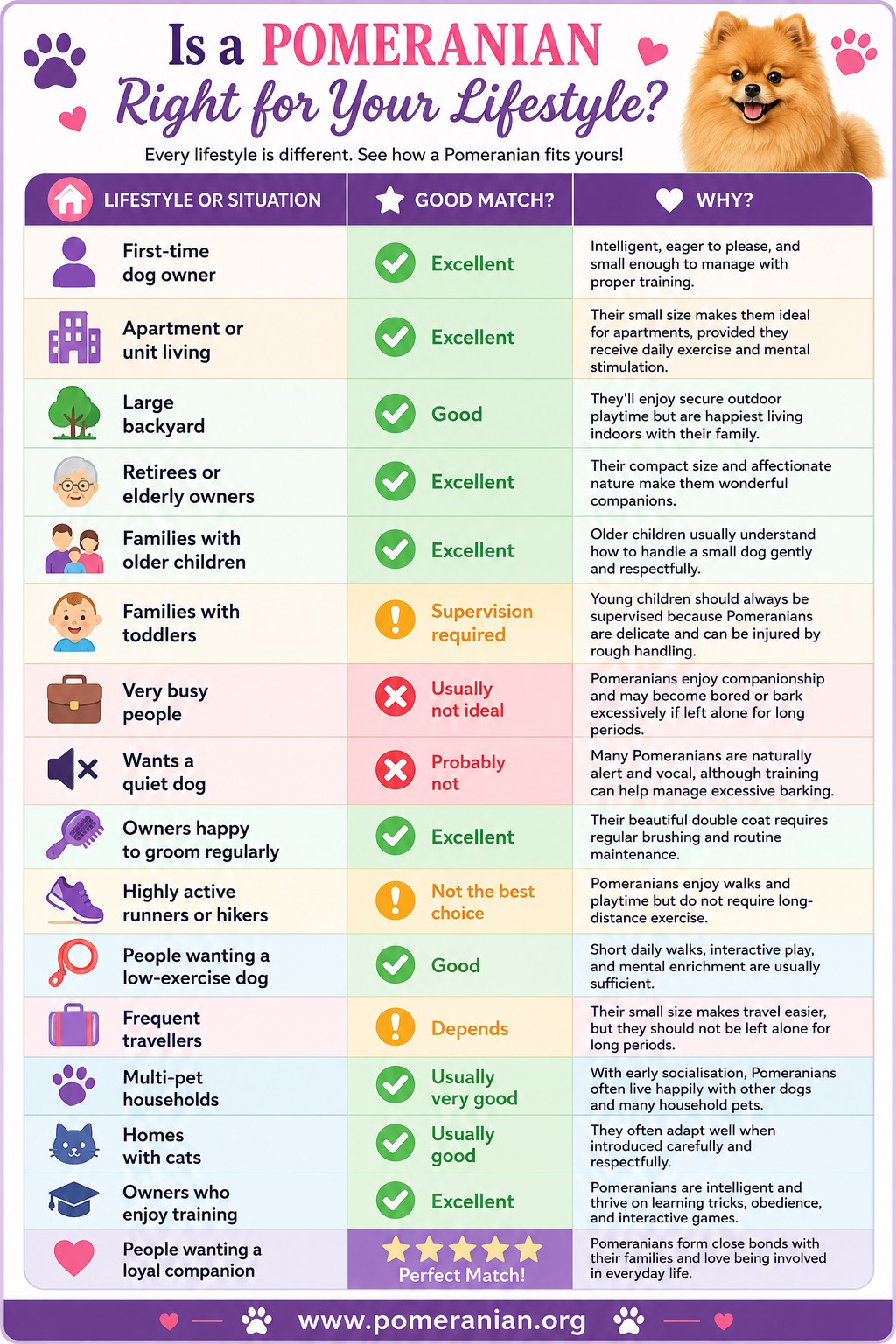
Yes, a Pomeranian can be a wonderful choice if you want a small, intelligent, loyal, and affectionate companion. Pomeranians suit many homes, including apartments, retirees, singles, and families with gentle older children.
However, they are not maintenance-free dogs. Pomeranians need regular grooming, consistent toilet training, early socialisation, daily attention, and mental stimulation. They do not require long walks, but they can bark when bored or under-stimulated.
Best suited to: owners who want a lively little companion and are prepared for grooming, training, and plenty of love.
Is A Pomeranian The Best Breed For You?
With so many adorable dog breeds to choose from, finding the perfect match for your lifestyle can be a challenge.
At Pomeranian Headquarters, we’ve created a fun and informative compatibility quiz to help you decide if a Pomeranian is the right breed for you.
This quiz highlights important points about Pomeranian temperament, care, and ownership that every potential Pom parent should carefully consider before bringing one of these delightful little dogs home.
Should I Get a Pomeranian Quiz
Answer honestly. Each question scores 0–3 points. Higher = better lifestyle fit for a Pom.
Education only — always consult your breeder and veterinarian for personalised advice.
Pros and Cons of a Pomeranian as a Pet
1. Pomeranian Intelligence Level is High
They thrive on challenges and do well in many dog sports. They need training, or they’ll train their owner. All dog breeds have their own unique learning styles, and Pomeranians are particularly eager to learn new tricks and absorb information quickly.
Despite their diminutive size (which they don’t realize), Pomeranians often confront other much bigger dogs – but they’ll still refuse to back down.
Poms are active, playful, extremely friendly, and fiercely protective of their owners.
2. Pomeranians are Adventurous
Pomeranians have a high energy level and are extremely adventurous animals. As for an attribute you wouldn’t expect from a toy dog, they make exceptional watchdogs. If they can hear or see something wrong in your house, their loud bark will quickly have you running.
If someone rings the doorbell or knocks, the barking will alert you, whether it’s someone you know or a stranger. There go all the store fundraising door knockers.
Unless a Pom barks, it’s a great deterrent, unless he can be seen. If it’s a stranger and he’s seen, it may or may not be enough to scare them off.
3. Pomeranian Grooming Needs
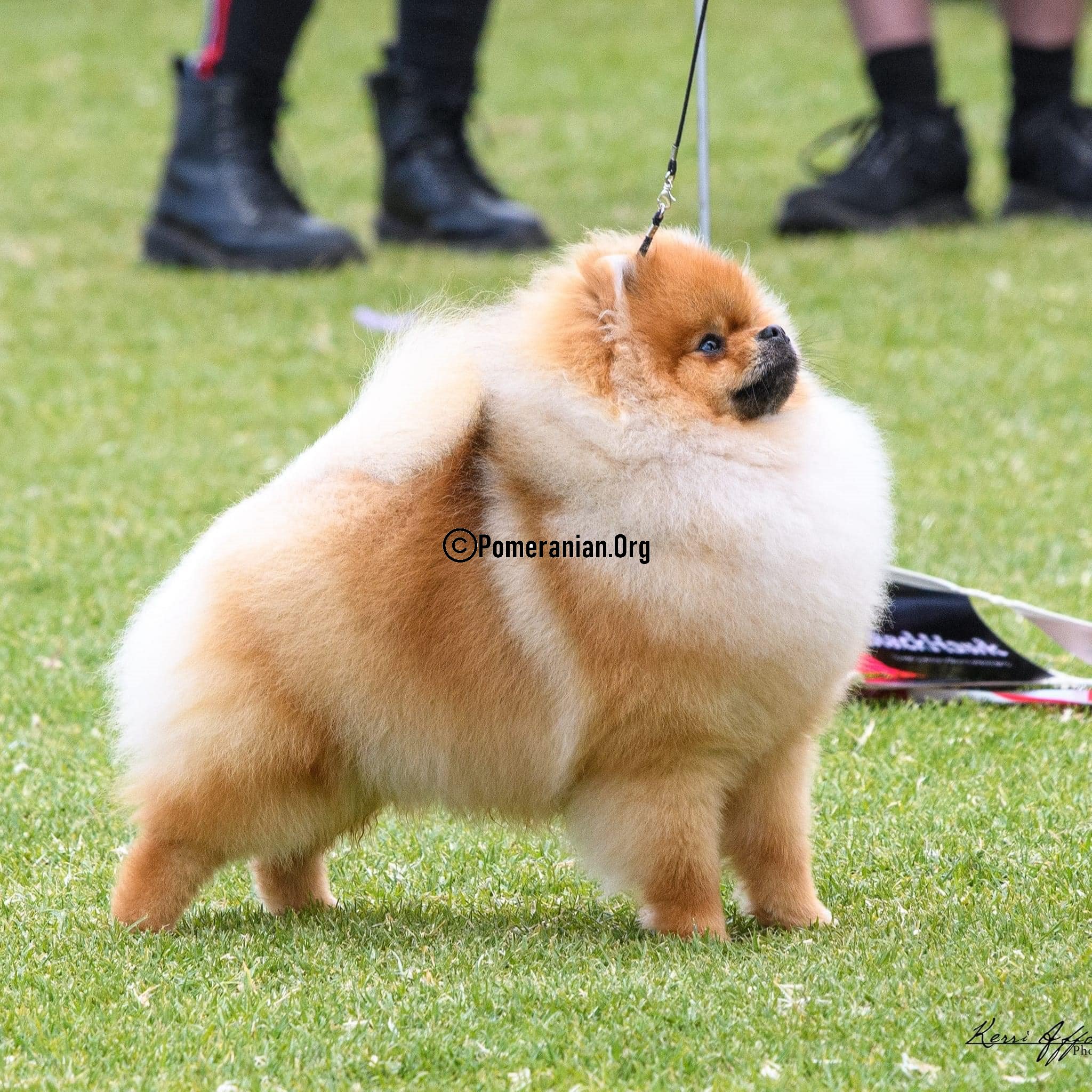
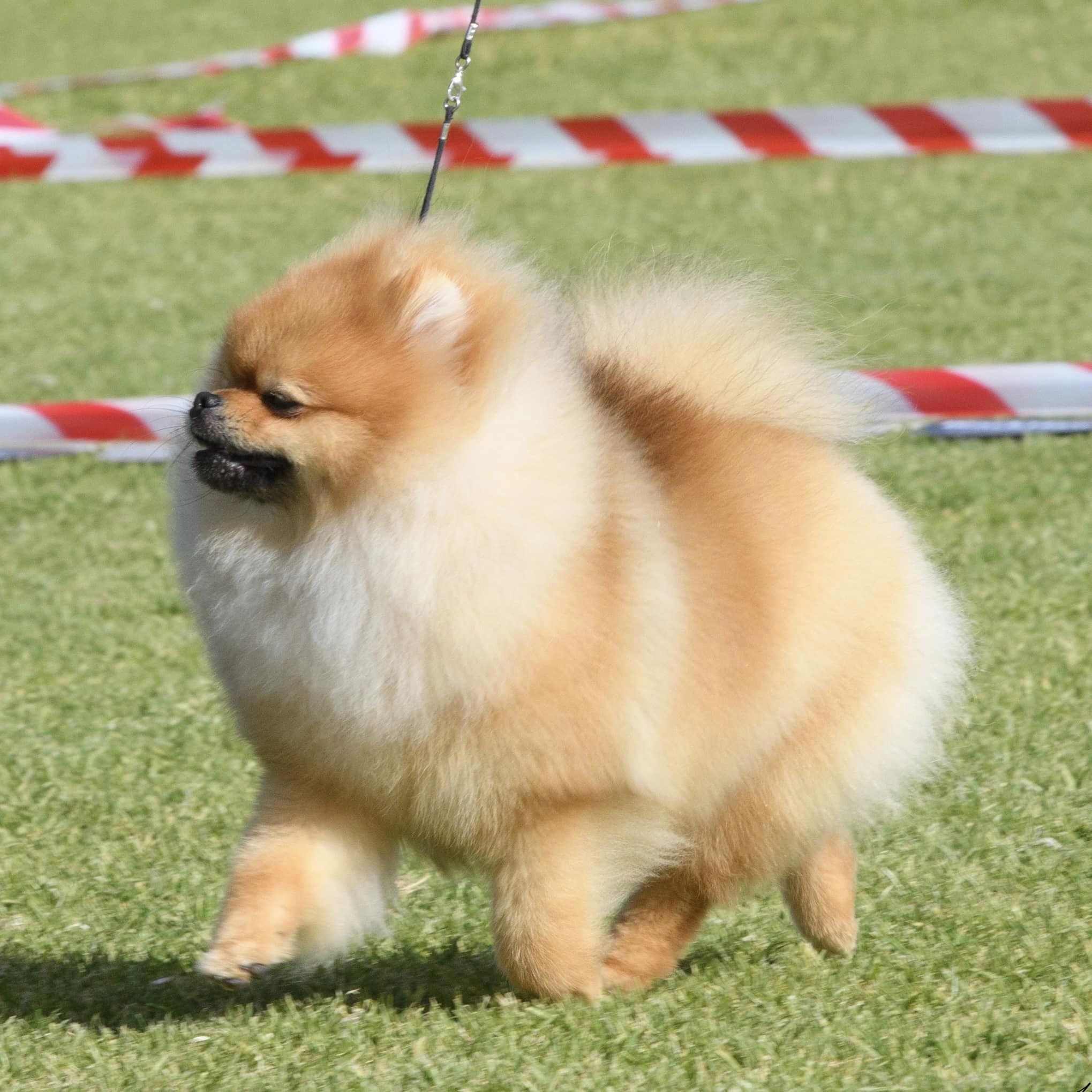
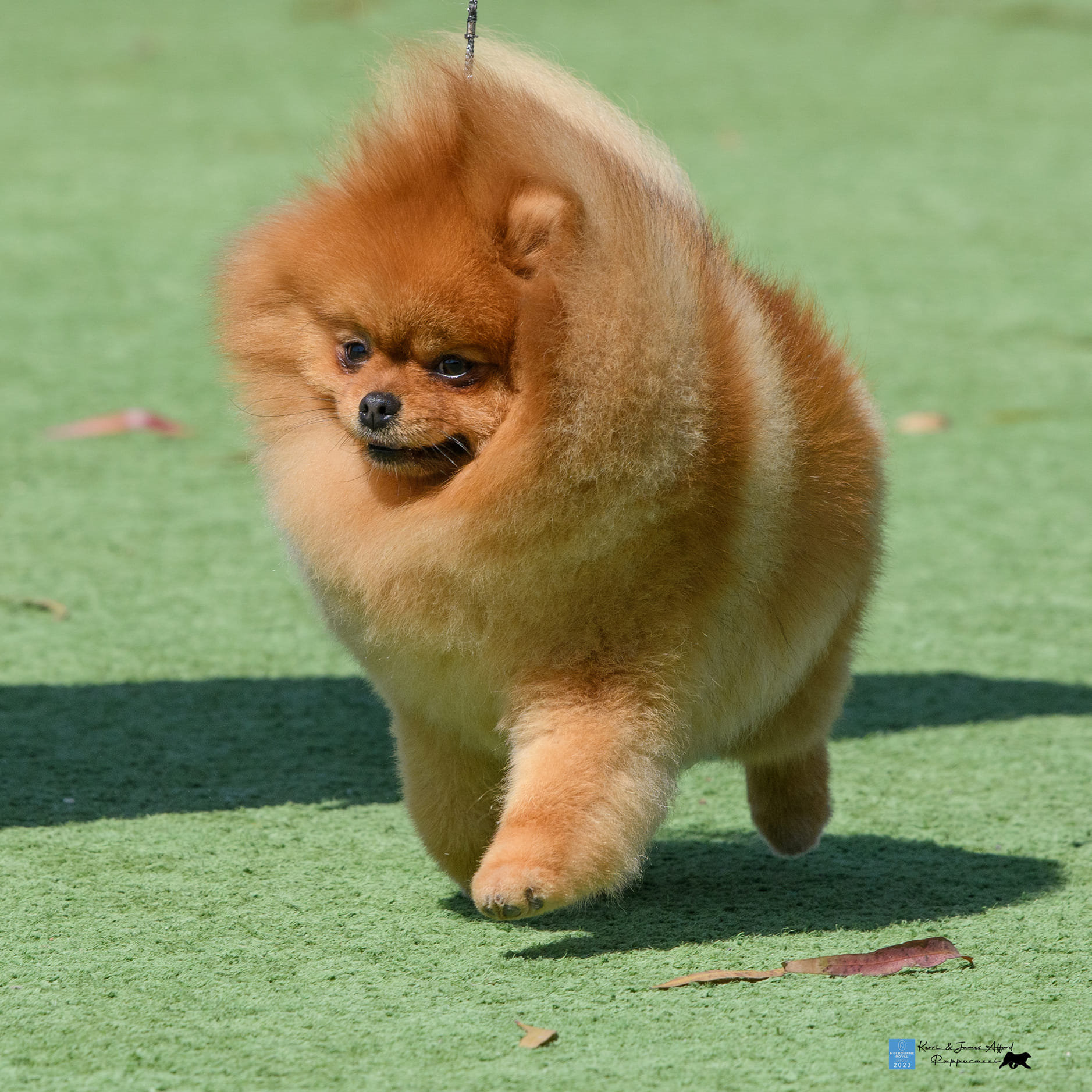
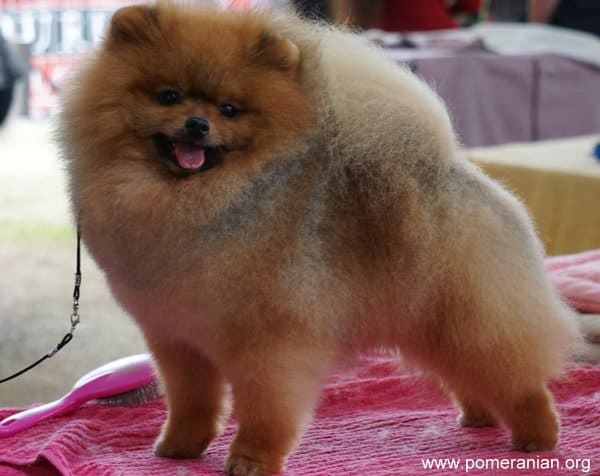
Many owners of other dogs seem to be jealous of a Pom’s glorious, puffy coat. Pomeranians have large coats that protect them from the weather and keep them warm. However, a large jacket requires proper care and maintenance.
A Pomeranian has two coats – an inner coat and an outer coat. The inner coat (also known as the base coat) is dense, helping him stay warm in colder weather and remain somewhat toasty in summer.
His outer coat is much lighter, and it protects the inner coat from most weather conditions. To maintain a healthy coat, he should be brushed daily with a good-quality brush. Your Pomeranian would love that feeling and the attention he’s getting.
Keeping your Pomeranian’s coat as healthy and clean as possible is necessary. It’s especially critical if the inner coat has been damaged in any way because there’s only a low possibility of regrowth.
Ensure that only a trained professional cuts your Pom’s hair and that they don’t cut the inner coat in any way.
Make sure that when anyone cuts your Pomeranian’s hair, they are trained professionals who know not to cut into its inner coat.
4. Pomeranian Barking
Some people love talking a lot, and some cats love “meowing” a lot, and, of course, there are dogs that enjoy barking. Pomeranians certainly fit the “barking” category, and it can be funny at times, but it can be irritating during the bad times.
When they’re full of energy, their behavior demands lots of attention from everyone around them, making it impossible to ignore.
Pomeranians are naturally very boisterous, which is evident because they bark a lot. However, there are other reasons for them to be classified as big barkers: they’re extremely loyal and fiercely protective of their owners. There may be a reason for their barking at times.
For example, if they’re barking at squirrels, cats, or people walking past your home (with or without a dog), and sometimes they’ll bark at you if they become too excited.
In my experience, they’ll often do it to warn you, thereby keeping you safe. They want the absolute best for their human parents.
5. The Pomeranian Napoleon Complex
Have you ever noticed your Pomeranian walking around expecting everybody (human and animal alike), to pay full attention to him immediately?
It can feel like he’s a member of royalty, and I suspect he uses that to his benefit. He might be quarreling with a larger dog, but he’ll refuse to concede.
Pomeranians certainly possess a “Napoleon complex,” like numerous other small breeds. They were members of the royal family in times past. Queen Victoria was a significant contributor to the development of today’s modern Pomeranian.
Whether this is or isn’t, why a Pom pretends he’s a big dog in a small body, it’s certainly a Pomeranian’s very cute trait.
6. Easy to Stay Healthy
One aspect of a pet’s care is ensuring they can burn off the energy accumulated and stored during their numerous daily naps. It’s also necessary for him to exercise daily.
This can include running around the house, walking, playing fetch in the garden, and more. This is vital to your Pomeranian’s life, particularly if he should lose weight.
Because a Pomeranian is small, it won’t have a lot of calories to burn. He won’t consume as much food as larger breeds, so a short walk every day is ideal.
Providing the walk is down the street or around the court, a Pomeranian’s compact body will find plenty of regular exercise.
7. The Pomeranian and Kids
Pomeranians are not 100% kid-friendly. It’s common for families to want a dog at least once, and at first glance, a Pomeranian would be perfect. Being small, a Pom seems ideal as he’s similar to a small child. It appears that there would be a lot of fun involved.
However, the truth is a bit different. Because of their size, a Pomeranian can be hurt easily if it’s playing with one or more small children.
Children of that size are still adjusting to their strength because they continue to grow, and the Pom might be hurt if play gets a bit rough. Pomeranians are also proud creatures; the dog may lash out if a negative interaction occurs.
If you want a Pomeranian because you have children, wait until they’re at least ten years old. If you have a child under ten and a Pomeranian, ensure you never leave them together unsupervised, or an accident may happen.
8. Are Pomeranians Loyal?
It’s a well-known fact that dogs are man’s best friend. One major reason is that, among animals, dogs are the most loyal creatures in the world. Pomeranians certainly match this description, and their unique character is extremely obvious.
When you get home from your job, your Pomeranian may run and greet you, tail wagging, and then he’ll spin in circles of joy. He might bark if somebody rings the doorbell to warn you of possible danger.
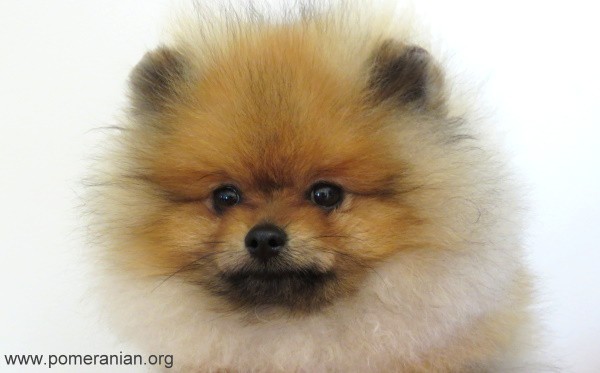
Eventually, you’ll end up on his good side after some time, and his loyalty to you will last forever. He’ll attempt to make sure you’re safe and strive to protect you whenever the chance arises.
It’s somewhat ironic that your small Pomeranian needs to protect you, considering his size, but it’s deeply embedded in his genes.
9. Pomeranian Separation Anxiety
Dogs have so much love for their owners that if you’re even away from home for two hours, it feels like their whole world has collapsed.
Pomeranians have a well-deserved reputation for forming a deep attachment to the person who owns and loves them, which is just one reason they are extremely popular. If you love your Pom, you’ll be given 10-fold love in return.
However, this is where separation anxiety can occur each time you leave your Pomeranian, even if it’s with other people that your dog knows and feels safe with.
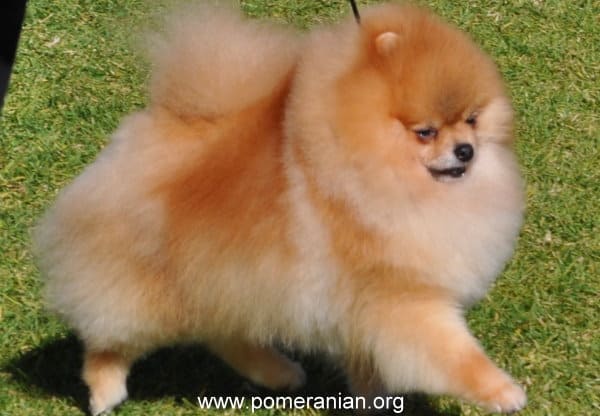
Behavior can vary from one dog to the next and may include sadness, crying, and waiting by the front door from the moment you leave until the exciting minute you return.
At first, this seems to be a cute trait because it’s a demonstration of how much your Pomeranian loves you and, at the same time, hates you being absent. Pomeranian separation anxiety isn’t healthy, and you should find an experienced dog trainer to help reduce the problem for you.
10. Pomeranian Spinning
One of the strong characteristics of a Pomeranian is that he’ll spin in circles nonstop and at a great speed every time he becomes extremely excited. It can cause you to feel dizzy if you watch it.
For an example of Pomeranian spinning, if you come home and say “walk” or touch his leash, he’ll begin to spin and bark excitedly simultaneously. Imagine those actions when you own a few Pomeranians; it will feel like chaos.
Other dog breeds also behave this way each time they become excited, but owners of Pomeranians know that it’s typical everyday behavior. All your dog is showing you is that he’s ecstatic and happy about whatever is next. I always say this is the Pomeranian saying: “When you are happy and know it…have a spin!
11. Black Skin Disease Pomeranian
Several medical problems are commonly found in Pomeranians, many of which are genetic. However, the saddest disease that a Pomeranian can experience (with few exceptions) is Black Skin Disease (also known as Alopecia X).
This disease can affect several Spitz breeds, including Pomeranians, and it can cause permanent hair loss and skin discoloration. It’s particularly insidious in that it strikes without warning.
If your Pomeranian’s hair begins to fall out and his skin color changes to dark gray and then black, you need to talk to your breeder and Vet about possible ways to control the issue.
12. Luxating Patella Pomeranian Issues
There are several health issues that all Pomeranian owners should be aware of. The number one problem that Pomeranians experience is luxating patella, which occurs when their kneecap moves in and out of its socket.
Unfortunately, this problem often results from environmental factors or genetic damage. Keeping your Pomeranian trim and healthy, feeding it a proper diet, and preventing your Pom puppy from jumping up on furniture can help prevent this issue.
It can also be inherited, so you must be mindful of this. If your Pom is walking differently from its usual way because its back leg(s) are not bending, it most likely has a luxating patella.
However, there’s positive news. Knee surgery can often resolve the problem fairly easily, so speak with your veterinarian to discuss the options.
13. Pomeranian Collapsed Trachea
A Pomeranian’s trachea collapses when the cartilage surrounding its windpipe breaks down, blocking its normal airflow. Such a collapse is frightening for both the owner and the Pomeranian concerned.
If his trachea collapses, several procedures can be performed to address the issue. However, Pomeranian collapsed trachea surgery is usually the most expensive.
Owning one Pomeranian can be costly over the years. There is another, cheaper, and probably not as efficient choice if your Pomeranian’s trachea has collapsed.
It’s why the majority of Pom parents choose a particular dog cough medicine formulated for canines with collapsed tracheas.
Pomeranian Collapsed Trachea Symptoms
If your Pomeranian exhibits any of the following symptoms:
- Heavy breathing after a period of activity.
- Gagging/choking after having a bite to eat or a drink.
- A Pomeranian’s collapsed-trachea cough sounds more like a very loud goose honking.
The diagnosis might be a Pomeranian collapsed trachea.
If this occurs, you must take your furry family member to the vet urgently and call ahead so they’re prepared and have a table available. Then, you can discuss potential treatment options for a Pomeranian with a collapsed trachea.
14. Pomeranian Food Allergies
Today’s dog food products contain many chemicals, preservatives, and additives, and when you try to read the labels, many of the ingredients are either unpronounceable or in a foreign language.
Major branding companies generally don’t include organic or all-natural ingredients because doing so affects their bottom line. Instead, they opt for as many shortcuts as possible to keep costs as low as possible while still generating high sales volume and maximizing profits.
Pomeranians and their counterparts in the small-breed category are extremely susceptible to many of these chemicals, preservatives, and additives, and frequently trigger allergic reactions. Corn, wheat, and various meats can also cause Poms allergies.
The most effective way to address such issues is to closely monitor each product you feed your Pomeranian and compile a precise list of foods that cause problems. Then, avoid those ingredients and focus your spending on completely natural, top-quality food for your much-loved ball of fur.
15. Pomeranian Bad Teeth
I’ve heard it said that dogs are high on the list of living creatures with the cleanest mouths on the planet, often cleaner than people’s mouths.
Sadly, Pomeranians aren’t at the top of the dog category because they have difficulty keeping their teeth as clean as they should be, leading to bad breath that’s downright stinky.
Pomeranians are often recognized for having dental issues, but the good news is that numerous cleaning options are available to proud owners. This means I must brush their teeth (it is extremely time-consuming if you own more than one Pomeranian).
However, I continue to use a toothbrush and toothpaste to brush their teeth every two weeks. Initially, I was doing that big job every week, but it felt rather excessive because I own several Pomeranians, and each one requires the same love, care, and attention.
I use the following additives in their food daily:

- FRESH PET BREATH – Finally say good-bye to dog and cat bad breath with our fast-acting pet bad breath treatment for dogs and cats. It’s the best, quick & easy cat & dog breath freshener.
- CLEAN TEETH AND GUMS – The easiest way to clean your pet’s teeth! Our veterinarian recommended cat and dog oral care water additive helps fight plaque and tartar for healthy teeth and gums.
- SKIP THE BRUSHING – That’s right, no more wrestling with pet toothpaste and toothbrushes; just add a capful of our cat and dog dental care liquid to their water bowl each day – it’s that easy!
- PICKY PET APPROVED – We don’t mask with mint or tea tree that can be harmful to dogs and cats. Our Pet Dental Water Additive is odorless and tasteless, so they don’t even know it’s there.
- IT WORKS – Trusted by pet parents, our cat and dog dental water additive is made in the U.S.A. with only the highest quality ingredients, and is a pet bad breath eliminator that actually works.
16. Is The Pomeranian Temperament Extroverted?
Everybody understands the personality differences between extroverts and introverts. Pomeranians would appear high on the list of extroverted animals you’re lucky to find. They’re great at commanding any audience and thrive when they’re the center of attention.
Your Pomeranian has several ways to attract attention, including begging, barking, spinning around in circles at high speed, or simply getting in the center of the action. Don’t expect your Pomeranian to stop this behavior.
Earlier, I mentioned how Pomeranians are extremely loyal and often bark, regardless of the reason, but these are merely part of being an extroverted breed.
Despite being cute and charismatic, never let a Pom manipulate you into giving them what they want (E.g., human food or treats). A Pomeranian, regardless of what he does, can be very convincing when he wants to be.
17. Pomeranian Potty Training Troubles Are Common
You might live in an apartment building, on a farm, in a house, or somewhere completely different. However, there’s one common denominator: your Pomeranian will need to learn what suits his surroundings, and that’s potty training. Pomeranians aren’t exempt from this, but appear harder to train than most dogs.
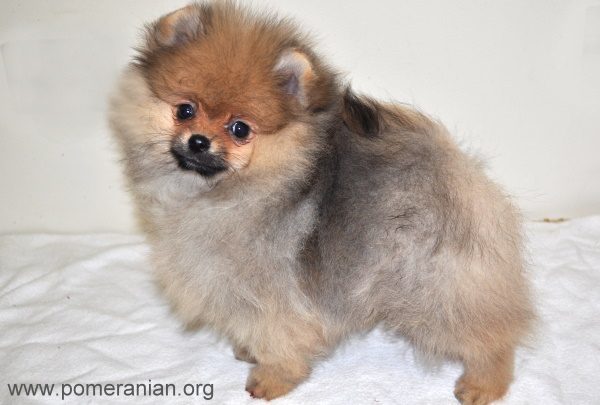
I have no idea why, but they have trouble learning not to do their business in the home. Some other canines I own (non-Pomeranians) usually learn this faster than my Poms.
Perhaps it’s psychological, and I am letting them get away with more than I should just because they’re so adorable. I sure hope this is NOT true.
18. Pomeranian Dog Lifespan
When you look at how long small dog breeds live, you’ll see that the lifespan for a Pomeranian is longer than most others. A Pomeranian can live between 12 and 16 years.
The figures I have mentioned are estimates because Pomeranians can lose their lives at any age. Suppose you do everything possible to look after your Pomeranian, including providing sufficient exercise. In that case, plenty of rest, high-quality food, and love and TLC each day should enable him to live a long, healthy life to look forward to.
19. There Are Many Different Colors of Pomeranian Dogs
Of all the dogs, breeds, sizes, and shapes that inhabit this wonderful world, the energetic Pomeranian breed comes in an incredible array of colors.
Different colors of Pomeranians may include red, orange, black, sable, cream, white, merle, chocolate, and brindle, among others. Orange, sable, and cream are the most popular colors, and the rest appear less frequently.
When Pom puppies first come out to join their families, they’re often lighter in color or darker than they’ll be upon maturity. All Pomeranians I have ever enjoyed owning were one of these colors, except Merle and Brindle Pomeranians.
20. How Much Do Purebred Pomeranians Cost?
Owning any dog won’t be a cheap prospect in the long term because after you pay for the rights to own him, you’ll need to feed him, give him toys to have fun with, take him to the local vet, and get involved with other members of your existing family, regardless of the number of legs. And so the list goes on and on.
Pomeranians are highly popular dogs, and their purchase price reflects that. If you want a Pom puppy, you’ll need to spend $2,000–$8,000; the average cost is around $5,000.
However, if money is an issue, consider an older Pomeranian or perhaps one currently in a rescue shelter. The price will plummet. If you want a purebred Pomeranian with exotic colors, your starting point is many thousands of dollars.
21. Pomeranian Portability
In today’s world, life is quite portable; some people think dogs should be, too. Pomeranians are much smaller than most other dogs, so it’s much simpler to put yours in a specially designed backpack for dogs, and off you go.
Some owners take mobility to an even more comfortable level and strap their dog into a stroller. They’re among the cutest dog products, and I’m certain my own Pomeranians would love to sit in a stroller when they’re tired after their walk. It would also be terrific if I could take them with me on my runs.
22. Pomeranian Size Has Drawbacks
They can easily hurt themselves when jumping off furniture, getting stepped on, or being dropped. They’re small enough to make you trip if they get in your way.
23. Pomeranian Size Advantages
- Caring for smaller dogs generally costs less.
- Their food bill is considerably smaller than that of a bigger dog.
- They don’t eat a lot, so their toilet deposits are smaller.
24. From the Land of Pomerania
Today’s Pomeranians have descended from a very long, proud line of ancestral dogs that themselves had descended from wolves. While people describe Poms today as cuddly and cute, that hasn’t always been the case. Pomeranians have an ancestral lineage of Arctic working dogs from a region known as Pomerania (in Germany and Poland).
The original Wolf Spitz dogs were strong, working dogs of good character. They were loyal to their master, whom they fiercely protected while doing their job.
All these characteristics remained when Pomeranians were bred down to the smaller, cuddly variety we see today. Most of today’s Pomeranians possess qualities that come from their proud ancestors.
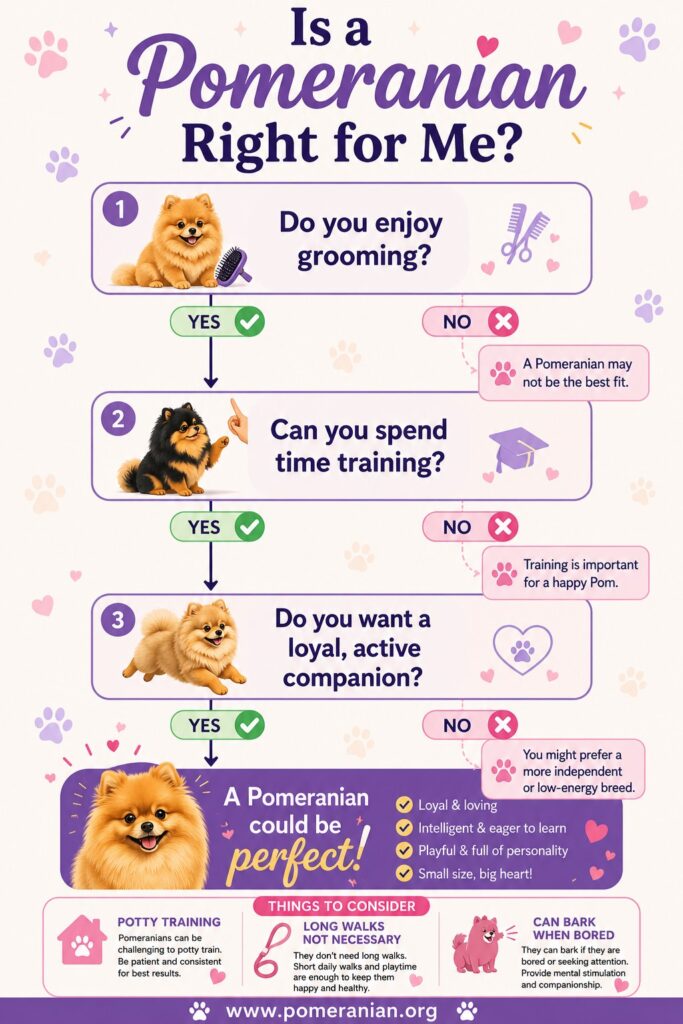
A Pomeranian May Not Be Right for You If…
- You work long hours every day.
- You dislike brushing dogs.
- You want a silent breed.
- You have very rough young children.
- You expect an easy, maintenance-free pet.
- You are buying purely because they are cute.
Common Mistakes First-Time Pomeranian Owners Make
Bringing home a Pomeranian puppy is an exciting experience, but first-time owners sometimes make mistakes that can affect their dog’s health, behavior, and long-term happiness. Fortunately, most of these problems are easy to avoid with the right knowledge and preparation.
1. Buying from the Cheapest Breeder
The purchase price is only a small part of the cost of owning a dog. Puppies from unethical breeders or puppy farms may develop expensive health or behavioral problems later in life.
Instead, choose a responsible preservation breeder who health-tests their breeding dogs, provides lifelong support, and breeds for health, temperament, and correct breed type—not simply for profit.
2. Choosing Color Over Health and Quality
It’s easy to fall in love with an unusual coat color, but color should never be your primary consideration. A rare-coloured Pomeranian is not automatically healthier, better bred, or of higher quality.
Always place greater importance on:
- Health
- Temperament
- Soundness
- Correct breed type
- Ethical breeding practices
3. Not Socializing Your Puppy Early
The critical socialization period occurs during the first few months of life. Puppies should be gently introduced to different people, sounds, environments, friendly vaccinated dogs, grooming, car travel, and everyday experiences.
Well-socialized Pomeranians are generally more confident, adaptable, and enjoyable companions.
4. Overfeeding
Pomeranians are tiny dogs with equally tiny stomachs. Feeding excessive treats or too much food can quickly lead to obesity, which increases the risk of joint problems, heart disease, diabetes, and a shorter lifespan.
Feed measured meals, monitor your puppy’s body condition, and avoid giving excessive table scraps.
5. Carrying Your Puppy Everywhere
Because Pomeranians are small and adorable, owners often carry them constantly. While occasional carrying is perfectly fine, puppies also need opportunities to walk, explore, build confidence, and learn how to interact with the world.
Allow your puppy to experience different environments safely, rather than protecting them from every new situation.
6. Skipping Regular Grooming
A Pomeranian’s beautiful double coat requires regular maintenance. Waiting until the coat becomes tangled or matted makes grooming stressful for both you and your dog.
Establish a grooming routine from puppyhood that includes:
- Brushing several times each week
- Regular bathing and drying
- Nail trimming
- Ear cleaning
- Dental care
Early positive grooming experiences help create relaxed adult dogs.
7. Expecting Instant Toilet Training
Pomeranians can be slower to toilet train than some larger breeds because of their small bladders and independent nature. Success requires patience, consistency, supervision, and a regular routine.
Avoid punishing your puppy for accidents, and reward them immediately for toileting in the correct place.
8. Not Providing Mental Stimulation
Although small, Pomeranians are highly intelligent dogs. Without enough mental stimulation, they may become bored, bark excessively, or develop unwanted behaviors.
Daily training sessions, puzzle toys, interactive games, scent work, and playtime help keep your Pomeranian happy and mentally fulfilled.
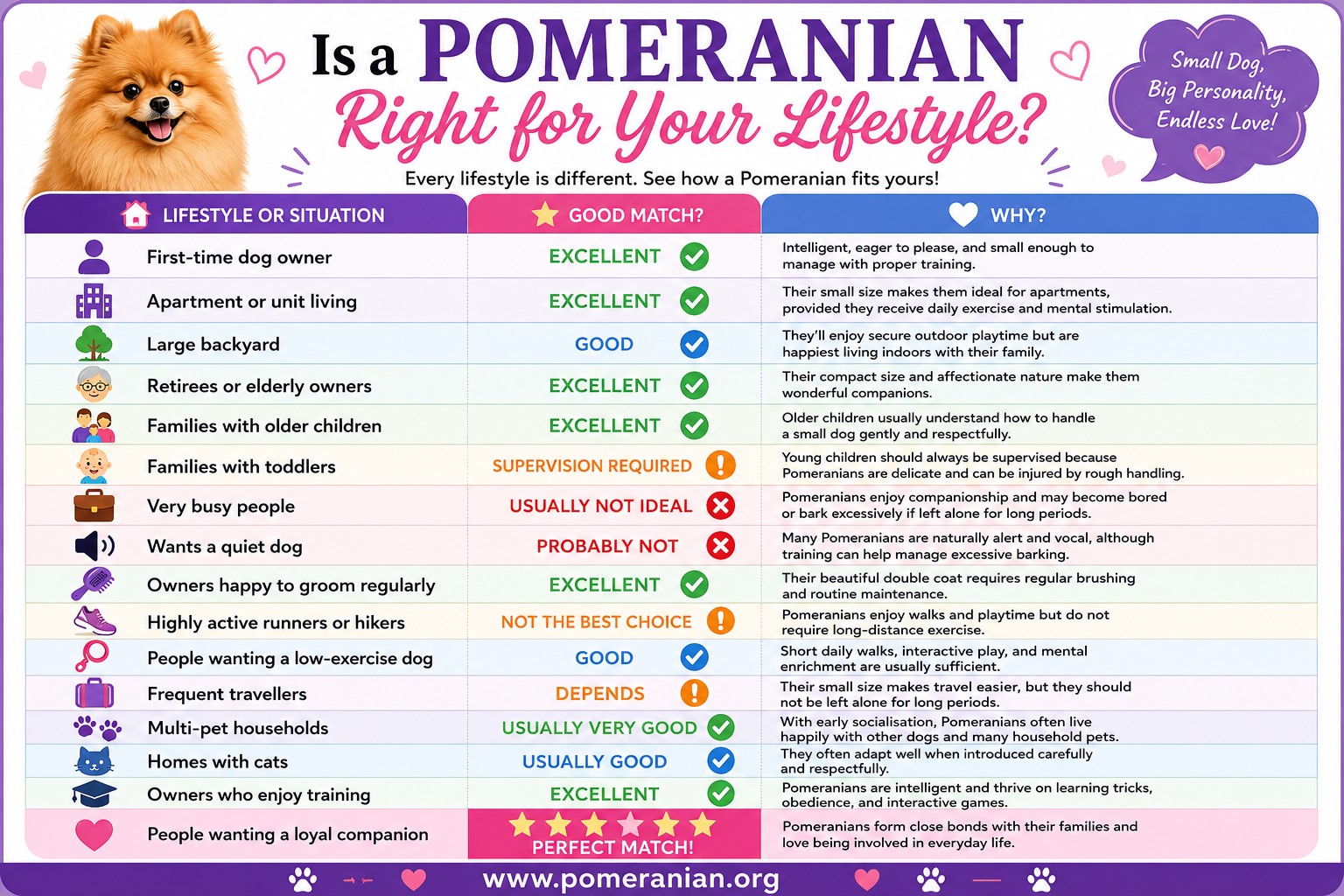
🐾 Frequently Asked Questions About Getting a Pomeranian
Click each question to reveal the answer.
🐶 Is a Pomeranian the right dog for me?
A Pomeranian could be perfect if you want a small, intelligent, affectionate companion and are prepared for grooming, training, socialisation, and plenty of companionship.
🏡 Are Pomeranians good apartment dogs?
Yes. Their compact size makes them excellent apartment dogs, provided they receive daily exercise, mental stimulation, and companionship.
👨👩👧👦 Are Pomeranians good for first-time owners?
Yes. Their intelligence and adaptability make them suitable for many first-time owners, although they do need patience, regular grooming, and consistent training.
🗣️ Do Pomeranians bark a lot?
Pomeranians are naturally alert and can be vocal. They may bark when bored, excited, alerting their owner, or seeking attention. Training and mental stimulation help reduce nuisance barking.
🚽 Are Pomeranians difficult to toilet train?
Some Pomeranians can take longer to toilet train because of their small bladders and independent nature. Patience, routine, supervision, and consistency are essential.
🚶 Do Pomeranians need long walks?
No. Pomeranians do not need long walks. Short daily walks, playtime, and mental enrichment are usually enough to keep them happy and healthy.
✂️ How much grooming does a Pomeranian need?
Pomeranians have a double coat that needs regular brushing, bathing, nail trimming, dental care, and routine maintenance to prevent knots and mats.
👶 Are Pomeranians good with children?
Pomeranians usually do best with gentle older children. Toddlers and young children must always be supervised because Pomeranians are small and delicate.
🐱 Can Pomeranians live with other pets?
Yes. Well-socialised Pomeranians often live happily with other dogs and can also adapt well to cats when introduced carefully.
❤️ How long do Pomeranians live?
With responsible breeding, good nutrition, regular veterinary care, and a healthy lifestyle, many Pomeranians live between 12 and 16 years, with some living longer.
🎨 Should I choose a rare-coloured Pomeranian?
Colour should never be your first priority. Health, temperament, soundness, and correct breed type are far more important than coat colour.
💜 What is the biggest mistake first-time owners make?
The biggest mistake is buying a puppy based only on price, colour, or appearance. A reputable breeder who prioritises health, temperament, and breed quality is always the better choice.
🐾 Expert Tip
A Pomeranian is much more than a beautiful little dog. They are intelligent, loyal companions who thrive on love, attention, and being part of the family.
🌐 www.Pomeranian.org
Conclusion
Owning a Pomeranian is far more than sharing your home with a beautiful little dog. It is a long-term commitment to one of the most intelligent, loyal, entertaining, and affectionate toy breeds in the world.
If you are prepared to invest time in training, grooming, and companionship, a Pomeranian will reward you with years of unconditional love, laughter, and devotion. For the right owner, few breeds can match the charm and personality of a well-bred Pomeranian.
This article was written by Pomeranian expert Denise Leo, a preservation breeder with over 50 years of experience showing and breeding champion Pomeranians under the renowned Dochlaggie prefix. Drawing on decades of hands-on experience and deep knowledge of breed standards, Denise shares her expert insights into the true characteristics, temperament, and care needs of the beloved Pomeranian.
Copyright Pomeranian.Org. All Rights Reserved.
References and Further Reading:
[1] Official Standard of the Pomeranian (AKC). American Kennel Club, 2011.
[2] Official English Kennel Club Pomeranian Breed Standard, 2017.
[3] Kimbering Pomeranians “1891-1991”.
[4] Denise Leo, The Pomeranian Handbook.
The Pomeranian Handbook